
What if the most eco-friendly choice you make today becomes landfill by 2028 because it couldn’t handle the intensity of the Arabian sun? We all want to create beautiful, green spaces, but the reality of our climate means that sustainable street furniture materials must be defined by their resilience first and their origin second. It’s frustrating to watch a significant investment degrade under harsh UV rays and salt air, especially when you’re striving to meet the strict Silver Sa’fa requirements under Dubai’s mandatory Al Sa’fat Green Building System. You shouldn’t have to choose between environmental stewardship and long-term durability.
I’ve spent years working with these materials, and I’ve seen how the right choice transforms a public space into a lasting legacy. This guide will help you discover high-performance, low-carbon options that align with the new LEED v5 standards and the 2026 FSC updates. We’ll explore why investing in quality, bio-based composites or recycled plastic lumber is a wise move for both your budget and the planet. You’ll learn exactly how to select assets that thrive in our unique environment while creating welcoming, aesthetically pleasing spaces for the community to enjoy.
Key Takeaways
- Understand why extreme durability is the cornerstone of true sustainability when designing for the UAE’s unique environmental challenges.
- Learn how to distinguish between high-performance sustainable street furniture materials such as FSC-certified hardwoods and resilient local stone.
- Discover the distinct environmental and functional advantages of modern innovations, including recycled HDPE and the latest bio-based composites.
- Master the art of calculating long-term ROI by prioritizing high-quality protective coatings and lifecycle costing over initial upfront prices.
- Gain expert insights into creating cohesive public realms that seamlessly blend resilient street furniture with thriving, natural greenery.
Why Material Selection is the Heart of Sustainable Urban Design
The soul of a vibrant city lives in its small details, the places where we rest, gather, and connect. When we speak about sustainable street furniture materials, we’re looking at much more than just recycled content; we’re embracing a circular economy where every bench and planter is designed for a long, meaningful life. In the unique intensity of the UAE, where the sun and salt air test every surface, longevity is the truest form of sustainability. Choosing a material that fails in three years isn’t just a budget error, it’s an environmental burden. We believe in crafting Street furniture that stands as a legacy, moving away from the disposable mindset that has quietly drained our resources for too long.
To better understand how thoughtful design creates joy in our cities, watch this helpful video:
The Shift Toward Environmentally Responsible Infrastructure
Our national commitment to carbon reduction has fundamentally changed the way we build. With the launch of LEED v5 in April 2025 and the mandatory Silver Sa’fa rating under Dubai’s Al Sa’fat system, we’re now required to quantify the embodied carbon of every hardscape element. This means looking beyond the “now” and assessing the entire lifecycle of a product. Extracting raw, virgin materials carries a heavy weight, whereas sourcing recycled or regeneratively grown components significantly lightens our footprint. By conducting thorough Lifecycle Assessments (LCA), we ensure that our urban assets contribute to a healthier planet from the moment they’re installed until they’re eventually reclaimed or repurposed. It’s a shift from consuming to stewarding.
The Role of Materials in Public Wellbeing
There is a quiet, restorative power in natural textures that synthetic alternatives simply can’t replicate. When we use biophilic sustainable street furniture materials like FSC-certified timber or cool, local stone, we create a sensory bridge back to the earth. These materials don’t just serve a function; they nurture the human spirit. A wooden bench feels warm and inviting, encouraging a weary commuter to pause and breathe. These tactile experiences foster a sense of belonging and community interaction, turning a simple sidewalk into a shared living room. By choosing materials that age gracefully and feel good to the touch, we’re investing in the long-term health and happiness of every resident who walks through our public spaces.
Timeless Timber and Stone: Natural Resilience in the UAE
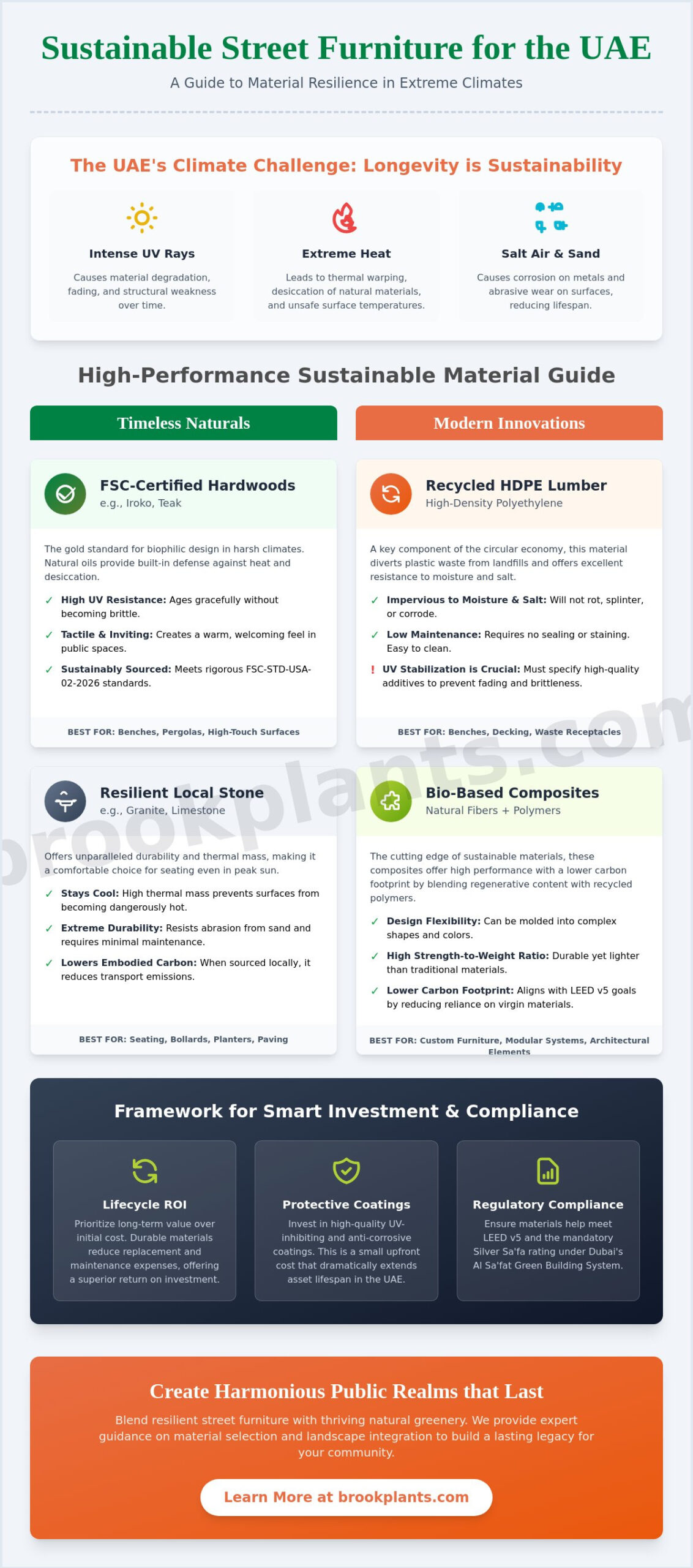
While many global design guides focus on resisting dampness and rot, our challenge in the UAE is the relentless intensity of the sun and the abrasive touch of desert sands. To create truly resilient urban spaces, we often return to the materials that have stood the test of time for centuries. When selecting sustainable street furniture materials, natural hardwoods and stone offer an honesty and durability that synthetic alternatives struggle to match. These materials aren’t just eco-friendly by origin; they’re sustainable because they don’t need to be replaced every few seasons due to UV degradation or thermal warping.
FSC-certified hardwoods like Iroko and Teak remain the gold standard for our region. These species are naturally rich in oils that act as a built-in defense mechanism against the desiccation caused by extreme heat. With lumber prices reaching multi-year lows of approximately $526 per thousand board feet in early 2026, these premium natural materials have become an increasingly viable choice for large-scale public realm projects. We take immense pride in sourcing timber that meets the rigorous FSC-STD-USA-02-2026 standards, ensuring that every bench or pergola supports the long-term health of global forests while providing a cool, tactile surface for our communities.
Stone offers a different kind of resilience, particularly when it comes to thermal mass. Unlike metal, which can become painfully hot to the touch in the height of summer, granite and local limestone absorb and release heat slowly. This physical property keeps seating areas significantly cooler and more comfortable for public use. If you’re looking for inspiration on how to integrate these natural elements into your next project, our collection of street furniture showcases how traditional materials meet modern, resilient design.
Thermal Modification: Making Wood Desert-Ready
Not all timber starts its journey ready for the desert. Thermal modification is a beautiful, chemical-free process that “cooks” the wood at temperatures between 180 and 210 degrees Celsius. This permanent change to the wood’s cellular structure reduces moisture absorption by up to 50 percent, which is vital for preventing warping during our humid coastal nights. It transforms sustainable softwoods into high-performance assets that age into a graceful, silver-grey patina without losing their structural integrity.
Stone and Masonry: Sourcing for Longevity
Granite is essentially immune to the “sandblasting” effect of our wind-blown desert environment. Its high density makes it nearly maintenance-free, resisting both the salt air of our coastlines and the heavy foot traffic of our city centers. We’re also seeing a wonderful rise in the use of recycled stone aggregates. By repurposing high-quality stone waste into contemporary masonry, we can achieve the same legendary durability while further reducing the embodied carbon of our sustainable street furniture materials. This approach ensures our urban assets remain as permanent and grounded as the landscape itself.
Modern Innovations: Recycled Plastics vs. Bio-Based Composites
As much as I love the honest grain of a well-aged Teak bench, I’m equally inspired by the scientific marvels currently reshaping our urban landscapes. While natural timber connects us to the earth, modern engineered materials allow us to close the loop on waste in ways that were once thought impossible. Today, sustainable street furniture materials include high-performance synthetics that stand up to the UAE’s environmental pressures with remarkable grace. These aren’t just plastic substitutes; they’re thoughtfully crafted assets designed to divert waste from our oceans and landfills while providing decades of service.
Recycled plastic lumber (RPL), specifically made from High-Density Polyethylene (HDPE), has matured into a formidable ally for urban planners. The global market for RPL reached $1.08 billion in 2026, reflecting a massive shift toward these durable, rot-proof alternatives. However, a bench in Dubai faces a much different life than one in London. For synthetic materials to truly succeed here, UV-stabilisation is a non-negotiable additive. Without these specific inhibitors, even the best recycled plastic will become brittle and fade under our sun. We view this technical precision as a moral anchor; if a product isn’t built to last in its specific environment, it isn’t truly sustainable.
Bio-based composites represent the next frontier, blending natural fibers with recycled polymers to create a material that feels organic yet performs like a champion. While the production cost of bio-based plastics remains approximately 1.5 to 2 times higher than traditional fossil-fuel-based plastics as of March 2026, the environmental dividends are profound. These composites offer a sophisticated aesthetic that mimics the warmth of wood while providing the structural rigidity needed for high-traffic public realms.
The Circular Economy in Action
Every piece of HDPE furniture represents thousands of milk jugs and detergent bottles that have been rescued from the waste stream. This isn’t just about using old plastic; it’s about creating a product that is itself 100 percent recyclable at the end of its 20-year lifespan. By choosing these sustainable street furniture materials, we’re actively reducing the global reliance on virgin plastics and lowering the embodied carbon of our city projects, directly supporting the goals of LEED v5 and the Al Sa’fat system.
Performance Comparison: Synthetic vs. Natural
While hardwood requires periodic oiling to maintain its rich hue, recycled plastic remains virtually maintenance-free for decades, needing only a simple wash to look as good as the day it was installed. These synthetic surfaces are naturally resistant to staining and graffiti, as most paints and markers fail to bond with the non-porous HDPE. Additionally, the significant weight of these materials provides excellent wind resistance, ensuring that bins and benches stay firmly rooted during desert storms without requiring excessive, carbon-heavy anchoring systems.
Designing for Longevity: Maintenance and Environmental ROI
A truly sustainable object is one that never needs to be thrown away. When we select sustainable street furniture materials, we aren’t just looking at the carbon footprint of production; we’re looking at the decades of life that follow. In our coastal cities, where the salt air is a constant companion, a beautiful design can quickly become a liability without the right protective craft. We see the choice of high-performance coatings and finishes as a pledge of respect to the materials themselves. It’s about ensuring that the energy and resources used to create a bench or a planter are honored through a lifespan that stretches across generations.
Investing in quality has never been more vital. With domestic prices for steel and aluminum rising by 13% to 20% in early 2026, the cost of replacing assets has become a significant burden for any project. By calculating the cost-per-year of service rather than just the upfront price, we find that ‘buying better’ is the most ecological and economical path. This approach honors the resources used and ensures our urban spaces remain vibrant without the constant need for new raw material extraction. If you’re ready to invest in assets that stand the test of time, explore our range of high-performance street furniture.
Corrosion Resistance and Metal Protection
Metals like aluminum and steel are wonderful for their strength and their 100% recyclability, but they require a protective shield in our climate. We rely on advanced powder coating and hot-dip galvanization to create a barrier against the abrasive sand and corrosive salt. This isn’t just about aesthetics; it’s about preserving the structural integrity of the piece. By preventing mechanical wear in high-traffic pedestrian zones, we ensure these assets remain safe and beautiful for everyone who uses them.
The Maintenance Cycle of Sustainable Materials
A healthy public space requires a gentle, consistent rhythm of care. We encourage using cleaning protocols that use pH-neutral, biodegradable agents to ensure that runoff doesn’t harm the surrounding soil or local greenery. Training facility managers to understand the specific needs of bio-composites and natural stone is a key part of our journey. When we design for disassembly, we make it simple to replace a single wooden slat or a specific bolt rather than discarding an entire bench. This mindful approach to repair is what transforms a simple product into a legacy urban asset, keeping our sustainable street furniture materials in use for as long as possible.
Creating Harmonious Public Realms with Brook Plants
At Brook Plants, we believe that a city truly breathes when its hardscapes and greenery live in perfect balance. We don’t see ourselves as simple intermediaries; we’re dedicated craftsmen-producers who care deeply about the entire lifecycle of our creations. Our philosophy is rooted in the idea that sustainable street furniture materials should never exist in isolation. Instead, they should embrace the living world, acting as a supportive stage for the plants that bring our urban spaces to life. This holistic perspective ensures that every bench, planter, and shade structure feels like a natural extension of the landscape, rather than an afterthought.
Designing for the UAE requires a deep understanding of how life survives in the heat. By integrating our custom furniture with advanced automatic irrigation systems and lush vertical gardens, we create micro-climates that are as functional as they are beautiful. Our planters aren’t just containers; they’re engineered environments that protect roots from thermal stress while complementing the textures of the surrounding architecture. We take immense pride in this internal cultivation of both our plants and our products, ensuring that every element meets our rigorous ecological standards before it ever reaches your site.
A Holistic Approach to Urban Landscaping
Scale and harmony are the quiet guides that turn a collection of objects into a cohesive public realm. Whether you’re sourcing through indoor plant wholesale UAE channels or designing a vast outdoor plaza, the materials you choose must speak the same language. We focus on creating a seamless transition between the built environment and the natural one. By using sustainable street furniture materials that mirror the earthy tones of our native flora, we help you build spaces that feel grounded, authentic, and deeply welcoming to every passerby.
Partnering for a Greener Future
We’re here to act as your trusted mentors, helping you navigate the complexities of modern green building certifications like LEED v5 and the Silver Sa’fa rating. Our role goes beyond providing assets; we offer expert instructional highlights and personalized insights to ensure your project’s long-term success. As you evaluate the best landscaping companies in UAE, look for a partner who understands that sustainability is a shared journey. We’re committed to helping you select resilient, high-performance materials that honor our planet and enhance the wellbeing of our communities for years to come.
Cultivating Resilient Cities Together
Building a vibrant urban space is a journey that requires both a vision for beauty and a deep respect for the environment. We’ve seen how the right sustainable street furniture materials, from thermally modified timber to high-performance recycled plastics, can withstand the unique challenges of our climate while fostering a sense of community. By prioritizing longevity and selecting materials that age with grace, you’re ensuring that your investment serves as a lasting legacy. It’s about moving beyond the temporary and creating public realms that truly breathe and endure.
Since 2004, we’ve dedicated ourselves to the craft of landscape design and execution across the UAE. As specialists in high-performance sustainable materials, we take pride in acting as your trusted partners for commercial and residential projects nationwide. We invite you to partner with Brook Plants for your next sustainable urban project and experience the difference that genuine craftsmanship and ecological passion can make. Let’s work together to nurture public spaces that are as resilient as they are beautiful.
Frequently Asked Questions
What are the most durable sustainable street furniture materials for the UAE?
High-density natural stone and thermally modified hardwoods are the most resilient options for our desert climate. These materials naturally resist the abrasive desert sands and high humidity without degrading. While stone offers incredible thermal mass to stay cool, thermally modified timber provides the stability needed to prevent warping without the use of harsh chemicals, ensuring a long, beautiful life for public seating.
How does recycled plastic furniture perform in extreme heat?
Recycled High-Density Polyethylene (HDPE) performs exceptionally well because it won’t rot, splinter, or absorb moisture during humid nights. It is vital to choose products with high UV-stability to prevent the material from becoming brittle over time. While it stays cooler than metal surfaces, it doesn’t quite match the natural cooling properties of stone when placed in direct midday sun.
Is FSC-certified timber really sustainable if it is imported?
Yes, because the long-term carbon sequestration of regenerative forestry often outweighs the transport emissions, especially when using durable species that last for decades. Under the new LEED v5 standards, we now quantify this embodied carbon to ensure total transparency. Choosing wood from forests managed under the FSC-STD-USA-02-2026 standard ensures you’re supporting global ecosystem health while building a legacy project for our region.
Can sustainable street furniture help with LEED or Estidama certification?
Selecting the right sustainable street furniture materials is essential for meeting the mandatory Silver Sa’fa rating under Dubai’s Al Sa’fat Green Building System. These choices also contribute directly to LEED v5 credits by reducing embodied carbon and incorporating recycled content. We help developers document these selections to ensure every bench and planter aligns with national sustainability mandates and international green building standards.
What maintenance is required for bio-based composite benches?
These innovative materials are designed for a gentle maintenance rhythm, requiring only regular cleaning with pH-neutral, biodegradable soap and water. Unlike natural timber, they don’t need annual oiling or staining to maintain their structural integrity or appearance. This makes them a wonderful choice for high-traffic areas where you want to reduce long-term labor costs while keeping the public space looking fresh and inviting.
How do sustainable materials compare in price to traditional steel or concrete?
Environmentally friendly materials often carry an upfront cost premium of 5% to 15% compared to conventional options as of early 2026. However, the true value lies in the lifecycle costing. When you factor in the significantly reduced need for repairs and the extended service life in our harsh climate, these resilient assets often prove to be the more economical choice for long-term municipal budgets.
Why is UV-stabilisation important for street furniture in the UAE?
Without specific UV-inhibitors, the intense Arabian sun can break down the molecular bonds of plastics and composites, leading to rapid fading and structural failure. This stabilisation acts as a vital protective shield, ensuring your furniture maintains its color and strength for its entire 20-year lifespan. It’s the difference between a product that lasts and one that becomes environmental waste within just a few seasons.
Can sustainable street furniture be recycled at the end of its life?
Many modern options are designed for a circular life, particularly metal components and HDPE plastics which are 100% recyclable. We prioritize “design for disassembly,” which allows individual parts to be reclaimed and repurposed at the end of their service. This ensures that the sustainable street furniture materials we place in our cities today don’t become the landfill challenges of tomorrow, honoring the earth’s resources.
Disclaimer
The content on this blog may be automatically generated and is provided “as is” without warranties of any kind, express or implied. No guarantee is made regarding the accuracy, completeness, or suitability of the information. The company expressly disclaims any liability for decisions or actions taken based on this content.
As this blog post was generated using automated content‑creation tools. While our team reviews posts for accuracy and relevance, the information provided may not always reflect the most current developments. The content is intended for general informational purposes only and should not be taken as professional advice. Our company is not liable for any actions taken based on this material.