
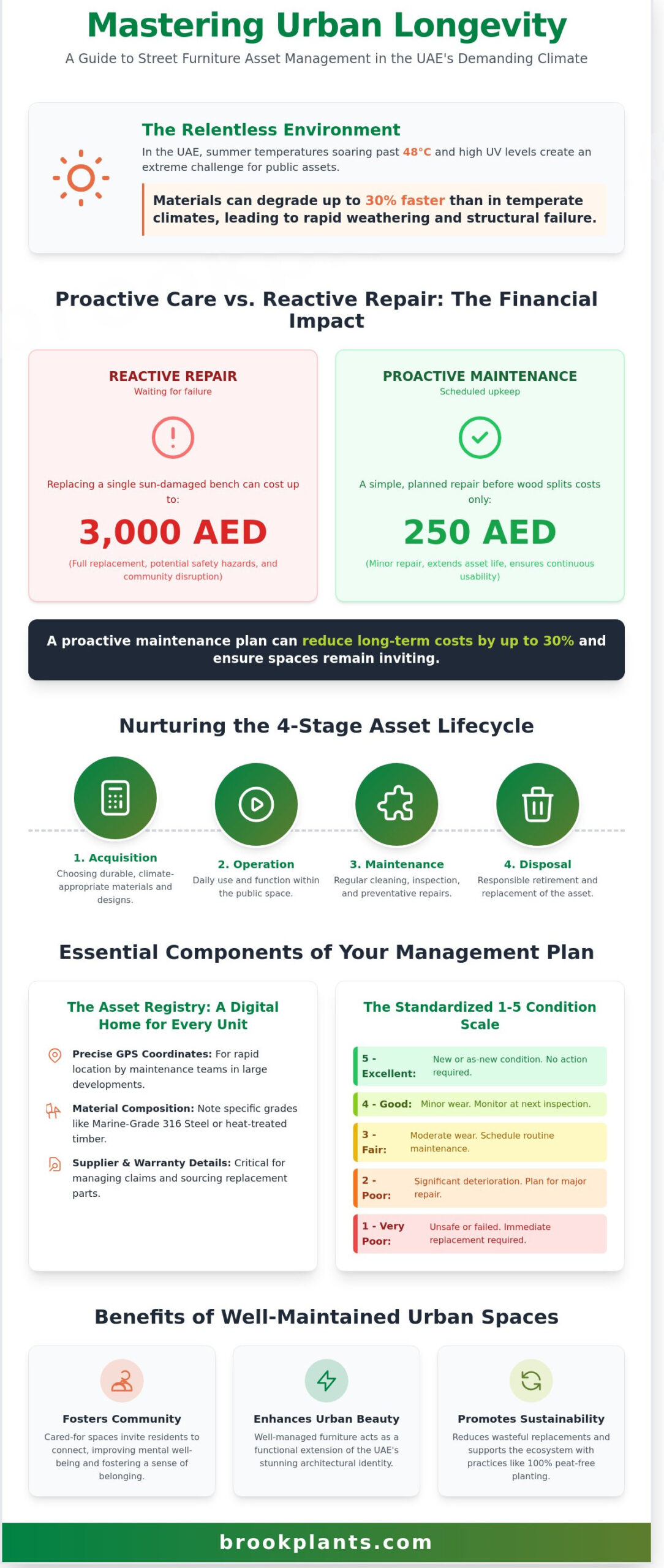
What if the secret to an enduring city square wasn’t just the initial design, but the way we nurture its growth over time? In the UAE, where summer temperatures frequently soar past 48°C, public assets face a relentless environment that can degrade materials up to 30% faster than in temperate climates. You likely feel the frustration of disorganized maintenance logs and the sting of unpredictable costs when a once-vibrant plaza begins to look weathered. We believe that managing these pieces is much like tending a garden; it requires patience, local expertise, and a reliable framework. By using a tailored street furniture asset management plan template, you can gain full control over the lifecycle of your urban elements. This guide promises to help you master the art of urban longevity with a structured framework for tracking and renewing your assets. We’ll provide a clear, actionable template structure that justifies your AED budget for high-quality replacements and ensures your shared spaces remain lush and inviting for years to come.
Key Takeaways
- Learn to nurture the four stages of the asset lifecycle to ensure your urban landscape remains a vibrant, functional extension of the UAE’s architectural beauty.
- Discover how to build a comprehensive registry and implement a street furniture asset management plan template to track the health of every unit with a standardized 1-5 condition scale.
- Master the art of categorizing public assets, from essential seating to lush integrated planters, to streamline maintenance workflows and improve the quality of social interaction.
- Establish a proactive baseline for your landscape by auditing current inventory and assigning scores that guide a reliable, long-term replacement and maintenance schedule.
- Understand how integrating 100% peat-free and sustainable management practices can enhance the longevity of your street furniture while protecting the delicate local ecosystem.
Understanding the Lifecycle of Urban Assets in the UAE
Street furniture isn’t just hardware bolted to the pavement; it’s a vibrant, functional extension of our shared landscape. Think of benches, bollards, and planters as the “hardy perennials” of the city. To keep these assets thriving, a street furniture asset management plan template becomes the gardener’s journal for urban planners. It ensures every piece is nurtured from its first day in the sun. Managing these pieces requires a deep understanding of infrastructure asset management, which looks at the total life journey of a city’s physical bones to ensure they remain safe and beautiful for everyone.
To better understand how these pieces fit into a larger urban strategy, watch this helpful video:
Every asset follows a four-stage lifecycle: Acquisition, Operation, Maintenance, and Disposal. It starts with Acquisition, where we choose materials that stand up to the heat. Then comes Operation and Maintenance, the daily care that keeps things functional. Finally, there’s Disposal, where we responsibly retire an item to make room for new growth. A structured street furniture asset management plan template helps track these stages, maintaining a “grown by us” quality that reflects the care we put into our public spaces.
While this guide focuses on public spaces, the same rigorous approach to maintenance is vital for industrial assets; for example, BioKem Oil Services helps facility managers choose the most effective cleaning and flushing methods to preserve high-value machinery.
The financial difference between proactive and reactive care is stark. According to industry data from the 2023 UAE Infrastructure Report, proactive maintenance can reduce long-term costs by up to 30% compared to reactive repairs. Fixing a bench before the wood splits might cost 250 د.إ today, while replacing a neglected, sun-damaged unit could soar to 3,000 د.إ later. Consistent care isn’t just a choice; it’s a smart investment in our city’s future.
The Cost of Neglect in Extreme Climates
In the UAE, our environment is beautiful but demanding. High UV levels and abrasive sands act like sandpaper on low-quality finishes. If we don’t manage these assets, they become safety hazards rather than amenities. Sustainability is our core pillar here. By choosing high-quality materials and maintaining them well, we reduce waste and ensure longevity in the harshest 50°C summers. This reduces the need for frequent, wasteful replacements.
The Emotional Connection of Well-Maintained Spaces
Architectural furniture does more than provide a seat; it invites the community to pause and breathe. When a park feels cared for, it supports the mental well-being of every resident. It transforms a simple thoroughfare into a place that feels like “home,” fostering a deep sense of belonging through thoughtful design. Well-maintained spaces encourage people to step outside and connect with nature and each other, creating a healthier urban ecosystem.
Essential Components of a Street Furniture Asset Management Plan Template
Think of your urban landscape as a vast, public garden. Just as a master gardener tracks every sapling and soil pH level, a robust street furniture asset management plan template serves as your roadmap for long-term health and beauty. In the UAE, where the intense sun and coastal humidity test even the sturdiest materials, having a structured approach ensures your community spaces remain vibrant and safe for years. This document isn’t just a list; it’s a living record of your commitment to quality and sustainability.
The Asset Registry: Beyond the Serial Number
Precision is the heartbeat of any successful registry. Every bench, solar-powered bin, and decorative bollard needs a digital “home” within your street furniture asset management plan template. We recommend including precise GPS coordinates for every unit. This allows maintenance teams to locate assets quickly in sprawling developments like Dubai Hills or Yas Island. You should also record specific material compositions, such as whether a frame uses marine-grade 316 stainless steel or heat-treated timber. Keeping original supplier details and warranty periods on hand ensures accountability and simplifies the process of sourcing matching parts when a “nurturing” touch is required.
Condition Assessment Framework
We use a standardized 1-5 scoring system to measure the physical health of each asset. A score of 1 represents a brand-new installation, while a 5 indicates an item has reached the end of its useful life and requires immediate replacement. When your team conducts inspections, they should look for specific UAE-centric issues like UV-induced fading, sand abrasion on powder coatings, or salt-air corrosion. We find it incredibly helpful to include a “Gardener’s Note” field for qualitative observations. This allows inspectors to describe the “feel” of a space, perhaps noting that a bench remains too hot to touch during July afternoons, suggesting a need for additional sustainable landscape solutions like natural shading.
- Maintenance Logs: Track every cleaning cycle, bolt tightening, and varnish application to build a history of care.
- Financial Forecasting: Estimate the “end of life” date for each asset to set aside AED for proactive replacements.
- Risk Assessment: Identify high-traffic zones, such as the Abu Dhabi Corniche, where assets require bi-weekly checks compared to monthly reviews in quieter residential pockets.
Effective management requires a steady, seasonal rhythm. In the UAE, your inspection frequency should shift with the weather. While a quarterly check might suffice during the cooler months from November to March, the harsh summer period demands more frequent monitoring to catch heat-related structural fatigue early. By treating these assets as part of a delicate ecosystem, you ensure that your investment continues to flourish, providing comfort and utility to every resident who walks through your urban garden.
Categorizing Assets: From Benches to Integrated Planters
Organizing your inventory by function is the most effective way to build a robust street furniture asset management plan template. By grouping items based on their purpose, you can assign maintenance teams with specific expertise to the right tasks. A technician who understands the nuances of timber preservation might not be the best person to troubleshoot a complex irrigation leak. In the heat of the UAE, we categorize assets into three distinct families: social seating, waste management, and green infrastructure. This approach ensures that every screw, slat, and leaf receives the care it needs to thrive in our unique climate.
Waste management bins are a vital part of this ecosystem. They must balance high functionality with an aesthetic that complements the surrounding architecture. In high-traffic zones like the Dubai Marina or Abu Dhabi’s Corniche, bins require a strict cleaning schedule to manage odors and maintain hygiene. We recommend selecting powder-coated metals that resist corrosion and are easy to sanitize, ensuring these essential items remain an asset rather than an eyesore.
Seating and Social Furniture
Seating is the heartbeat of any public square, offering a place for connection and rest. Managing these assets requires a deep understanding of how different materials react to 45-degree summer temperatures. Timber benches provide an earthy, warm feel but need regular oiling to prevent the wood from drying and splintering. Metal and composite materials are incredibly hardy, though they often require heat-reflective coatings to stay safe for public use during the day. We love seeing these seating elements integrated with Vertical Gardens in the UAE to create a lush, cooling microclimate. Your plan should also mandate 100% accessibility, ensuring every resident can enjoy the space comfortably regardless of their mobility needs.
Planters and Green Infrastructure
Planters are more than just decorative vessels; they are complex living systems that require precise oversight. An effective street furniture asset management plan template tracks the health of internal irrigation lines just as closely as the exterior finish of the pot. We have found that choosing the perfect planters is only the first step. You must also manage the lifecycle of the botanical content, from the vibrancy of the foliage to the quality of the soil.
Gardener’s notes: Check your drainage holes every 30 days. In the UAE, stagnant water trapped at the bottom of a large planter can lead to root rot within weeks. We always use peat-free compost in our own nursery projects to ensure the long-term health of the plants while staying true to sustainable, eco-conscious values. By monitoring the synergy between the vessel and the vegetation, you extend the life of the entire asset and keep the urban landscape looking architectural and lush.
Step-by-Step: Implementing Your Maintenance and Replacement Schedule
Implementing a street furniture asset management plan template is much like tending to a sprawling estate; it requires a keen eye for detail and a steady hand. We begin by auditing your current landscape to establish a firm baseline inventory. This isn’t a mere list, but a detailed map of every bench, planter, and lighting fixture under your care. By knowing exactly what you have, you can move from reactive repairs to a proactive rhythm of care.
Every asset deserves a condition score. We use a standardized 1 to 5 scale, where 1 represents a “new” state and 5 indicates a “failed” asset that poses a safety risk. In the UAE, we also establish a “Criticality Factor” for high-visibility areas. A weathered bench in a quiet suburban cul-de-sac might be a level 3 priority, but that same bench on the Dubai Corniche or near the Burj Khalifa is a level 1 priority because of the sheer volume of foot traffic. Plan for a recurring maintenance rhythm, such as deep cleans every 90 days, to keep the urban environment looking vibrant. Review and update your plan every December to reflect new acquisitions and the past year’s wear.
Climate-Specific Maintenance Tasks
The UAE climate is beautiful but demanding on materials. For assets within 5 kilometers of the coast, salt-mist removal must be scheduled every 30 days to prevent the slow creep of corrosion on metal frames. UV-protection reapplications for timber and high-grade plastics are essential every 6 months to stop the intense sun from leaching the color and strength from your furniture. We also implement sand-clearance protocols for moving parts; a single desert storm can clog hinges and smart-bin sensors if they aren’t cleared within 48 hours of the winds subsiding.
Forecasting Replacement Cycles
Predicting when an asset will reach the end of its life shouldn’t be guesswork. By using historical data from previous installations, you can see that low-grade materials often fail within 3 years in our heat, whereas sustainable, high-quality alternatives can last 15 years or more. It’s always wiser to budget for durable, eco-conscious upgrades rather than cheap fixes that require constant attention. Investing more AED upfront in architectural-grade materials reduces your long-term waste and keeps your spaces looking lush and inviting.
Ready to enhance your urban landscape with sustainable, long-lasting solutions? Explore our range of expertly crafted outdoor elements designed for the unique UAE climate.
Enhancing Urban Landscapes with Managed Street Furniture Solutions
Creating a vibrant urban environment in the UAE requires more than just placing benches and bins; it demands a lifecycle approach that respects the local climate. At Brook Plants & Landscaping, we apply the same “grown by us” philosophy to our curated furniture collections as we do to our nursery stock. We believe that every element of the public realm should be treated with the care of a living organism. Using a comprehensive street furniture asset management plan template ensures your investment stays vibrant for years, rather than succumbing to the intense Gulf sun within a few seasons.
Our commitment to sustainability is the heartbeat of our operations. We are proud to be 100% peat-free, a standard we maintain to protect global carbon sinks while providing the healthiest start for our plants. This eco-conscious mindset extends to our furniture selection, where we prioritize materials that offer longevity without harming the planet. We’ve seen how integrating high-quality assets with sustainable softscaping can transform a sterile walkway into a lush, welcoming community hub.
Sourcing Durable Urban Furniture
Professional Maintenance Partnerships
Managing a diverse portfolio of assets can be complex. We simplify this by offering recurring maintenance contracts that cover both your botanical and structural needs. Instead of juggling multiple vendors, you work with a single partner who understands the relationship between a shaded bench and the tree providing that canopy. Our team helps you populate your street furniture asset management plan template with real-world data, tracking wear and tear to prevent costly emergency repairs. We’ve found that regular inspections can extend the life of urban assets by up to 40%, significantly reducing the long-term financial burden on developers and municipalities. If you’re ready to protect your landscape’s future, request a landscape maintenance quote to see how our hands-on expertise can support your vision.
Cultivating Longevity in Your Urban Landscape
At Brookplants, we’ve spent over 20 years perfecting the art of climate resilient outdoor landscaping. Since our founding in 2004, we’ve focused on sustainable methods and expert craftsmanship to bring urban visions to life. We provide a seamless experience by handling design, execution, and professional maintenance under one roof, treating your project with the same care we give our own nursery. Explore our range of durable street furniture and professional maintenance services today. Your landscape is a living investment, and we’re here to help it flourish through every season.
Frequently Asked Questions
What is a street furniture asset management plan?
A street furniture asset management plan is a strategic roadmap that outlines how to track, maintain, and replace public assets like benches and bins. It’s essential for achieving the sustainability goals of the Dubai 2040 Urban Master Plan. Using a street furniture asset management plan template helps city planners ensure every piece of furniture remains safe and beautiful for the community.
How often should street furniture be inspected in the UAE?
You should schedule formal inspections at least four times per year to combat the UAE’s intense UV levels and high humidity. Summer temperatures reaching 50 degrees Celsius can cause rapid material degradation. Monthly visual checks are also recommended to spot early signs of salt corrosion or heat stress on integrated planters before they become costly problems.
What are the best materials for durable street furniture?
Marine grade 316 stainless steel and GRC provide the best resistance to the UAE’s coastal air and extreme heat. For a more natural feel, we recommend sustainably sourced hardwoods like Iroko or Teak. These materials offer an architectural elegance while standing up to the 90 percent humidity levels common in our coastal cities.
Can I use a simple spreadsheet for an asset management template?
A simple spreadsheet works well for small community gardens with fewer than 50 assets. However, for complex urban developments, a digital street furniture asset management plan template integrated with GIS mapping is more effective. This ensures you can track the lifecycle of every bench and planter with botanical precision. For industry professionals managing residential or commercial outdoor projects, Patio Link provides the specialized software needed to maintain this level of organizational excellence and stay ahead of maintenance needs.
What is the average lifespan of a public park bench?
A high quality public park bench typically lasts between 10 and 15 years in the UAE. Without regular treatment, the harsh sun can reduce this lifespan by 30 percent. Choosing hardy materials and applying UV resistant coatings helps maintain the vibrant look of your garden furniture for the full duration of its expected life.
How do I calculate the ROI of a proactive maintenance plan?
You calculate ROI by comparing the 1,200 AED cost of annual preventative cleaning and coating against the 8,000 AED cost of premature replacement. Proactive maintenance programs often result in a 40 percent reduction in long term capital expenditure. This steady approach to care ensures your budget supports a lush, thriving environment without unexpected financial shocks.
Does street furniture management include irrigation for planters?
Integrated irrigation is a critical component of managing street furniture that includes planters. In our arid climate, automated drip systems ensure plants stay healthy while reducing water waste by 60 percent compared to manual watering. Our gardener’s notes suggest pairing these systems with peat-free soil to encourage deep root growth and long term plant vitality.
Disclaimer
The content on this blog may be automatically generated and is provided “as is” without warranties of any kind, express or implied. No guarantee is made regarding the accuracy, completeness, or suitability of the information. The company expressly disclaims any liability for decisions or actions taken based on this content.
As this blog post was generated using automated content‑creation tools. While our team reviews posts for accuracy and relevance, the information provided may not always reflect the most current developments. The content is intended for general informational purposes only and should not be taken as professional advice. Our company is not liable for any actions taken based on this material.