
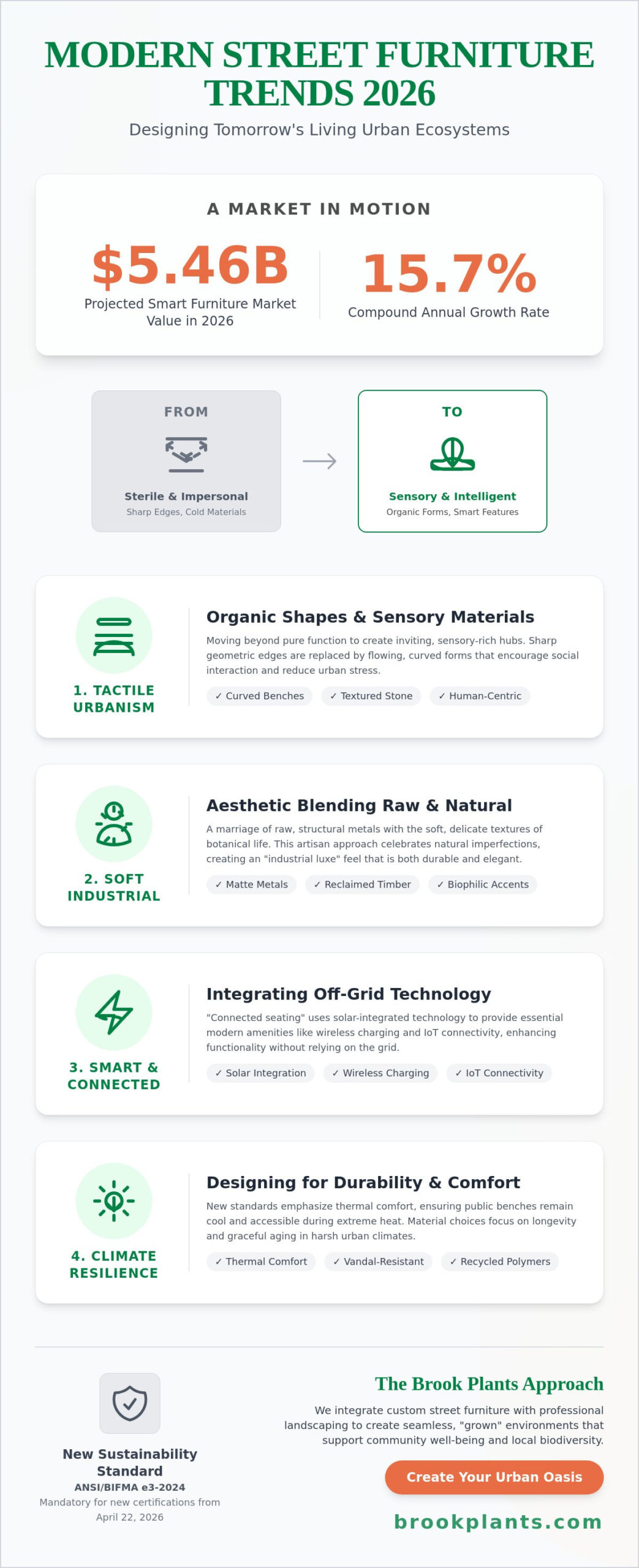
Did you know the smart adaptive street furniture market is projected to reach $5.46 billion in 2026? This 15.7% growth rate highlights a major shift in how we think about our shared outdoor environments. As we explore the modern street furniture design trends 2026, we’re seeing a move away from sterile, dated seating toward “living urban ecosystems” that prioritize both sensory comfort and climate intelligence. We know how difficult it is to find assets that don’t look worn after one season or struggle to integrate modern tech without looking clunky. It’s a challenge to meet national sustainability targets while keeping a space feeling warm and organic.
This article provides a roadmap for creating inviting hubs that meet the new ANSI/BIFMA e3-2024 sustainability standards, which became mandatory for all new certifications on April 22, 2026. You’ll learn how to blend “industrial luxe” aesthetics with biophilic elements that feel grown, not just manufactured. We’ll preview the rise of tactile, curved designs and smart charging stations that make public spaces more inclusive and resilient. By the end, you’ll have the expert knowledge needed to implement durable, stylish assets that truly serve your community’s needs.
Key Takeaways
- Learn why organic, curved shapes are replacing sharp geometric edges to create more inviting, sensory-rich urban hubs that encourage people to linger.
- Discover how modern street furniture design trends 2026 blend raw industrial metals with soft botanical textures for a balanced, artisan feel in public spaces.
- Explore the rise of “connected seating” that uses solar-integrated technology to provide wireless charging and IoT connectivity without relying on the grid.
- Understand how new 2026 durability standards focus on thermal comfort to keep public benches cool and accessible even during periods of extreme heat.
- See how integrating custom street furniture with professional landscaping creates a seamless, “grown” environment that supports both community well-being and local biodiversity.
The Rise of Tactile Urbanism: Organic Shapes in 2026 Street Furniture
Designing for the future isn’t just about how a bench looks from a distance. It’s about how it feels when you rest your hand on it. Tactile Urbanism is the integration of sensory materials into public infrastructure. In 2026, we’re seeing a vibrant shift toward these touch-friendly installations. We’ve moved past the cold, impersonal steel of the early 2000s; instead, we’re embracing textures that invite interaction. This change is a core part of the modern street furniture design trends 2026, where the goal is to make urban spaces feel as welcoming as a private garden.
Sharp geometric edges are quickly being replaced by organic, flowing lines. These softer shapes reflect a growing desire for urban planning that prioritizes human well-being over rigid efficiency. By softening the hard edges of our cities, we reduce the visual friction that contributes to urban stress. When we consider the various elements of street furniture, it’s clear that these installations are no longer just functional objects. They’re architectural tools used to foster calm and encourage people to pause in their busy lives.
To better understand this shift in aesthetic and sensory design, watch this helpful video:
Curved Forms and the Human Connection
Rounded benches and serpentine seating are becoming the standard for inclusive urban design in 2026. Unlike straight, back-to-back seating that can feel isolating, curved forms encourage natural social grouping. They allow people to face one another comfortably, turning a simple rest stop into a community hub. We’re moving away from “hostile architecture” that intentionally makes seating uncomfortable. Instead, the modern street furniture design trends 2026 focus on mimicking natural landforms, like smoothed river stones or rolling hills, to create a sense of belonging. These shapes feel more intuitive to our bodies and help lower cortisol levels in crowded city centers.
Sensory Materials for Public Durability
Achieving a “soft” look doesn’t mean we have to sacrifice strength. Designers are now utilizing textured stone and honed concrete to provide a premium, touchable feel that stands up to heavy use. Wood-grain finishes are particularly effective for adding warmth to concrete-heavy environments. They bring a delicate, architectural beauty to the most rugged assets without the high maintenance of traditional timber. It’s vital to balance that lush, inviting aesthetic with vandal-resistant surfaces. By choosing materials that age gracefully, like high-quality recycled polymers or acid-etched metals, we ensure these assets remain beautiful and functional for decades.
Materiality and the “Soft Industrial” Aesthetic
The “Soft Industrial” trend is truly blossoming as we look toward the future of our cities. It’s a move away from the cold, clinical feel of high-shine stainless steel toward something much more grounded and tactile. We’re seeing a beautiful marriage between raw, structural metals and the delicate textures of botanical life. This approach is a hallmark of modern street furniture design trends 2026, where the goal is to create assets that feel like they’ve been crafted by a steady hand rather than stamped out by a machine. Natural imperfections, like the unique swirl of a wood grain or the slight variation in a matte finish, are now being celebrated as markers of true quality and luxury. It’s about finding beauty in the authentic and the enduring.
Sustainable Timber and Reclaimed Elements
When we think about sustainability, it starts with the bones of the project. Using FSC-certified hardwoods ensures that our urban forests are managed with the same care we’d give our own nursery. Reclaimed timber is also gaining ground, as it tells a story of heritage that resonates with environmentally conscious communities. These materials aren’t just beautiful; they’re resilient. Starting April 22, 2026, the ANSI/BIFMA e3-2024 Furniture Sustainability Standard becomes mandatory for new certifications, pushing for even higher material performance across the industry. To keep these natural materials looking lush, a simple seasonal treatment is often all it takes to protect against the elements. If you’re looking for ways to blend these textures into your own projects, our range of bespoke street furniture offers a perfect starting point for creating spaces that feel both modern and timeless.
The Language of Metal and Glass
The way we use metal is changing too. Instead of sterile surfaces, we’re seeing powder-coated metals in “Emotional Color” palettes. Shades like “Canary Yellow” are being used to spark joy and improve wayfinding in grey cityscapes. Perforated metals allow for an industrial look that remains approachable and light, letting the surrounding greenery peek through the structure. We’re also seeing artisanal glass integrated into bollards and seating. This isn’t just for show; it’s about integrating technology into the urban fabric through illuminated features and smart sensors that feel part of the design rather than an afterthought. It’s a delicate balance of strength and light that makes a public space feel alive and responsive to its visitors.
Smart Furniture: Integrating Technology into the Urban Fabric
Technology in 2026 is becoming invisible. We’re moving away from clunky, bolted-on gadgets and toward a seamless blend of digital utility and natural beauty. This shift is a defining pillar of modern street furniture design trends 2026, where the goal is to enhance the urban experience without disrupting the “earthy” peace of a public park. The smart adaptive street furniture market is currently surging toward a $5.46 billion valuation this year, driven by a 15.7% growth rate. This isn’t just about adding gadgets; it’s about creating “Connected Seating” that serves as a vital organ for the city. These assets now come standard with integrated IoT sensors that monitor everything from foot traffic to local air quality, providing data that helps us understand how our communities actually breathe.
Integrating these features requires a craftsman’s touch. We believe that a bench should still feel like a place of rest, even if it’s also a high-speed data hub. By embedding technology within the “soft industrial” materials we discussed earlier, like textured stone or reclaimed timber, we keep the human connection front and center. This data-driven approach is essential for Designing for Climate Resilience, as sensors can detect rising urban heat levels in real-time, allowing city planners to trigger cooling measures or adjust irrigation through our automatic irrigation systems to protect surrounding greenery.
Solar Power and Public Lighting
The latest benches are becoming self-sustaining power hubs. We’re now designing seating with hidden solar panels that soak up energy during the day to power ambient night lighting. This extends the life of a park well into the evening, making it feel safer and more vibrant. We’ve also seen a rise in “Smart Planters.” These architectural assets use sensors to monitor soil moisture and plant health automatically. Gardener’s note: These systems ensure that even the most delicate herbaceous perennials thrive without constant manual checks, mirroring the sustainable, “grown by us” philosophy we apply to all our living installations.
Charging Stations and Digital Connectivity
Cables are a thing of the past. Inductive charging is now being integrated directly into stone and wood surfaces, allowing users to power their devices simply by setting them down. This keeps the aesthetic clean and lush, avoiding the mess of visible wires. Furthermore, modern street furniture design trends 2026 see these assets acting as Wi-Fi mesh points. By future-proofing designs for 5G and upcoming smart city requirements, we’re helping to build a national digital infrastructure that feels organic. It’s about making sure our public spaces are as connected as our homes, while still providing a sanctuary from the digital noise.
Designing for Climate Resilience: The 2026 Durability Framework
Climate resilience is no longer a choice; it’s the #1 priority for urban planners this year. We’re seeing a fundamental shift in how we build for our cities, moving away from assets that merely exist toward those that actively protect. The modern street furniture design trends 2026 reflect this deep commitment to protecting our public spaces from the elements. In this new era, 2026 durability is measured by a material’s lifecycle carbon footprint and UV stability. It’s about ensuring that every bench, planter, and shade structure can withstand the test of time and temperature without losing its architectural beauty.
We’ve found that true resilience comes from a deep understanding of natural cycles. Just as we nurture a delicate herbaceous perennial to survive a harsh winter, we must design our urban furniture to thrive in high-sun and high-humidity zones. This isn’t just about structural strength anymore; it’s about thermal comfort and environmental harmony. By integrating our automatic irrigation systems into street-level greening, we can create cooler microclimates that make even the busiest city centers feel like a lush sanctuary. View our collection of climate-resilient street furniture to see how these elements come together.
Heat Mitigation and Material Choice
Heat mitigation is a delicate dance between material selection and architectural shading. When we compare the thermal properties of concrete, timber, and recycled polymers, the differences are striking. Concrete can hold heat for hours, while light-coloured stone and treated wood remain much cooler to the touch. These materials are essential for high-sun environments where “thermal comfort” is a key requirement for public safety. We’re also seeing a rise in “Botanical Touches,” a trend where integrated planters and vertical gardens are used to naturally cool seating areas. This biophilic approach reduces the “urban heat island” effect, making outdoor spaces usable even during peak summer temperatures.
Longevity in Harsh Environments
Longevity in harsh environments requires a craftsman’s eye for detail and a commitment to quality. We specify marine-grade metals and high-density polymers to ensure national longevity, especially in coastal areas where salt spray is a constant factor. These materials are incredibly hardy and resistant to the fading effects of intense UV exposure. Gardener’s Note: Protecting your furniture from salt, sand, and extreme humidity is vital for maintaining that “grown by us” look. By choosing maintenance-free designs, developers can significantly reduce the total cost of ownership. These assets are built to be self-sufficient, allowing them to age gracefully while remaining vibrant and welcoming for the community.
The Brook Plants Approach: Where Landscaping Meets Architecture
We believe that a city should feel like a garden. In 2026, we’re seeing a beautiful shift where street furniture isn’t just an object placed on a pavement; it’s part of a living, breathing system. This integration is at the heart of modern street furniture design trends 2026. Our “Grown by Us” philosophy ensures that the greenery we pair with our seating is nurtured with expert care from the very start. It’s not about simply placing a bench next to a pot. It’s about crafting a singular architectural module where the plant and the seat exist in harmony. This biophilic balance requires a deep knowledge of which hardy plants can thrive alongside structural materials in our unique national climate.
The smart adaptive street furniture market is growing at a CAGR of 15.7%, reaching $5.46 billion in 2026. This data tells us that people want more than just a place to sit; they want environments that feel alive and responsive. We focus on creating these “living urban ecosystems” by blending our horticultural expertise with modern design. By choosing plants that are architectural and resilient, we ensure that the soft landscaping doesn’t just survive but thrives within the urban fabric.
Custom Planters as Structural Elements
Modern urban planning is moving beyond standard, off-the-shelf pots. We focus on large-scale, custom-fabricated planter systems that act as the literal backbone of a public space. These aren’t just containers; they’re structural elements that define boundaries, provide shade, and offer comfortable seating. By integrating automatic irrigation systems directly into the furniture, we ensure the greenery remains lush without the need for constant manual intervention. This is particularly vital for commercial developments and hospitality spaces. If you are sourcing for large-scale projects, our Indoor Plant Wholesale UAE guide offers expert insights into selecting the right species for integrated environments. We’re proud to lead the shift toward “Green Infrastructure” across the UAE, creating spaces that truly breathe.
Creating Cohesive Urban Ecosystems
Our design process is a journey from a shared vision to a final, maintenance-ready installation. We act as your mentors, guiding you through the selection of materials and botanical pairings that will age gracefully together. A signature part of our work is our 100% peat-free approach to landscaping. This commitment to the planet ensures that your sustainable furniture choices are matched by truly eco-conscious horticultural practices. We don’t just sell products; we grow communities. Whether it’s a vibrant vertical garden or a serpentine bench with built-in shade, every piece is designed to be a durable, stylish asset for decades. Ready to transform your space? Partner with Brook Plants for your 2026 urban design project and let’s grow something beautiful together.
Cultivating Smarter Cities for 2026
The urban landscape is undergoing a beautiful transformation. By embracing organic shapes and climate-resilient materials, we can turn sterile pavements into vibrant community hubs. These modern street furniture design trends 2026 show that technology and nature don’t have to be at odds; they can work together to create inclusive, cool, and connected spaces. Whether it’s through solar-integrated seating or lush planter systems, the focus remains on human comfort and environmental health. We’ve moved toward a future where every bench and bollard serves the community’s well-being.
With over 20 years of UAE landscaping expertise, we pride ourselves on being more than just providers. We are craftsmen dedicated to sustainable, 100% peat-free horticultural practices. Our specialists excel at creating custom planters and automatic irrigation systems that ensure your greenery stays vibrant in our unique climate. We invite you to Explore Brook Plants Street Furniture & Landscaping Solutions and see how we can bring your vision to life. Let’s work together to grow a future that feels as welcoming as a well-tended garden.
Frequently Asked Questions
What are the most durable materials for street furniture in 2026?
High-density polymers and marine-grade metals are the most resilient choices for public spaces this year. These materials meet the rigorous ANSI/BIFMA e3-2024 standards that became mandatory on April 22, 2026. Light-coloured stone and treated hardwoods are also excellent for their UV stability and ability to age gracefully in harsh national climates. These choices ensure your urban assets remain vibrant and structurally sound for decades without looking dated.
How can smart technology be integrated into public benches without ruining the design?
Technology is integrated through invisible methods like inductive charging coils embedded directly beneath stone or wood surfaces. This approach is a key part of modern street furniture design trends 2026, allowing users to charge devices without clunky wires. Hidden IoT sensors can also be tucked into the structure’s frame to monitor foot traffic or air quality. It’s about keeping the “earthy” aesthetic of the park while providing modern connectivity.
Is solar-powered street furniture worth the investment for large-scale projects?
Solar-powered furniture is a highly valuable investment for large-scale projects, particularly in areas where grid connection is difficult. With the smart adaptive street furniture market growing at a 15.7% rate in 2026, these self-sustaining power hubs are becoming a standard requirement. They power ambient night lighting and charging stations using renewable energy. This reduces long-term operational costs and helps developers meet national sustainability targets effortlessly.
What is biophilic street furniture design and why is it trending?
Biophilic street furniture design is the practice of integrating natural elements, like planters and vertical gardens, into public seating. It’s trending because it directly addresses urban stress by reconnecting people with nature. This “grown by us” approach uses architectural plants to soften hard city edges. It creates a lush, inviting environment that improves community well-being and supports local biodiversity in even the densest urban centres.
How do you prevent street furniture from becoming too hot in direct sunlight?
We prevent furniture from overheating by selecting materials with high thermal comfort ratings, such as light-coloured stone and treated timber. Unlike dark steel or unshaded concrete, these surfaces don’t absorb as much solar radiation. Integrating large shade structure umbrellas or natural canopies through vertical gardens also provides essential cooling. These design choices ensure that seating remains usable and safe even when temperatures peak during the summer months.
Can custom street furniture be integrated with existing irrigation systems?
Custom street furniture can be seamlessly integrated with automatic irrigation systems during the fabrication process. We specialize in creating planter-seating modules that house hidden water lines and soil moisture sensors. This setup ensures that your architectural greenery stays lush and healthy without the need for manual watering. It’s a perfect solution for creating self-sufficient urban ecosystems that thrive year-round in our national climate.
What maintenance is required for modern timber street furniture?
Modern timber furniture requires minimal but specific care to maintain its architectural beauty. We recommend using FSC-certified hardwoods that are naturally resistant to rot and insects. A simple seasonal treatment with a protective oil helps prevent silvering and keeps the wood grain looking vibrant. Choosing high-quality, hardy species from the start is the best way to ensure longevity in outdoor settings while preserving a touchable, premium feel.
How does Brook Plants handle large-scale street furniture installation?
Our team handles large-scale installations by managing the entire journey from design concept to the final placement of assets. We specialize in custom-fabricated planter systems and integrated landscapes that are built to be durable and stylish. Our 20+ years of UAE landscaping expertise allows us to navigate complex urban sites with ease. We ensure every piece is perfectly positioned to create a cohesive, inviting community hub.
Disclaimer
The content on this blog may be automatically generated and is provided “as is” without warranties of any kind, express or implied. No guarantee is made regarding the accuracy, completeness, or suitability of the information. The company expressly disclaims any liability for decisions or actions taken based on this content.
As this blog post was generated using automated content‑creation tools. While our team reviews posts for accuracy and relevance, the information provided may not always reflect the most current developments. The content is intended for general informational purposes only and should not be taken as professional advice. Our company is not liable for any actions taken based on this material.