
Did you know that as of May 30, 2026, failing to align your project with the latest UAE climate mandates can result in fines reaching AED 2,000,000? For many developers, the pressure to meet LEED certification landscaping requirements feels like a race against the desert sun, especially when high evaporation rates make every water credit feel like a hard-won victory. We understand the deep pride you take in creating spaces that breathe and thrive. The shift from LEED v4.1 to the new v5 standards adds technical layers to our shared craft of environmental stewardship, but it doesn’t have to be a source of confusion.
You’re looking for a way to build a landscape that is both a resilient sanctuary and a masterpiece of sustainable design. This guide provides a clear roadmap to earning maximum points in the Water Efficiency and Sustainable Sites categories while ensuring your project remains aesthetically premium. We’ll explore the mandatory carbon and climate resilience assessments now required under LEED v5, offering practical insights to help you balance international benchmarks with local regulations like Al Sa’fat 2.0. It’s time to transform these technical hurdles into a flourishing, eco-conscious reality that respects our planet’s natural cycles.
Key Takeaways
- Learn to harmonize site ecology with resource conservation by focusing on the essential Sustainable Sites and Water Efficiency categories.
- Discover how to achieve the 50% irrigation reduction threshold in the desert by utilizing non-potable sources like AC condensate and graywater.
- Master the cooling power of vertical gardens and shade structures to combat the Heat Island Effect while creating a lush sanctuary.
- Understand the LEED certification landscaping requirements for sourcing materials that favor local growth and recycled content to lower your project’s carbon footprint.
- Follow a thoughtful roadmap from the first sketch to the final certification, ensuring your landscape thrives as a lasting testament to sustainable beauty.
What are LEED Certification Landscaping Requirements?
Imagine a garden that doesn’t just sit on the land but actively heals it. In our craft, we view the outdoor environment as a living extension of the building’s soul. When we talk about LEED certification landscaping requirements, we’re describing a holistic framework that treats site ecology and resource conservation as a single, breathing system. This international standard, known as Leadership in Energy and Environmental Design (LEED), provides the technical rigor needed to ensure your outdoor spaces contribute meaningfully to the planet’s health. By meeting these standards, your landscaping helps determine whether a project achieves Certified, Silver, Gold, or the prestigious Platinum status.
The journey toward a certified landscape primarily flows through two categories: Sustainable Sites (SS) and Water Efficiency (WE). While Sustainable Sites focuses on how we protect the local habitat and manage rainwater, Water Efficiency challenges us to reduce our reliance on precious potable water. Every choice, from the placement of a shade tree to the selection of a specific groundcover, acts as a building block for your total point score. It’s a rewarding process that proves luxury and ecological responsibility can walk hand in hand.
To help visualize these strategies, watch this helpful overview of cost-effective ways to earn points:
The Core Pillars of Outdoor Sustainability
Success begins with a deep respect for the land’s natural rhythm. We aim to reduce the environmental footprint by selecting plants that belong in our arid climate and designing sites that minimize disruption to the soil. It’s about finding that sweet spot where human comfort meets ecological preservation. LEED landscaping is the intersection of architectural rigor and natural stewardship, ensuring every square meter of greenery serves a functional purpose.
LEED v4.1 vs. v5: What Changed for 2026?
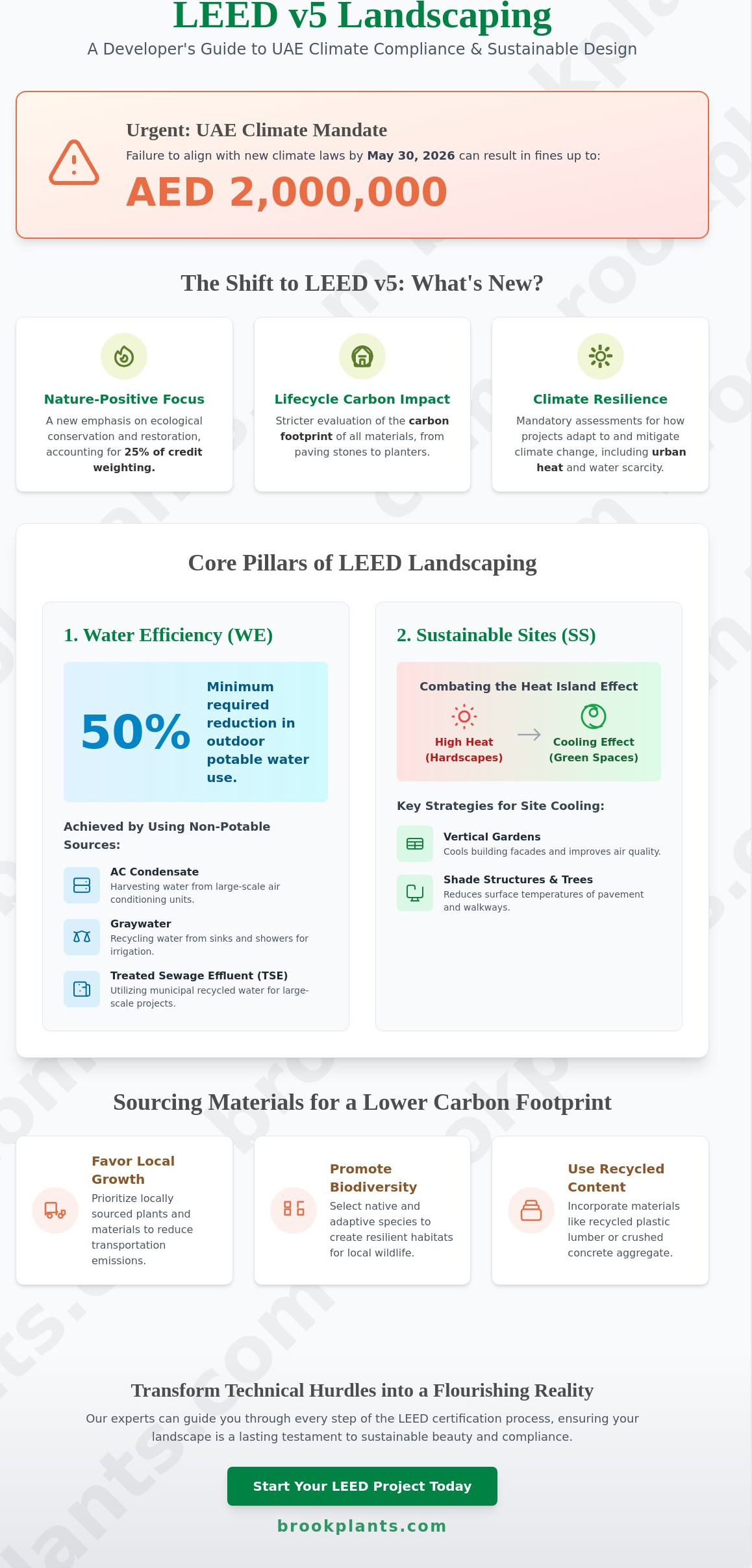
The landscape of certification changed significantly with the launch of LEED v5 on April 28, 2025. We’ve moved toward “nature-positive” outcomes, where 25% of the credit weighting now focuses on ecological conservation and restoration. There’s a much sharper focus on the lifecycle carbon impact of your materials, from the stones in your paths to the production of your planters. This aligns perfectly with the UAE’s Federal Decree-Law No. (11) of 2024, which mandates full climate compliance by May 30, 2026. We now look at urban greenery not just for shade, but as a vital tool for carbon sequestration and climate resilience.
Maximizing Water Efficiency (WE) Credits in Arid Climates
In the heart of the UAE, water isn’t just a resource; it’s a precious gift we must steward with precision. To meet the LEED certification landscaping requirements, you’re tasked with achieving a minimum 50% reduction in outdoor water use from a calculated baseline. This doesn’t mean your garden must look sparse or neglected. By shifting from potable water to alternative sources like graywater, treated sewage effluent (TSE), or even the condensation harvested from large-scale AC units, you can maintain a premium, lush feel while staying within strict credit boundaries. It’s about being clever with what we already have.
The “baseline case” is a standard landscape with conventional irrigation, while your “design case” accounts for your specific plant choices and efficiency measures. This technical comparison is the foundation of your WE credits. Many of the principles we use here mirror the strategies found in Green Infrastructure in the Semi-Arid West, where managing limited water is a way of life. By focusing on the specific needs of each plant, we move away from wasteful, blanket watering and toward a more rhythmic, natural cycle of hydration.
Smart Irrigation and Evapotranspiration Tracking
Technology should always serve nature. Modern automatic irrigation systems use weather-based controllers that track real-time evapotranspiration (ET) rates. These systems adjust watering schedules based on local humidity and wind, ensuring plants get exactly what they need and nothing more. Pressure-regulating components are vital here; they prevent misting and water loss, keeping the system operating at peak efficiency even during the peak of summer. It’s a reliable way to eliminate human error and protect your landscape’s health.
The Role of Xeriscaping and Native Flora
Native plants are the moral anchor of any sustainable desert garden. By selecting species with low Landscape Coefficient (Kl) values, you significantly lower the water demand of your design. We often group these plants into hydrozones, which means we place species with similar thirst levels together. This prevents the common mistake of over-watering a drought-tolerant shrub just because it’s sitting next to a more demanding flower. It’s a thoughtful approach to design that honors the desert’s natural resilience while ensuring every drop of water serves a purpose.
Sustainable Sites (SS): Combating the Heat Island Effect
Urban centers often feel like ovens because concrete and asphalt soak up the sun’s intensity. This is the Heat Island Effect, a phenomenon that drives up energy costs and makes outdoor living nearly impossible during a UAE summer. To meet LEED certification landscaping requirements, we must design sites that reflect heat rather than absorb it. By cooling the immediate microclimate, we reduce the building’s cooling load and create a more comfortable sanctuary for everyone. This strategy is essential for projects aiming to meet the May 30, 2026, compliance deadline for the UAE’s new climate laws.
The LEED v4.1 green building standard provides a clear framework for these “Heat Island Reduction” credits. We focus on two main paths: providing shade and using reflective materials. It’s a delicate balance of choosing the right textures and tones to ensure the ground stays cool underfoot. Beyond the technical points, this approach fosters biodiversity by creating “stepping stone” habitats where local pollinators can rest and thrive amidst the urban sprawl. By creating these green pockets, we’re not just cooling the air; we’re restoring a bit of the natural world to our cities.
High-SRI Materials and Shading Strategies
Reflection is our best defense against the sun. We recommend selecting light-colored pavers and street furniture with a high Solar Reflectance Index (SRI) to bounce thermal energy back into the atmosphere. For areas where living trees might struggle with immediate water constraints, our preserved palms offer a brilliant solution, providing instant, natural-looking shade without any irrigation demand. You can also integrate vertical gardens on building facades to act as organic insulation, while large shade structure umbrellas protect plazas and walkways from direct solar gain. These elements work together to lower surface temperatures significantly, making outdoor spaces usable even in high heat.
Permeable Paving and Ecogrid Solutions
The ground needs to breathe to stay cool. Traditional solid surfaces trap heat and cause runoff, but using Ecogrid allows for a more porous, natural surface. These open-grid systems earn vital SS credits by reducing the amount of impervious area on your site. When paired with high-quality geotextiles for soil stability and filtration, you create a landscape that manages rainwater effectively while promoting ground cooling. This combination of softscape and hardscape ensures your project feels grounded and connected to the earth’s natural cooling cycles. It’s a practical way to satisfy technical requirements while building a resilient, long-lasting environment.
Sourcing Materials and Promoting Biodiversity for LEED Points
A garden’s true beauty often lies in the stories of its components. When we consider the LEED certification landscaping requirements, the focus shifts toward the origin and health of every material we touch. Sourcing plants from local nurseries is more than just a logistical choice. It’s a strategic effort to minimize transport-related carbon emissions, which is a central goal of the LEED v5 framework launched in 2025. By choosing regional flora, we ensure the environments we build are natural extensions of the UAE’s unique ecosystem, reducing the project’s overall embodied carbon from the very start.
The USGBC requires meticulous documentation for material ingredient reporting. You’ll need to provide proof of recycled content for your street furniture and planters, along with evidence that your soil amendments are free from synthetic chemicals. This rigorous reporting ensures that every element of your project supports a non-toxic, sustainable future. We believe that avoiding harsh synthetics is a commitment to the long-term health of our soil and the delicate life it supports. It’s a rewarding process that turns a simple site into a sanctuary of health and biodiversity.
Geotextiles and Soil Health Management
High-quality geotextiles act as the silent protectors of your garden’s structure. These materials improve drainage and prevent soil erosion, which is vital for the sandy foundations common in this region. We carefully select soil media that meets LEED organic standards, focusing on moisture retention to support growth during the peak of summer. Preparing the ground is a craftsman’s ritual. It is about creating a living foundation that allows roots to breathe, ensuring that the health of the plant starts deep beneath the surface. This careful preparation is what makes a landscape resilient against the elements.
Recycled Content and Local Sourcing
We take great pride in selecting street furniture and planters with verified post-consumer recycled content. This choice directly lowers the environmental impact of your site. For projects requiring professional greenery, leveraging indoor plant wholesale UAE networks allows for eco-certified sourcing that aligns with international standards. Supporting regional biodiversity by prioritizing Ghaf and other culturally significant trees honors the heritage of the land while earning vital points. If you are ready to source materials that meet these rigorous standards, our selection of sustainable outdoor landscaping products offers the verified quality your project deserves.
Implementing a LEED-Compliant Landscape Strategy Nationally
Bringing a sustainable vision to life in the UAE requires more than just a list of plants. It’s a journey that begins with a deep understanding of the land and ends with a thriving, point-earning sanctuary. With the May 30, 2026, deadline for full compliance with the UAE Climate Law quickly approaching, the stakes for your outdoor environment have never been higher. Transitioning from a technical design to a certified reality involves a clear roadmap. You must move from the initial concept through rigorous construction documentation to the final LEED submission with a steady, expert hand. It’s a process of internal cultivation where every choice reflects a commitment to quality and care.
Collaborating with experts who understand the technical rigor of green building is essential. When you integrate landscape architects and specialists early in the project lifecycle, you ensure that LEED certification landscaping requirements are woven into the very fabric of the site. This early alignment allows you to lock in critical specifications for your automatic irrigation and native plant selections before the first shovel hits the ground. It prevents the common pitfall of trying to “green” a project after the primary structures are already set. Remember, a LEED garden is a living system, not a static installation.
The Design and Execution Roadmap
Your construction documents are the blueprint for your project’s ecological success. They must clearly define how your outdoor landscaping will meet specific credit thresholds, such as the 50% water reduction target we discussed earlier. We recommend ensuring that every geotextile layer and Ecogrid installation is documented with precision. This transparency builds trust with the USGBC and simplifies the final certification phase. It’s about moving seamlessly from the “why” of sustainability to the “how” of high-performance execution.
Ongoing Maintenance for Long-Term Compliance
While our focus is on providing the foundation for these beautiful spaces, maintenance is the partner that keeps your LEED rating valid over time. We suggest you verify that your chosen maintenance team performs recurring checks on irrigation efficiency and soil health. They must be vigilant in avoiding invasive species that could disqualify your site’s ecological credits. While we don’t offer maintenance services, we know that professional upkeep is what protects your initial investment and the planet’s health. It ensures your garden remains a flourishing asset for years to come.
Final LEED Landscaping Checklist:
- Confirm all plant species are non-invasive and drought-tolerant for the UAE climate.
- Verify that the automatic irrigation system is connected to a non-potable water source.
- Ensure all hardscape materials meet the required SRI values to combat the Heat Island Effect.
- Document the use of recycled content in all street furniture and planters.
- Audit soil health to ensure organic standards are maintained without synthetic chemicals.
Cultivating a Resilient Legacy for the UAE
Building a landscape that thrives in our unique climate requires a blend of technical precision and a deep love for the natural world. By focusing on smart water management, cooling our cities with reflective materials, and sourcing flora that truly belongs here, you transform LEED certification landscaping requirements from a technical hurdle into a flourishing reality. These choices don’t just earn points; they create cooling sanctuaries that protect our planet’s future while honoring the heritage of our land. It’s about finding that perfect balance between architectural rigor and the rhythmic cycles of nature.
At Brook Plants & Landscaping LLC, we’ve been dedicated to this craft since 2004. As primary producers rather than intermediaries, we take immense pride in our sustainable methods and our specialized expertise in high-efficiency automatic irrigation. We’re here to act as your trusted mentor, ensuring your outdoor environment is both a technical success and an aesthetic masterpiece. We invite you to partner with Brook Plants & Landscaping LLC for your LEED-certified landscape design and let us help you grow something extraordinary. Together, we can build a greener, more resilient UAE that will flourish for generations to come.
Frequently Asked Questions
How many LEED points can landscaping earn?
Landscaping can contribute to over 15 points across the Water Efficiency and Sustainable Sites categories. While the exact number depends on your project type, such as New Construction or Core and Shell, the outdoor environment is a primary driver for achieving Gold or Platinum status. It’s a powerful way to demonstrate your commitment to ecological restoration and water stewardship through thoughtful design and material selection.
Are native plants mandatory for LEED certification in the UAE?
Native and adaptive plants aren’t strictly mandatory for every credit, but they’re essential for earning the “Protect or Restore Habitat” points. In our arid climate, using native flora is the most practical way to meet LEED certification landscaping requirements for water reduction. These plants have spent centuries adapting to the desert’s rhythm, making them the most resilient choice for a sustainable and thriving garden.
How does an automated irrigation system affect LEED credits?
An automatic irrigation system equipped with smart, weather-based controllers is a cornerstone for earning Water Efficiency credits. These systems eliminate the waste of manual watering by responding to real-time national humidity and evaporation rates. By ensuring every drop reaches the root zone without runoff, you can hit the 50% water reduction threshold required for higher certification tiers while protecting your project’s long-term health.
What is the Solar Reflectance Index (SRI) and why does it matter for my garden?
The Solar Reflectance Index measures how well a surface reflects solar heat instead of absorbing it. In our urban canyons, high-SRI materials like light-colored pavers and street furniture are vital for reducing the Heat Island Effect. Using these materials keeps your plazas and walkways significantly cooler, which helps lower the building’s overall energy demand and earns vital points in the Sustainable Sites category.
Can I earn LEED points for indoor plants and vertical gardens?
Yes, you can earn points for vertical gardens and indoor landscaping through credits related to biophilic design and heat island reduction. Vertical gardens provide natural insulation for facades, while indoor plants improve air quality and the well-being of the people inside. These living elements bridge the gap between the built environment and the natural world, creating a healthier, more vibrant space that resonates with occupants.
What are the documentation requirements for LEED landscaping materials?
You’ll need to provide verified documentation such as Environmental Product Declarations (EPDs) and Material Ingredient Reports for your hardscape and soil amendments. The USGBC also requires proof of post-consumer recycled content for items like planters and street furniture. Keeping a meticulous record of where your plants were grown helps satisfy the “Local Sourcing” requirements, which emphasize regional production and reduced transport emissions.
How do I calculate the baseline water use for my outdoor space?
Calculating your baseline involves using the LEED Outdoor Water Use Calculator, which compares a standard landscape to your specific design case. The baseline assumes a conventional irrigation system and standard plant types for the region. You then demonstrate your efficiency by showing how your use of native plants and non-potable water sources reduces that initial number by at least 50% to earn credits.
Can existing landscapes be retrofitted to meet LEED standards?
Existing landscapes can certainly be retrofitted to meet LEED certification landscaping requirements, specifically under the LEED for Operations and Maintenance (O+M) rating system. This often involves upgrading to smart irrigation, replacing thirsty turf with xeriscaping, and installing permeable solutions like Ecogrid. It’s a rewarding way to breathe new life into an older site while aligning with the UAE’s 2026 climate compliance goals.
Disclaimer
The content on this blog may be automatically generated and is provided “as is” without warranties of any kind, express or implied. No guarantee is made regarding the accuracy, completeness, or suitability of the information. The company expressly disclaims any liability for decisions or actions taken based on this content.
As this blog post was generated using automated content‑creation tools. While our team reviews posts for accuracy and relevance, the information provided may not always reflect the most current developments. The content is intended for general informational purposes only and should not be taken as professional advice. Our company is not liable for any actions taken based on this material.