
What if the most expensive mistake in your urban development isn’t the construction, but a poorly defined irrigation clause? In the UAE, where summer temperatures regularly exceed 45°C, not knowing how to write an RFP for public landscaping services often leads to scorched soil and significant budget overruns in the form of AED. You likely already feel that the traditional bidding process is broken, especially when over 60% of bids arrive with incomparable pricing due to vague scope definitions. It’s exhausting to manage project failures that stem from a lack of technical precision in your initial tender documents.
We’re here to help you cultivate a better approach. As growers who care deeply about the lifecycle of every plant, we know that success starts long before the first shovel hits the ground. This guide empowers you to master the art of crafting a professional Request for Proposal that secures high-quality, sustainable landscaping for our unique climate. You’ll learn to attract eco-conscious contractors who understand the delicate balance of desert horticulture. We’ll provide a structured, repeatable template and the specific botanical criteria required to ensure your public spaces remain vibrant, lush, and resilient throughout the 2026 season and beyond.
Key Takeaways
- Learn to differentiate between standard quotes and complex urban requirements to build a professional, expert-led foundation for large-scale public projects.
- Discover how to write an RFP for public landscaping services that prioritizes climate resilience, mandating water-wise xeriscaping to ensure greenery thrives in the challenging UAE summer.
- Master the art of defining a comprehensive scope of work, pairing vibrant softscape aesthetics with the technical precision of automatic irrigation and modern urban infrastructure.
- Establish weighted evaluation criteria that move beyond the bottom line, allowing you to vet contractors for their genuine horticultural expertise and commitment to sustainable growth.
- Navigate the tender process with confidence by managing site visits and Q&A sessions that ensure all bidders respect the long-term health and budget (AED) of your urban landscape.
Understanding the Framework of a Public Landscaping RFP
In the thriving urban centers of the UAE, where green spaces are vital for cooling our cities under the Dubai 2040 Urban Master Plan, learning how to write an RFP for public landscaping services is the first step toward a flourishing environment. Unlike a simple quote for a private backyard, a public sector Request for Proposal (RFP) serves as a comprehensive blueprint for long-term growth. It ensures that every plant, from the hardiest Ghaf tree to the most vibrant desert shrub, is selected with the community’s future in mind. This document isn’t just about procurement; it’s about finding a partner who shares a passion for sustainable, peat-free practices and resilient urban design.
Public sector projects carry a weight of responsibility that private residential work doesn’t. While a homeowner might prioritize immediate aesthetics, a public project must mitigate long-term environmental and financial risks. A poorly planned tender can lead to high water costs or the failure of non-native species that can’t handle the 45°C summer heat. By using a structured RFP, you’re protecting public funds and ensuring the landscape remains healthy for decades.
To better understand this concept, watch this helpful video:
A landscaping RFP is a structured tool for evaluating methodology, sustainability, and price.
RFP vs. RFQ: Choosing the Right Procurement Path
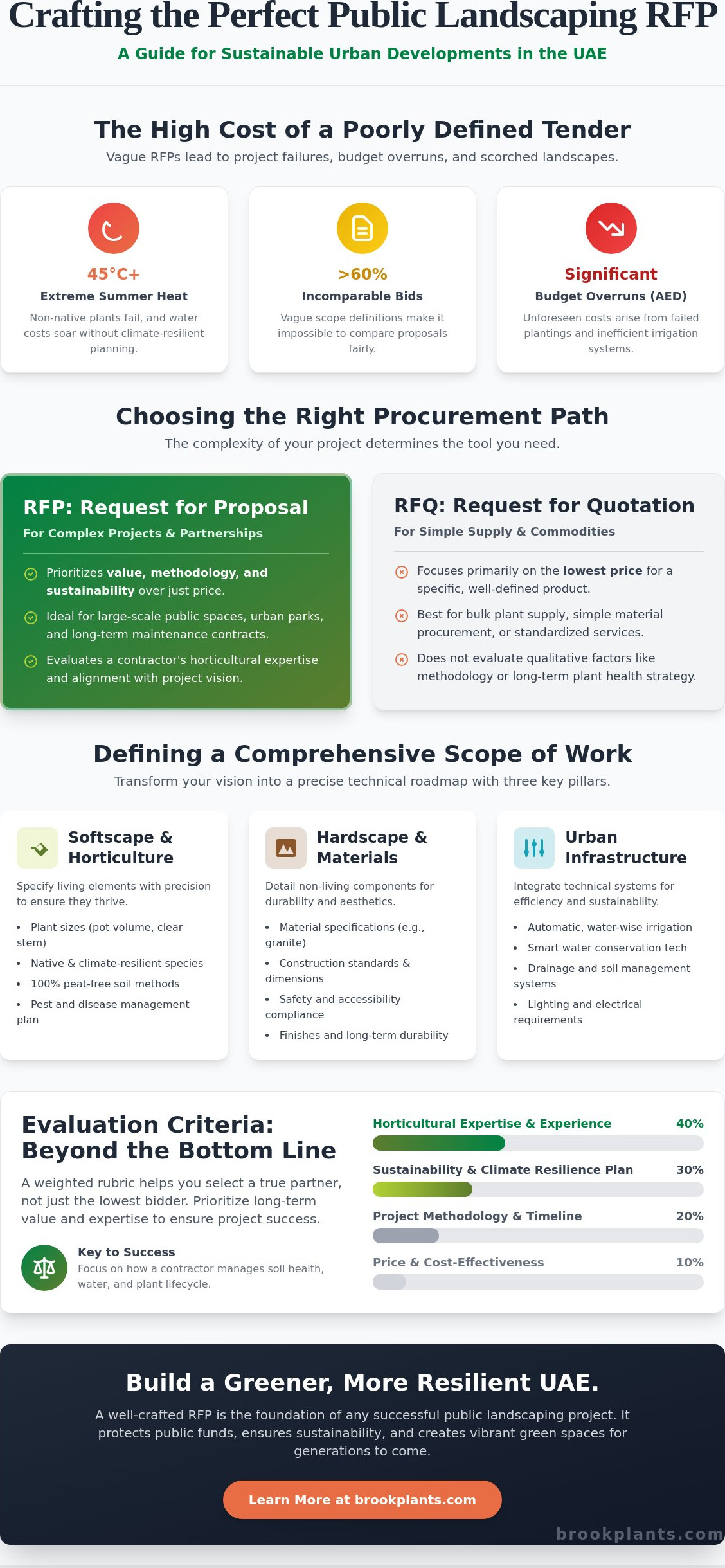
Choosing between an RFQ and an RFP depends on the complexity of your project. You’ll use a Request for Quotation (RFQ) when you just need a bulk supply of plants, perhaps for a simple roadside planting where the lowest price for healthy stock is the main priority. Complex public works require the qualitative depth of an RFP. This approach prioritizes “value” over the lowest bid, looking at how a contractor manages soil health and water conservation. It’s the difference between buying a product and investing in a living ecosystem that’s “grown by us” with care and botanical precision.
The Core Components of a Professional Document
A professional RFP must be rooted in clear administrative instructions. This includes firm deadlines and site visit dates to ensure everyone starts on level ground. In the UAE, legal compliance is non-negotiable. You must specify requirements for valid trade licenses and insurance minimums that meet local municipality standards, often requiring coverage up to 1,000,000 د.إ or more depending on the project scale.
We also suggest including a “Gardener’s Note.” This is your chance to share the heart of your project. Whether you’re creating a sanctuary for local birds or a cooling park for families, sharing your vision helps contractors tailor their botanical expertise. When a contractor knows you value 100% peat-free methods and hardy, architectural plants, they can propose a solution that aligns with your environmental values and the long-term health of the planet.
Defining a Comprehensive Scope of Work for Urban Green Spaces
A successful project begins with a clear vision. When you are learning how to write an RFP for public landscaping services, the scope of work acts as your technical roadmap. It transforms a vague desire for “more greenery” into a precise set of deliverables. In the UAE, where urban environments face extreme heat and high salinity, these specifications must be robust. You should categorize your requirements into three distinct pillars: softscape, hardscape, and urban infrastructure. This ensures that every element, from the smallest groundcover to the heaviest granite bench, is accounted for in the initial bid.
Softscape and Horticultural Standards
The living elements of your project require the most care in their definition. Specify plant sizes using clear metrics like pot volume or clear stem height to ensure you don’t receive undersized specimens. We always advocate for 100% peat-free growing media in public tenders. It’s a practice we follow at our nursery because it supports the long-term health of the planet while providing a stable environment for roots to thrive. Your RFP should also demand a minimum 12-month establishment period. This ensures the contractor remains responsible for the “grown by us” quality you expect during those critical first seasons. For a touch of immediate impact, consider specifying architectural species like the Pritchardia pacifica or vibrant, drought-tolerant shrubs that can handle the 50°C summer peaks.
Hardscape, Irrigation, and Street Furniture
Public spaces are only as good as their durability. Your RFP must define technical specs for automatic irrigation systems that utilize moisture sensors and weather-based controllers. These systems can reduce water consumption by 25% compared to traditional timers, a vital saving in our region. For heavy-traffic areas, incorporate Ecogrid or similar porous paving systems. These maintain soil stability and improve drainage during the occasional heavy winter rains. When selecting street furniture, specify materials with high UV-resistance ratings to prevent the sun from bleaching your benches and bins within a single season.
Integrating these elements into a single, cohesive bid prevents the “patchwork” look that often plagues public parks. If you’re looking for inspiration on which hardy, vibrant species work best in local soils, our expert horticultural team can provide a list of tried-and-tested varieties grown right here in our nursery. By setting these high standards early, you ensure the finished space is both beautiful and easy to maintain for decades to come.
Incorporating Sustainability and Climate Resilience
Designing for the UAE isn’t just about aesthetics; it’s a battle against the 50°C heat of an Arabian August. When you’re figuring out how to write an RFP for public landscaping services, your first priority must be the survival of the green space. We’ve seen too many projects lose 40% of their canopy within the first two years because the specs didn’t account for local reality. Mandating xeriscaping isn’t a limitation; it’s an opportunity to use the vibrant, architectural beauty of species that actually thrive here. Climate resilience is the primary driver of ROI in national landscaping projects.
Your tender should require rigorous standards for soil salinity management. In coastal regions or areas near Sabkha flats, salt buildup can turn a lush park into a barren patch in months. Specify high-performance drainage systems that prevent waterlogging. This is surprisingly common in over-irrigated public plots where heavy clay soils are used. A gardener’s top tip: always ask for a soil analysis report before the first sapling is planted. It’s the only way to ensure the long-term health of your investment.
Water-Wise Specifications
Every drop counts when you’re managing public funds. Your RFP should mandate smart controllers that use real-time weather data to adjust flows automatically. We recommend specifying the use of Treated Sewage Effluent (TSE) for all non-contact public areas. It’s a sustainable way to keep parks green without tapping into precious desalinated water reserves. Prioritise native species like the Ghaf or Sidr in your plant schedules. These aren’t just hardy; they’re part of our heritage and require 60% less water than thirsty, non-native imports once established.
Eco-Friendly Material Standards
Sustainability starts in the soil, not just the leaves. At Brookplants, we’re proud to be 100% peat-free, and your RFP should demand the same from any contractor. Peat extraction destroys vital carbon sinks, and high-quality composted alternatives offer far better moisture retention for our scorching climate. Sourcing from local nurseries is another essential requirement for your procurement document. Plants “grown by us” or other local growers are already acclimated to the intense UV levels of the region. This reduces transplant shock and cuts down the carbon footprint of transport. For shaded pedestrian underpasses or areas with zero natural light, specify high-quality preserved palms. They offer the lush look of real foliage without the impossible water demands or the need for expensive grow-light systems.
Establishing Evaluation Criteria and Selection Rubrics
Choosing the right partner for a public project isn’t just about finding the lowest number on a spreadsheet. When you’re learning how to write an RFP for public landscaping services, you’ve got to build a rubric that rewards horticultural excellence and long-term sustainability. A well-crafted scoring system ensures the public realm stays vibrant for years; it prevents the disappointment of a garden that looks lush on opening day but fades within a single season. At Brookplants, we’ve seen how a focus on the “how” rather than just the “how much” creates spaces that truly thrive.
Technical vs. Financial Weighting
In the UAE, a 70/30 or 60/40 technical-to-financial split is the safest path for high-visibility public works. This ratio protects public interests by prioritizing the health of the soil and the vigor of the plants over a cut-price bid that might fail during the 45-degree July heat. You should establish “Pass/Fail” criteria for essential certifications, such as OSHAD compliance or specific ISO standards for environmental management. A proposal might offer a low price in AED, but if the “Execution Plan” lacks a realistic labor allocation for summer maintenance, the long-term costs of plant replacement will far outweigh any initial savings.
Vetting the Contractor’s Expertise
You need to dig into the roots of the company’s experience. Ask for specific details on their in-house staff. Do they employ certified arborists or irrigation specialists who understand the nuances of local water conservation? A vital part of your evaluation should be their supply chain resilience. Ask how they intend to source indoor plant wholesale uae at scale for public lobbies and transit hubs. Ensure they provide references for similar national-scale projects, specifically those involving the maintenance of indigenous species like the Ghaf tree or complex xeriscaping across multiple municipalities.
- Methodology: Does the bidder prioritize organic fertilizers and peat-free growing media?
- Portfolio: Have they managed public projects with a contract value exceeding 500,000 AED?
- Maintenance Transition: Is there a clear 90-day plan for handing over the site from the installation team to the permanent maintenance crew?
- Resource Management: How do they track water usage and soil moisture levels in real-time?
The “Methodology” section is where a contractor proves they aren’t just resellers. They should explain their approach to integrated pest management without relying on harsh chemicals. A clear “Maintenance Transition” plan prevents the common “planting and ghosting” phenomenon, where a site suffers because the handover was rushed or poorly documented. By requiring a detailed schedule of works, you ensure the contractor is as dedicated to the lifecycle of the garden as we are to our own nursery stock.
If you’re looking for a partner who values quality and sustainability in every leaf, explore our sustainable nursery practices to see how we support large-scale greening projects.
Navigating the Tender Process and Finalising the Contract
Once you’ve mastered how to write an RFP for public landscaping services, the focus shifts to the live tender window. This phase is where your document meets reality. Managing the Q&A period correctly ensures every bidder receives the same clarifications, preventing any unfair advantage. You’ll likely receive technical queries about irrigation specifications or plant availability for the 2026 season. Always document these questions and send a unified response to all parties through your procurement portal. This transparency builds trust and results in more accurate, comparable bids.
The Site Visit and Pre-Bid Meeting
A mandatory site visit is your best tool for filtering out contractors who lack attention to detail. Structure the visit to observe how bidders interact with the land. Do they ask about the salinity of the soil or the existing utility lines that might interfere with deep-rooting trees? Sharing these technical site challenges ensures that the final bids are grounded in reality. After the visit, distribute a formal “Minutes of Meeting” document. This record becomes an essential part of the contract, ensuring no one can claim ignorance of the site’s specific constraints later.
Finalising the contract requires a firm grip on financial safeguards common in the UAE. Public projects typically involve a performance bond, often set at 10% of the total contract value, to protect the municipality against non-performance. You should also structure milestone payments linked to specific achievements, such as the successful installation of hardy, native shrubs across a designated park zone. Retentions, usually 5% to 10% of the total AED value, are held back for a defect liability period of 12 months. This ensures the plants thrive through their first harsh summer. Defining the “Handover” phase is critical; it marks the point where the execution team passes the responsibility to the maintenance crew, ensuring a seamless transition for the public space.
Partnering for Success
Choosing a partner who understands the delicate balance of the UAE’s environment is vital. At Brook Plants & Landscaping, we aren’t just suppliers; we’re dedicated growers who take pride in every leaf and root. Our commitment to sustainable urban growth is reflected in our 100% peat-free media, a standard we’ve championed to protect global ecosystems while ensuring your local project flourishes. When you’re refining how to write an RFP for public landscaping services, consider the value of a partner who provides plants that are “grown by us” specifically for the local climate. Our expert team is ready to help you create vibrant, resilient green spaces that stand the test of time. Consult with our experts for your next public landscaping project and let’s grow something beautiful together.
Cultivating Resilient Urban Landscapes for 2026 and Beyond
Building a greener future for the UAE starts with a precise, vision-led procurement process. By defining a scope that prioritises climate-resilient horticulture and establishing a transparent scoring rubric, you ensure your public spaces thrive despite the intense heat. Mastering how to write an RFP for public landscaping services allows you to move beyond simple maintenance and toward true ecological stewardship. It’s about finding a partner who understands the delicate balance of our local environment and the importance of architectural beauty in urban design.
At Brookplants, we’ve been nurturing these connections since 2004. With over 20 years of national experience, we specialise in 100% peat-free practices that protect our soil’s long-term health. Our team provides comprehensive design, execution, and supply capabilities to bring lush, vibrant life to every project. We’re proud to be growers who care about the entire lifecycle of the plants we supply. To start your journey toward a more sustainable public realm, download our guide to professional landscaping services today. We’re here to help you grow something extraordinary that lasts for generations.
Frequently Asked Questions
What is the difference between an RFP and a simple quote for landscaping?
An RFP seeks a comprehensive strategy and long term partnership, while a simple quote focuses purely on the cost of a specific task. When you learn how to write an RFP for public landscaping services, you’re looking for a grower’s expertise in nurturing architectural plants rather than just a price for mowing. RFPs evaluate a contractor’s methodology, sustainability standards, and technical knowledge, which is essential for complex public spaces in the UAE.
How long should the bidding period be for a public landscaping RFP?
A standard bidding period for a public landscaping RFP in the UAE should last between 4 and 6 weeks. This timeframe allows dedicated craftsmen to conduct site visits, assess the soil health, and calculate the water requirements for lush, vibrant greenery. Shorter periods of 14 days often result in rushed, inaccurate proposals that fail to account for the seasonal rhythms and specific challenges of our local climate.
Should I include a specific budget range in my landscaping RFP?
You should include a specific budget range to ensure proposals align with your financial reality and quality expectations. Providing a range, such as 500,000 AED to 750,000 AED, helps contractors select the right hardy species and sustainable irrigation systems for your project. This transparency prevents the disappointment of receiving beautiful, architectural designs that aren’t feasible within your actual 2026 fiscal constraints.
What are the most common mistakes when writing a landscaping scope of work?
The most frequent error is using vague language like “regular maintenance” instead of specifying “pruning twice per year” or “weekly weed removal.” Another mistake is neglecting the soil’s health, which leads to delicate plants struggling in the UAE heat. Ensure your scope includes clear expectations for peat-free organic amendments and precise irrigation schedules to keep your public parks thriving and healthy.
How do I verify if a landscaping contractor actually uses sustainable practices?
To verify sustainability, require proof of specific certifications like ISO 14001 or evidence of 100% peat-free growing methods. Ask for a list of their current suppliers and a “gardener’s note” detailing how they manage water waste in arid conditions. Truly eco-conscious growers will proudly share their organic pest management logs and local sourcing data from the previous 12 months to prove their commitment to the planet.
Can I include indoor and outdoor landscaping in the same RFP?
You can include both, but it’s best to separate them into distinct lots within your RFP document. Indoor plants require specific light levels and humidity controls that differ significantly from the hardy, sun-loving shrubs used in outdoor public plazas. By splitting the requirements, you’ll ensure that experts who understand the nuances of both environments can provide a tailored approach for every vibrant leaf and delicate bloom.
What insurance requirements are standard for public landscaping in the UAE?
Standard requirements in the UAE include Public Liability insurance with a minimum coverage of 1,000,000 AED to 5,000,000 AED depending on the project’s scale. You must also mandate Workmen’s Compensation and Professional Indemnity insurance for any design elements. These protections ensure that the community and the craftsmen are safe while they work to create lush, architectural landscapes across the Emirates.
How often should a public landscaping maintenance contract be re-tendered?
Public landscaping maintenance contracts should typically be re-tendered every 3 to 5 years. This cycle allows enough time for a contractor to deeply understand the garden’s natural rhythm while ensuring the service remains competitive and modern. According to industry standards in Dubai and Abu Dhabi, a 3 year initial term with a 2 year optional extension is the most effective way to build a reliable partnership.
Disclaimer
The content on this blog may be automatically generated and is provided “as is” without warranties of any kind, express or implied. No guarantee is made regarding the accuracy, completeness, or suitability of the information. The company expressly disclaims any liability for decisions or actions taken based on this content.
As this blog post was generated using automated content‑creation tools. While our team reviews posts for accuracy and relevance, the information provided may not always reflect the most current developments. The content is intended for general informational purposes only and should not be taken as professional advice. Our company is not liable for any actions taken based on this material.