
Did you know that the average property owner in the UAE over-saturates their plants by 38 percent, yet lawns continue to wither under the relentless 2026 summer heat? It is a frustrating paradox to watch your water bills climb as high as the June temperatures while your grass turns into a brittle, golden landscape. You have likely spent hours wondering how to revive a dying lawn in the UAE without draining your bank account or wasting precious resources. It’s heartbreaking to see your outdoor sanctuary feel more like a desert than a retreat, especially when you are doing your best to keep it alive.
We believe that a scorched lawn is rarely a lost cause; it’s often just a sign that the soil and the roots are struggling against salinity and compaction. You can transform that brown patch back into a lush, vibrant green sanctuary using expert-led, sustainable methods that respect our unique environment. This guide will walk you through the essential steps to restore your turf’s health while actually lowering your water consumption. We’ll explore how to fix soil nutrition, optimize your automatic irrigation for current DEWA tariffs, and use organic conditioners to ensure your lawn thrives long after the recovery is complete.
Key Takeaways
- Learn to distinguish between a truly dead lawn and one in “heat dormancy” by using the simple “Tug Test” to check root health.
- Understand why sandy soil compaction and groundwater salinity are the silent culprits behind brown patches and how to heal your soil’s foundation.
- Discover the expert-led steps of how to revive a dying lawn in the UAE through restorative techniques like dethatching and core aeration to invite life back to the roots.
- Master the “deep and infrequent” watering philosophy and the benefits of smart automatic irrigation to reduce water waste while keeping your turf hydrated.
- Implement sustainable maintenance habits, such as the “One-Third Rule” for mowing, to ensure your green sanctuary remains resilient against the harsh summer heat.
Is Your UAE Lawn Dead or Just Dormant? The Diagnostic Phase
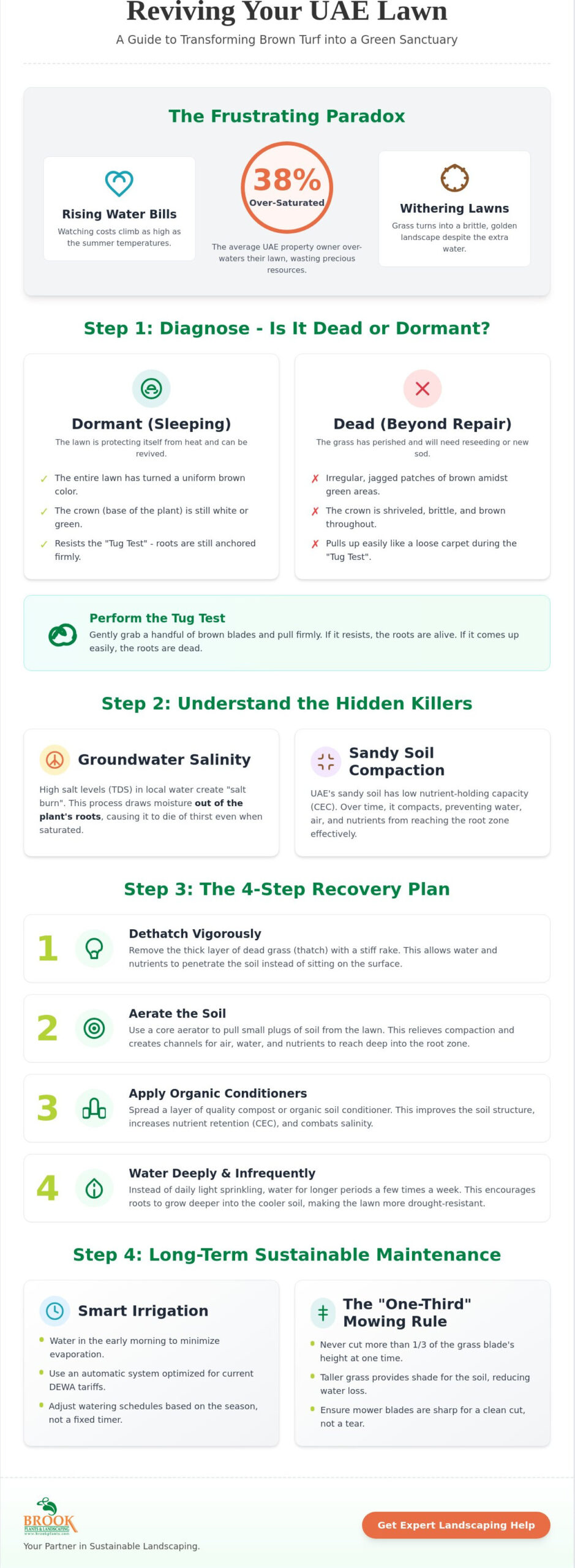
Watching your vibrant green sanctuary fade into a crisp, uniform brown under the intense Arabian sun is a stressful experience for any gardener. However, before you assume the worst, it’s vital to recognize that your grass might not be dead. In our region’s extreme climate, many turf varieties enter a state of “heat dormancy” to protect their most vital part: the crown. Heat dormancy is a physiological response to transpiration exceeding water intake. By shutting down the blades, the plant preserves moisture for the roots, waiting for better conditions to return.
Understanding Lawn care fundamentals helps you see past the surface level browning. A dormant lawn is simply sleeping, whereas a dead lawn is beyond a simple water-based recovery. To determine how to revive a dying lawn in the UAE, you first need to identify which state your grass is in. Look closely at the browning pattern; if the entire lawn has changed color evenly, it’s likely a natural defense against the heat. If you notice irregular circles or jagged patches of brown amidst green, you’re likely facing a different challenge, such as localized soil issues or pests.
To better understand how to differentiate between a dormant lawn and a dead one, watch this helpful video:
The most reliable way to check for life is to inspect the crown, which is the white, fleshy base of the grass plant where the blades meet the roots. Gently pull back the brown foliage at the soil line. If you see a hint of white or green at this base, the heart of the plant is still beating. If the crown is shriveled, brittle, and brown throughout, that specific plant has likely perished. Performing these checks across various spots in your garden will give you a clear map of where recovery is possible.
The “Tug Test” and Root Inspection
A simple physical check can tell you a lot about what’s happening beneath our sandy soil. Grab a handful of brown blades and give them a firm, steady pull. If the grass resists and stays anchored, the root system is still functional and holding on. If the turf comes up easily, like a loose carpet, the roots have likely rotted or been severed by pests. For a deeper look, use a trowel to lift a small 10cm plug of soil. Healthy roots should be firm and reach deep into the ground, while mushy or foul-smelling roots indicate that the ground has become waterlogged and anaerobic.
Identifying Common UAE Lawn Pests
Sometimes the heat isn’t the only enemy. Local grubs and sod webworms thrive in our humid coastal regions, often hiding just beneath the surface. You can spot their presence early in the morning by looking for “frass,” which looks like tiny green sawdust, or delicate silk webbing draped across the dew. Fungal diseases like “Large Patch” are also common here, especially when heavy irrigation is paired with high humidity. These often appear as expanding yellow or orange-tinted circles that eventually turn brown, signaling that a targeted treatment is needed before you can successfully learn how to revive a dying lawn in the UAE.
The Hidden Killers: Salinity and Sandy Soil Compaction
Once you’ve confirmed your lawn is dormant rather than dead, the next hurdle is understanding the invisible chemistry of our desert environment. Many residents find that despite heavy watering, their grass continues to struggle. This is often because our natural sandy soil has almost zero Cation Exchange Capacity (CEC). In simple terms, sand particles don’t have the electrical charge needed to “grip” onto nutrients. When you apply standard fertilizers, they simply wash straight through the porous sand and into the groundwater, leaving your turf hungry and weak.
Salinity is another silent adversary that often goes unnoticed until the damage is severe. High levels of Total Dissolved Solids (TDS) in local groundwater can lead to “salt burn.” This occurs when salt accumulates around the roots, creating an osmotic pressure that actually draws moisture out of the plant. It’s a cruel irony; your lawn can die of thirst while sitting in a puddle of salty water. Learning how to revive a dying lawn in the UAE requires addressing these underlying soil issues before you even think about increasing your irrigation frequency.
Compaction also plays a major role in lawn decline. You might think sandy soil can’t compact, but in the UAE, fine desert dust and silt settle between the larger sand grains. Over time, this creates a dense, concrete-like layer that prevents oxygen and water from reaching the root zone. Applying more water to a compacted, salty lawn often makes the situation worse by preventing the soil from “breathing,” which leads to root rot and further salt accumulation.
Combatting Salt Accumulation
Watch for a white, powdery crust on the soil surface. This is a clear warning of salt buildup that’s suffocating your grass. To fix this, you need to perform “leaching.” This involves applying a heavy, controlled volume of fresh, low-salinity water to physically push the accumulated salts down below the root zone. We always recommend a professional soil test to determine your exact salinity levels, as this ensures your recovery plan is based on data rather than guesswork.
Amending Sandy Soil for Better Retention
To break the cycle of nutrient loss, you must introduce organic matter to the sand. High-quality compost and peat moss adapted for our climate can jumpstart microbial life in otherwise sterile desert sand. These microbes act as a biological “glue” that holds water and nutrients where they belong. For long-term structural success, using Geotextiles is a vital technique to separate your rich soil layers from the natural drainage base. This prevents your expensive amendments from sinking into the depths of the desert, ensuring your lawn has a stable, nutrient-rich foundation to thrive through the summer heat.
A Step-by-Step Recovery Plan for UAE Turf
Once you’ve diagnosed the state of your grass and addressed the underlying salinity of your soil, it’s time to roll up your sleeves for the physical restoration. Reviving a scorched garden isn’t about a single magic application; it’s a sequence of deliberate, rhythmic actions that mirror the natural cycles of growth. When you’re learning how to revive a dying lawn in the UAE, you have to move beyond simple surface care and focus on the architecture of the turf itself. This recovery plan is designed to open up the earth and invite life back into the roots through a series of mechanical and nutritional interventions.
- Step 1: Dethatching (Verticutting): Use a vertical mower to slice through the “thatch,” which is the thick layer of dead organic matter that sits between the green blades and the soil surface. This layer acts like a waterproof tarp, preventing hydration from reaching the roots.
- Step 2: Core Aeration: Instead of just spiking the ground, use a core aerator to remove small plugs of soil. This physically breaks up the compaction we discussed earlier, allowing oxygen and nutrients to penetrate deep into the sandy base.
- Step 3: Top-dressing: Spread a thin, even layer of nutrient-rich organic mix across the surface. This fills the aeration holes with high-CEC material that actually holds onto water.
- Step 4: Targeted Fertilization: Apply a slow-release formula specifically designed for high-heat environments. Avoid quick-fix chemicals that can shock an already stressed plant.
- Step 5: Deep, Infrequent Watering: Shift your irrigation schedule to provide heavy soakings that reach the bottom of the root zone, encouraging the grass to grow deeper and more resilient.
Dethatching and Aeration Specifics
For aggressive UAE grasses like Paspalum or Bermuda, vertical mowing is a necessity rather than an option. These varieties produce thick runners that quickly become a tangled, suffocating mat. It’s best to perform these invasive procedures during the transition months of late March or October. You should avoid the peak heat of July and August, as the grass needs a bit of environmental “breathing room” to recover from the mechanical stress. While small residential gardens can often be managed with hand tools, larger landscapes benefit from professional-grade power equipment to ensure uniform depth and effective thatch removal.
Choosing the Right Nutrient Mix
It’s a common mistake to reach for high-nitrogen fertilizers when you see brown patches. In our climate, excessive nitrogen can “burn” a stressed lawn by forcing rapid top growth that the roots can’t support. Instead, focus on Potassium (K), which strengthens cell walls and improves heat tolerance. We also find that adding micronutrients like Iron (Fe) is the secret to achieving that deep emerald green without the risk of salt-induced stress. This balanced approach is the most sustainable way to ensure you’re successful when figuring out how to revive a dying lawn in the UAE, creating a garden that isn’t just green, but truly healthy from the inside out.
Optimising Your Automatic Irrigation System
Water is the lifeblood of your garden, but in our arid climate, it’s a resource that requires careful stewardship rather than just abundance. Many homeowners believe that a daily five-minute sprinkle is the secret to a healthy lawn, but this is actually the primary cause of shallow, weak roots that bake as soon as the sun rises. When you’re looking for how to revive a dying lawn in the UAE, the solution often lies in changing your delivery method. We advocate for a “deep and infrequent” watering philosophy. By providing 15-20mm of water just three times a week, you encourage the roots to dive deep into the cooler soil layers, creating a resilient turf that can withstand the afternoon heat.
Even the most expensive landscaping can fail if the water isn’t reaching its target. Clogged nozzles or misaligned sprinkler heads create “dry spots” that look like disease but are actually just thirst. You also have to account for wind drift; those gentle evening breezes can carry fine mist away from your grass and onto your pavement, wasting water and leaving your lawn parched. Monitoring your system’s performance is a rhythmic task that ensures your garden thrives through every season.
Calibration and Coverage Testing
To ensure your lawn is getting an even drink, you can perform a simple “Catch Can Test.” Place several flat-bottomed containers, like empty tuna cans, across your lawn and run your irrigation for a full cycle. If some cans are overflowing while others are nearly empty, you have a coverage issue. You should aim for “head-to-head” coverage, where the spray from one sprinkler reaches all the way to the next one. 3:00 AM to 6:00 AM is the optimal watering window in the UAE to minimize evaporation and ensure the moisture soaks deep into the sand before the humidity peaks.
Upgrading to Smart Irrigation
Modern technology has transformed how we manage desert landscapes. Upgrading to Automatic Irrigation systems with smart controllers can reduce your water waste by up to 30 percent. These systems use real-time UAE weather data to adjust watering schedules automatically, skipping cycles when it’s humid or unseasonably cool. By integrating rain sensors and soil moisture probes, you move from guessing to knowing exactly what your plants need. This level of precision is a cornerstone of professional Outdoor Landscaping, preventing the cycle of over-saturation and salt buildup that leads to lawn failure. If you’re ready to modernize your garden’s heartbeat, exploring our range of irrigation solutions is the next step toward a sustainable, green sanctuary.
Sustainable Long-Term Maintenance and Prevention
Once you’ve mastered the rhythmic steps of how to revive a dying lawn in the UAE, your focus must shift from emergency recovery to the gentle art of preservation. A healthy, thriving lawn is the most effective defense against the encroachment of stubborn weeds and the arrival of destructive pests. When your turf is dense and vibrant, it naturally outcompetes unwanted seeds for space and nutrients. Maintaining this resilience requires a commitment to natural cycles and a deep respect for the stress our environment places on every blade of grass.
The transition from a scorched patch to a lush sanctuary is a journey of patience. You’ve already addressed the soil’s salinity and optimized your automatic irrigation; now, you must ensure your mechanical habits don’t undo that hard work. Consistency is the heartbeat of a beautiful garden. By following a few expert-led principles, you can prevent the cycle of browning and revival from ever starting again, keeping your outdoor living space green through even the harshest summer months.
Best Mowing Practices for the Desert
We always advocate for the “One-Third Rule”: never remove more than 33 percent of the grass blade during a single mow. Cutting your grass too short shocks the plant and forces it to use its energy for foliage recovery rather than root depth. For common varieties like Bermuda, we recommend a height of 2.5-4cm. In the peak of summer, leaving the grass slightly longer provides natural shade to the soil surface, which protects the delicate root crowns from sun-scorch and reduces evaporation. Always ensure your mower blades are professionally sharpened; dull blades shred the grass, leaving ragged, brown tips that act as open wounds for fungal diseases to enter. If you’re dealing with a current disease issue, be sure to remove and bag your clippings rather than mulching them back into the turf.
When to Call the Professionals
There are moments when soil chemistry is so severely damaged or compaction is so deep that DIY efforts aren’t enough. If you’ve followed the steps on how to revive a dying lawn in the UAE but still see persistent “dead zones,” it may be time for a total renovation. We provide Fixed-Price Landscape Execution for homeowners who need a complete reset of their outdoor space, ensuring the foundation is built correctly from day one. Entrusting the heavy lifting of a total lawn renovation to experts ensures that every geotextile layer and irrigation line is placed with precision. A professional eye can catch minor irrigation misalignments or nutritional imbalances before they lead to a total lawn failure, giving you back the pride in your outdoor sanctuary. Transform your lawn with Brook Plants & Landscaping LLC and secure the long-term health of your green retreat.
Reclaiming Your Green Sanctuary
Restoring a scorched lawn is more than a weekend project; it’s a commitment to understanding the delicate balance between our harsh desert climate and the needs of the soil. You’ve learned that the secret to how to revive a dying lawn in the UAE isn’t simply adding more water. Instead, it requires a thoughtful combination of breaking through soil compaction, leaching away harmful salts, and transitioning to a deep, infrequent irrigation rhythm that respects our precious resources. By focusing on root health and soil structure, you’re building a landscape that doesn’t just survive the summer but thrives through it.
If the challenge feels overwhelming, remember that you don’t have to walk this path alone. With over 20 years of experience in UAE landscape design and execution, our team brings deep expertise in both intimate residential villa gardens and sprawling commercial greening. We are specialists in water-efficient automatic irrigation systems that ensure your sanctuary stays lush without wasting a drop. Book a Professional Lawn Consultation with Brook Plants today to begin your garden’s transformation. Your dream of a vibrant, sustainable outdoor living space is within reach, and we’re here to help you nurture it back to life.
Frequently Asked Questions
Is it better to water my lawn at night or in the morning in the UAE?
Early morning between 3:00 AM and 6:00 AM is the ideal time to water your garden. This specific window allows moisture to soak deep into the sandy soil before the intense sun causes high evaporation rates. Unlike late-night watering, which can leave grass damp for too long and invite fungal diseases, morning irrigation ensures the blades dry quickly as the day warms up, keeping the plant healthy and resilient.
Why is my grass turning brown even though I water it every day?
Frequent, shallow watering often leads to brown patches because it prevents roots from growing deep into the cooler layers of the earth. If you are struggling with how to revive a dying lawn in the UAE, check for soil compaction or salt buildup. These factors block moisture absorption even if the surface feels wet. Transitioning to a deep, infrequent watering schedule is usually the first step toward a true recovery.
What are the best grass varieties for the UAE climate?
Paspalum and Bermuda are the most resilient choices for our local environment. Paspalum is particularly prized for its incredible salt tolerance and ability to maintain a deep green hue even when using lower-quality groundwater. Bermuda grass is exceptionally hardy and recovers quickly from heavy foot traffic, making it a favorite for family villas. Both varieties thrive in full sun and handle the summer heat with grace when properly maintained.
Can I use greywater or AC condensate to water my lawn?
You can certainly use AC condensate and treated greywater, but it’s vital to monitor the chemical balance of these sources. AC water is essentially distilled and lacks the minerals your grass needs, so it should be used as a supplement rather than a sole source. Greywater must be properly filtered to remove harmful salts or soaps that could damage the delicate soil microbiome we’ve worked so hard to cultivate in the sand.
How often should I fertilise my lawn in the desert?
Aim to fertilise your turf every four to six weeks during the active growing seasons of spring and autumn. It’s best to avoid heavy applications during the absolute peak of the summer heat, as the grass is already under significant physiological stress. Using a slow-release, organic-based nutrient mix ensures a steady supply of food without the risk of chemical burns or sudden, unsustainable growth spurts that weaken the plant.
What is the best way to get rid of weeds without killing my grass?
The most sustainable way to manage weeds is to maintain a thick, healthy lawn that leaves no room for intruders to take root. If weeds do appear, manual extraction is the safest method for your soil’s long-term health. Avoid broad-spectrum herbicides that can weaken your grass. Instead, focus on the “One-Third Rule” of mowing to keep your turf dense and naturally resistant to weed encroachment through every season.
Should I replace my lawn with artificial turf if it keeps dying?
While artificial turf is low-maintenance, it can reach scorching temperatures in the UAE summer, often becoming too hot to walk on safely. Real grass acts as a natural air conditioner, cooling the air around your home through transpiration. Before choosing synthetic options, consider how to revive a dying lawn in the UAE using sustainable landscaping techniques. A living garden provides a cooling, sensory experience that artificial materials simply cannot replicate.
How long does it take for a brown lawn to turn green again?
You can typically expect to see a noticeable green-up within 14 to 28 days once you implement a restorative plan. If the grass was merely in a state of heat dormancy, the response to deep watering and aeration is often quite rapid. However, if the lawn suffered from severe salt burn or pest damage, it may take a full month of consistent care to rebuild the root strength needed for lush growth.
Disclaimer
The content on this blog may be automatically generated and is provided “as is” without warranties of any kind, express or implied. No guarantee is made regarding the accuracy, completeness, or suitability of the information. The company expressly disclaims any liability for decisions or actions taken based on this content.
As this blog post was generated using automated content‑creation tools. While our team reviews posts for accuracy and relevance, the information provided may not always reflect the most current developments. The content is intended for general informational purposes only and should not be taken as professional advice. Our company is not liable for any actions taken based on this material.