
What if the greatest threat to your desert sanctuary isn’t the scorching sun, but the very water you use to keep it alive? It’s a painful irony many homeowners face: watching plants succumb to root rot in one of the driest regions on earth. We’ve seen the frustration of salt crusts choking the soil and muddy patches that turn a beautiful villa garden into an unusable swamp after a brief downpour or a minor irrigation glitch. You want a landscape that breathes and thrives, not one that struggles against its own environment.
We’re here to help you reclaim your outdoor space. This guide focuses on fixing poor garden drainage problems by blending traditional craftsmanship with modern, sustainable landscaping techniques tailored for the UAE. You’ll discover how to transform waterlogged ground into a healthy, well-drained ecosystem that respects our local water security goals. We’ll walk through the essentials of soil health, the benefits of permeable solutions like Ecogrid, and how to design a garden that manages both seasonal rains and daily irrigation with ease. It’s time to build a foundation that supports long-term growth and environmental stewardship.
Key Takeaways
- Understand why arid soils struggle to manage water and how to identify the specific causes of waterlogging in your UAE landscape.
- Master professional techniques for fixing poor garden drainage problems, including the strategic use of surface grading and French drains wrapped in protective geotextiles.
- Discover the advantages of integrating Ecogrid as a sustainable, 100% permeable foundation that keeps your garden dry and usable throughout the year.
- Learn to nurture your soil through aeration and organic enrichment, improving its structure to allow roots to flourish without the risk of rot.
- Find out how to calibrate your automatic irrigation system to work in harmony with your garden’s drainage rate, ensuring a healthy, water-efficient outdoor space.
Understanding Why Garden Drainage Fails in Arid Environments
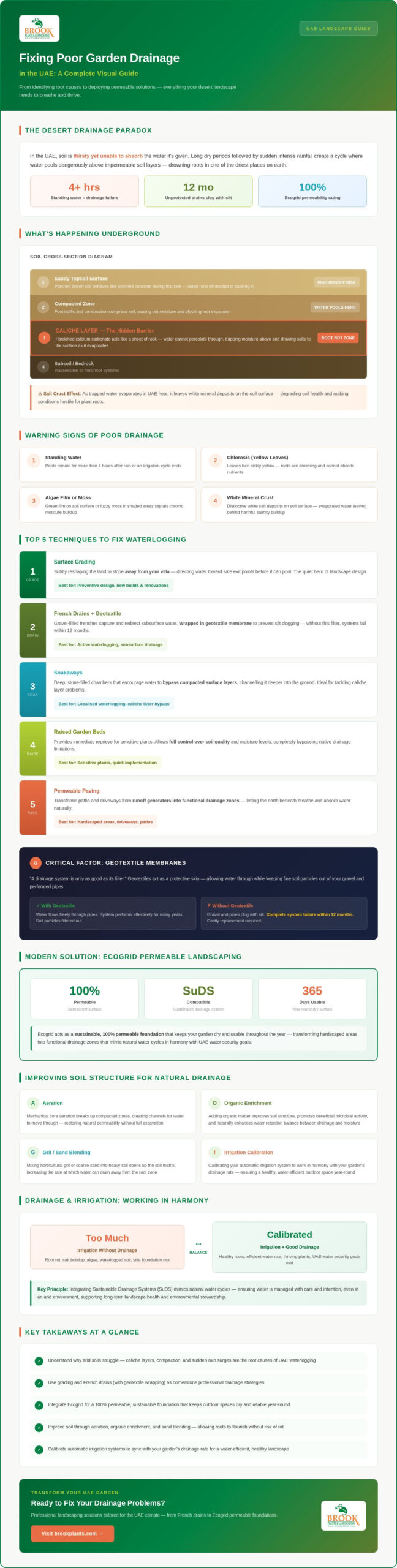
We often think of the desert as a place that hungrily drinks every drop of water. In reality, poor drainage is simply the soil’s inability to move moisture away from delicate roots with enough speed to prevent suffocation. In our unique UAE climate, we face a cycle of long, baking dry periods followed by intense, sudden rainfall. This creates a paradox where the ground is thirsty yet unable to absorb the water it’s given.
Beneath the surface, many gardens harbor “caliche,” a stubborn, naturally occurring layer of hardened calcium carbonate. This underground barrier acts like a sheet of rock, stopping water from percolating down. When water sits trapped above this layer, it doesn’t just drown roots; it brings salt to the surface. As the heat evaporates the standing water, it leaves behind white salt crusts that degrade soil health and make fixing poor garden drainage problems a necessity for any thriving landscape. Integrating Sustainable drainage systems (SuDS) into your garden design helps mimic natural water cycles, ensuring that even in an arid environment, water is managed with care and intention.
To better understand how these principles work in practice, watch this helpful video:
The Impact of Sudden Rainfall Surges
During the first few minutes of a storm, parched desert soil often behaves like polished concrete. Instead of soaking in, water rushes across the surface, creating runoff that can erode your carefully planned hardscape or even threaten villa foundations. Soil density determines how effectively water can penetrate the surface, with compacted areas acting as a total seal against moisture.
Signs Your Garden Has a Drainage Problem
It’s easy to miss the early warnings if you don’t know what to look for. If you notice standing water that remains for more than four hours after a rain event or an irrigation cycle, your soil is struggling. You might see “chlorosis,” where leaves turn a sickly yellow because the roots are literally drowning and cannot take up nutrients. Other telltale signs include a green film of algae, fuzzy moss in shaded spots, or those distinctive white mineral deposits that signal a buildup of salinity. By recognizing these signs early, you can start the process of fixing poor garden drainage problems before the damage to your plants becomes permanent.
Top 5 Practical Techniques for Fixing Garden Waterlogging
Once you’ve identified those soggy patches, the path to a healthy garden begins with choosing the right intervention. Grading is the quiet hero of landscape design. By subtly reshaping the land to slope away from your villa, you direct water toward safe exit points before it can pool. French drains offer a more active solution. These gravel filled trenches, often hidden beneath decorative stone or turf, capture and redirect subsurface water. When it comes to fixing poor garden drainage problems, these drains are a cornerstone of any professional strategy.
For localized waterlogging, soakaways provide a deep, stone filled chamber that encourages water to bypass surface layers. This is particularly useful when dealing with the challenges of soil in arid regions, where natural absorption is often limited by compacted layers. Alternatively, raised garden beds offer an immediate reprieve for sensitive plants, allowing you to control the soil quality and moisture levels entirely. Finally, permeable paving transforms paths and driveways from runoff generators into functional drainage zones that let the earth breathe.
The Role of Geotextiles in Long-Term Drainage
A drainage system is only as good as its filter. Geotextiles act as a protective skin, allowing water to pass into your pipes while keeping fine soil particles out. Without this barrier, your gravel and perforated pipes will likely clog with silt, leading to a complete system failure within twelve months. For most garden projects, a non-woven membrane is the superior choice for filtration; it provides the necessary permeability while maintaining structural integrity. If you’re looking for high quality materials to start your project, exploring professional geotextiles and landscaping supplies can ensure your system stands the test of time.
Implementing French Drains Correctly
Building a French drain requires patience and precision. Start by digging a trench that maintains a consistent slope of at least 1% to 2%, ensuring gravity does the heavy lifting. Line the entire trench with a non-woven geotextile, leaving enough fabric to wrap over the top later. This careful preparation is the difference between a temporary fix and a permanent solution.
- Fill the bottom with a 50mm layer of clean gravel, ideally sized between 20-40mm for optimal water flow.
- Lay your perforated pipe with the holes facing downward to capture rising groundwater efficiently.
- Cover the pipe with more gravel, wrap the geotextile over the top to seal the system, and finish with soil or decorative mulch.
Following this layered approach ensures that fixing poor garden drainage problems becomes a rewarding craft that protects your garden’s health for years to come. It’s about working with the land, not against it, to create a space that remains dry and usable even after the heaviest desert downpour.
Modern Solutions: Ecogrid and Permeable Landscaping
While traditional trenches and grading are vital, modern technology offers a way to have solid surfaces without sacrificing the earth’s ability to breathe. Ecogrid is a standout choice for those who value both utility and environmental stewardship. It’s a cellular grid system made from 100% recycled materials that provides a stable, load-bearing surface while remaining completely permeable. This means you can create a driveway or a garden path that doesn’t contribute to runoff. As you look for permanent ways of fixing poor garden drainage problems, these grids stand out because they address the root cause of surface pooling rather than just moving the mess elsewhere.
The beauty of this system lies in its versatility. You can fill the cells with local gravel to match your villa’s stone work or use a soil and seed mix to create a “green” driveway that feels like a natural extension of your lawn. It’s a delicate balance of form and function; the grid provides the strength needed for a vehicle, while the open cells allow the soil to drink freely. Whether you’re reinforcing a utility area for heavy equipment or building a winding path through your palms, these grids ensure the ground stays level, dry, and beautiful.
Why Permeability Matters for Soil Health
A garden that can’t breathe is a garden that’s dying. When water can’t penetrate the surface, oxygen is cut off from the root zone, leading to the “drowning” sensation we discussed earlier. Permeable surfaces also play a crucial role in reducing the “heat island” effect in your private sanctuary. In the UAE, traditional concrete slabs bake in the sun and radiate heat long after sunset. Grids filled with organic material or stone allow the ground to cool naturally. They also act as a shield against soil compaction, which is a major hurdle in fixing poor garden drainage problems in high-traffic areas where feet and tires constantly press down on the earth.
Comparing Ecogrid to Traditional Concrete
The difference between a concrete slab and a permeable grid is the difference between fighting nature and working with it. Concrete forces water to move horizontally, often overwhelming your garden’s edges or neighboring properties. In contrast, Ecogrid allows for vertical drainage, letting water return to the water table where it belongs. While traditional methods remain essential practical drainage solutions for many scenarios, modern grids offer a durability that concrete often lacks in our extreme heat. They don’t crack under thermal expansion and require far less maintenance over time. By choosing a system that integrates naturally with your softscape, you’re investing in the long-term health of your land.
Improving Soil Structure for Natural Drainage
While engineering solutions like French drains provide the highway for water to exit, the soil itself must act as the local network that receives and filters every drop. In many UAE gardens, the earth becomes so compacted that it rejects water entirely, leading to the puddles and salt crusts we’ve discussed. Aeration is the first step in fixing poor garden drainage problems at a biological level. By physically breaking up the surface, we allow the land to breathe again, creating pathways for moisture to reach deeper layers where it can be put to use.
Adding organic matter is equally vital. In our sandy environment, mixing in high-quality compost and coarse sand helps create tiny “pockets” within the soil structure. These pockets hold onto just enough moisture for the plants while allowing the excess to drain away freely. It’s a delicate craft that transforms “dead” dirt into a living sponge. To protect this new structure, we always recommend a thick layer of organic mulch. Mulching prevents the sun from baking the surface into a hard crust, ensuring that when you do irrigate, the water penetrates the root zone instead of washing away as runoff.
Mechanical Aeration Techniques
For garden lawns that feel like walking on stone, mechanical aeration is a game changer. We generally prefer core aeration, which removes small plugs of soil, over spike aeration, which can sometimes increase compaction around the holes. The best time to perform this in the UAE is during the milder months of October or February, allowing the grass to recover before the extreme heat sets in. The depth of these channels directly impacts root health; deeper aeration increases the surface area for gas exchange, which significantly improves root transpiration and overall plant vigor.
Choosing Plants that Tolerate “Wet Feet”
Sometimes, the natural topography of a villa garden means certain areas will always be slightly damper than others. Instead of fighting the land, we can embrace it by selecting species that tolerate “wet feet.” These plants act as natural pumps, drawing moisture from the ground and releasing it into the air. For confined spaces where ground drainage is a persistent challenge, vertical gardens offer a brilliant way to manage moisture through controlled, elevated planting systems. If you’re also looking to manage high-humidity areas inside your home, you can find inspiration in our guide to the best indoor plants for professional sourcing.
If you’re ready to revitalize your soil with high-quality amendments or professional expertise, explore our range of outdoor landscaping and soil solutions to give your garden the foundation it deserves.
Integrated Landscape Design: Drainage and Irrigation Synergy
A garden’s health depends on a delicate balance between the water we provide and the earth’s ability to process it. Often, the journey of fixing poor garden drainage problems reveals that the irrigation system is inadvertently working against the land. An automatic irrigation system that isn’t carefully calibrated to your soil’s specific infiltration rate creates an artificial swamp, even in the peak of a desert summer. This over-saturation doesn’t just waste a precious resource; it actively suffocates the roots we are trying to nurture.
We believe that drainage shouldn’t just be a hidden utility; it can be an aesthetic triumph. Designing “rain gardens” or dry creek beds using local river stones creates a beautiful, naturalistic feature that serves a vital purpose. These areas act as functional basins during sudden UAE rain surges, allowing water to collect and settle slowly rather than rushing toward your villa’s foundation. When professional outdoor landscaping is executed with this level of foresight, drainage is built into the very soul of the garden from day one, rather than being added as a messy afterthought.
Smart Irrigation for Better Drainage
Modern technology offers us the tools to be better stewards of our environment. Moisture sensors are a vital addition to any desert garden; they act as the “brain” of your system, preventing irrigation cycles from running when the soil is already saturated from a recent downpour. Drip irrigation is another essential choice, delivering water with 90% to 95% efficiency directly to the root zone. This targeted approach significantly reduces the surface runoff often caused by traditional sprinklers, which can lose nearly half of their water to evaporation and wind. By scheduling shorter, frequent cycles that match your soil’s natural absorption rate, you ensure every drop is used effectively.
Professional Maintenance and Long-Term Success
Ensuring your garden remains a dry, usable sanctuary requires a rhythmic approach to care. Even the best-engineered systems need a watchful eye to prevent silt from slowly migrating into soakaways or debris from blocking exit points. It’s helpful to view your plants as an early warning system. A sudden shift in leaf color or the appearance of moss in a previously dry corner can signal a change in subsurface drainage. For large estate gardens, ensuring these checks are part of a regular routine is the best way to protect your investment. By maintaining this harmony between water delivery and removal, you aren’t just fixing poor garden drainage problems; you’re fostering a resilient ecosystem that will thrive for generations.
Cultivating a Resilient Desert Sanctuary
Transforming a waterlogged yard into a thriving ecosystem is a journey of understanding the land beneath your feet. By addressing the root causes of compaction and salinity, you aren’t just fixing poor garden drainage problems; you’re building a sustainable foundation that respects the UAE’s unique environment. Whether you choose the structural strength of Ecogrid or the natural filtration of a well-designed rain garden, the goal is to create a space where water is a blessing rather than a burden. A garden that breathes is a garden that flourishes.
We’ve spent over 20 years refining our craft as specialists in sustainable drainage and landscape design. From the initial design phase to precise execution and ongoing maintenance, our team is dedicated to helping you achieve an outdoor space that stays healthy and vibrant. If you’re ready to reclaim your garden from puddles and salt crusts, we invite you to Request a Professional Landscape Consultation for Your Garden. Let’s work together to ensure your landscape remains a dry, beautiful, and vibrant haven for years to come. Your desert oasis is waiting to reach its full potential.
Frequently Asked Questions
How do I know if my garden drainage problem is serious?
Serious drainage issues are marked by water that remains on the surface for more than four hours after irrigation or rain. You might also notice a persistent white crust, which is actually salt buildup, or plants that appear wilted despite having wet soil. These signs indicate that the natural balance of your soil is compromised, requiring a thoughtful approach to fixing poor garden drainage problems before root rot sets in.
Can I fix poor drainage without digging up my whole lawn?
You don’t always need to excavate your entire landscape to see results. Targeted interventions like mechanical aeration and the addition of organic compost can significantly improve soil structure. For high-traffic paths, installing Ecogrid sections provides a load-bearing surface that stays permeable. These focused methods allow you to restore health to your garden without the disruption of a full-scale reconstruction.
What is the best material for a French drain in the UAE?
The most effective French drains in our climate use a combination of clean 20-40mm gravel and a high-quality perforated pipe. This specific stone size ensures there’s plenty of space for water to flow freely. Wrapping the entire assembly in a non-woven geotextile is a non-negotiable step. It acts as a filter to keep fine desert silt from clogging your system over time.
Will a new irrigation system help with my drainage issues?
A modern irrigation system is a powerful tool for managing moisture levels. By switching to drip irrigation and adding smart moisture sensors, you ensure that you only provide the water your plants can actually use. This prevents the artificial waterlogging that occurs when traditional sprinklers overwhelm the soil’s natural absorption rate, making it a key part of fixing poor garden drainage problems.
What is the difference between a soakaway and a French drain?
A French drain is a horizontal trench designed to redirect water away from a specific area, while a soakaway is a deep, vertical pit. The drain acts like a pipe to move water elsewhere, but the soakaway acts as a temporary reservoir. It holds the water in a stone-filled chamber, giving it the time it needs to slowly percolate back into the deeper ground layers.
How does Ecogrid help with garden waterlogging?
Ecogrid solves waterlogging by providing a cellular framework that prevents the soil from becoming a solid, compacted mass. Because the grids are 100% permeable, rain and irrigation can pass straight through to the earth below. This keeps the surface dry and stable, even under the weight of a car or heavy foot traffic, ensuring your garden remains usable regardless of the weather.
Is it possible to have poor drainage in sandy desert soil?
It is a common misconception that sandy soil always drains well. In the UAE, we often deal with “caliche” layers, which are hardened deposits of calcium carbonate that act like an underground slab of concrete. Even if the surface looks sandy, these deep barriers can trap water around the roots, leading to the same soggy conditions you’d find in heavy clay environments.
Should I use a geotextile membrane for all drainage projects?
We strongly recommend using a non-woven geotextile membrane for every drainage installation. This fabric is essential for filtration; it allows water to pass through while holding back the fine sand and silt that would otherwise fill your pipes. Skipping this layer is one of the most common reasons drainage systems fail within their first year, as the gravel eventually becomes choked with debris.
Disclaimer
The content on this blog may be automatically generated and is provided “as is” without warranties of any kind, express or implied. No guarantee is made regarding the accuracy, completeness, or suitability of the information. The company expressly disclaims any liability for decisions or actions taken based on this content.
As this blog post was generated using automated content‑creation tools. While our team reviews posts for accuracy and relevance, the information provided may not always reflect the most current developments. The content is intended for general informational purposes only and should not be taken as professional advice. Our company is not liable for any actions taken based on this material.