
The cheapest bench you buy today will likely become your most expensive liability within five years. When planning a community sanctuary, the initial cost of street furniture for public parks often hides the true story of its lifecycle. With the global market projected to grow to $16.95 billion by 2031, choosing the right fixtures requires more than just a glance at a price tag. We understand the frustration of balancing a limited budget against the need for architectural pieces that are hardy enough to survive both the elements and heavy public use.
At Brookplants, we bring the same eco-conscious craftsman spirit to our urban fixtures as we do to our 100% peat-free nursery. We’ll help you look beyond the $2,364.00 sticker price of a concrete and wood bench to understand its true value over time. You’ll discover a comprehensive breakdown of 2026 pricing, including $383.00 fixed stools and essential ADA height requirements for accessible tables. We’ll explore how recycled materials, which are growing at a rate of 7.68%, can lower your long-term costs. This guide provides a clear budgeting framework to ensure your park remains a vibrant, sustainable haven for years to come.
Key Takeaways
- Learn how strategically placed architectural fixtures can transform a green space by increasing community “dwell time” and overall engagement.
- Understand the impact of the “Climate Tax” and why choosing UV-stabilized materials is vital for ensuring the longevity of your park’s assets.
- Navigate the total cost of street furniture for public parks by identifying the differences between standard, premium, and bespoke architectural price tiers.
- Identify the hidden logistical expenses, from professional ground fixing to site access requirements, that shape your final project budget.
- Gain the expertise to draft a street furniture tender that prioritizes sustainable craftsmanship and lifetime value rather than just the lowest initial bid.
Understanding the Value and Utility of Urban Park Furniture
Think of a public park not just as a collection of trees and turf, but as a vibrant living room for the community. While the initial cost of street furniture for public parks might seem like a secondary line item, these pieces are actually the functional backbone of any successful green space. Collectively known as street furniture, these objects bridge the gap between the wild beauty of nature and human utility. Without a place to sit, a path to follow, or a bin to keep things tidy, a park is merely a plot of land rather than a destination. Street furniture is essential infrastructure for social cohesion and urban comfort.
The synergy between lush softscapes and architectural fixtures creates a sense of place that encourages visitors to linger. This concept, often called “dwell time,” is a key metric for urban planners. When people stay longer, they engage more deeply with their environment and each other. With the global market for these fixtures projected to reach $16.95 billion by 2031, it’s clear that cities are investing heavily in this social fabric. High-quality fixtures signal to the public that a space is cared for, which in turn increases the perceived value of the entire development.
The Social Impact of Quality Park Fixtures
Seating placement is a delicate art that directly influences how a community interacts. Ideal for encouraging a quiet conversation or providing a necessary rest for elderly walkers, benches must be positioned with intention. Beyond comfort, the role of lighting and bollards is critical for public safety. These elements define boundaries and illuminate paths, ensuring the park remains a welcoming haven even after the sun sets. We’ve found that aesthetic harmony between hardy furniture and vibrant plantings is vital. A mismatched or neglected bench can make even the most delicate garden feel forgotten, while a well-chosen piece elevates the surrounding landscape.
Economic Benefits for Commercial and Public Developers
Choosing premium street furniture isn’t just about beauty; it’s a savvy financial move. High-durability, vandal-resistant designs significantly reduce the need for frequent replacements. For developers, these fixtures act as a branding tool, signaling a commitment to quality that can increase surrounding property values. In fact, parks and recreational areas are the fastest-growing segment for these installations, with a projected growth rate of 7.55% through 2031. Gardener’s Note: Just as we prioritize 100% peat-free growing methods to ensure the long-term health of our plants, selecting sustainable, locally-sourced furniture ensures the long-term health of your project’s budget.
Key Factors That Influence the Cost of Park Fixtures
Selecting the right components for a shared space is much like choosing the right specimen for a specific corner of the garden. You wouldn’t plant a delicate fern in a sun-scorched courtyard, and you shouldn’t install untreated timber in a high-traffic urban park. The cost of street furniture for public parks is heavily dictated by the “Climate Tax.” This refers to the essential investment in UV-stabilized and heat-resistant coatings that prevent materials from warping or fading under intense exposure. When you’re deep in park budgeting and planning, it’s vital to account for these protective layers early in the process.
Material Science and Climate Resilience
Material choice is the primary driver of the initial purchase price. In 2025, metal remained the dominant material with a 37.74% market share, largely due to its durability. However, we see a growing shift toward recycled plastics and upcycled aluminum, which is projected to grow at a CAGR of 7.68% through 2031. While powder-coated steel offers a clean, architectural look, coastal parks require marine-grade finishes to resist salt-spray corrosion. Treated hardwoods provide a warm, earthy aesthetic but often come with a higher price premium compared to Glass Reinforced Plastic (GRP). If you’re looking for sustainable options that mirror the longevity of our hardy nursery stock, recycled composites offer an excellent return on investment.
Design Complexity and Smart Integration
Customization adds another layer to the budget. When analyzing the cost of street furniture for public parks, the choice between modular and bespoke designs often dictates the total project spend. While off-the-shelf modular systems are cost-effective, bespoke designs allow for a unique identity. Integrating technology, such as solar-powered charging stations or Wi-Fi connectivity, is a major trend for 2026. These features enhance the user experience but require specialized manufacturing. Inclusive design is no longer optional. Following ADA recommendations, such as maintaining a seat height between 17 and 19 inches, ensures accessibility for all. Even though these bench guidelines aren’t yet legally enforceable standards, they are best practices for a truly welcoming space.
Don’t overlook the impact of manufacturing origin. Recent tariffs on imported steel and aluminum have increased costs and extended procurement timelines. Sourcing locally not only supports domestic manufacturing but also reduces the carbon footprint of shipping heavy fixtures across the country. This approach aligns with our own commitment to being 100% peat-free, as we believe the lifecycle of a product is just as important as its first day in the sun.
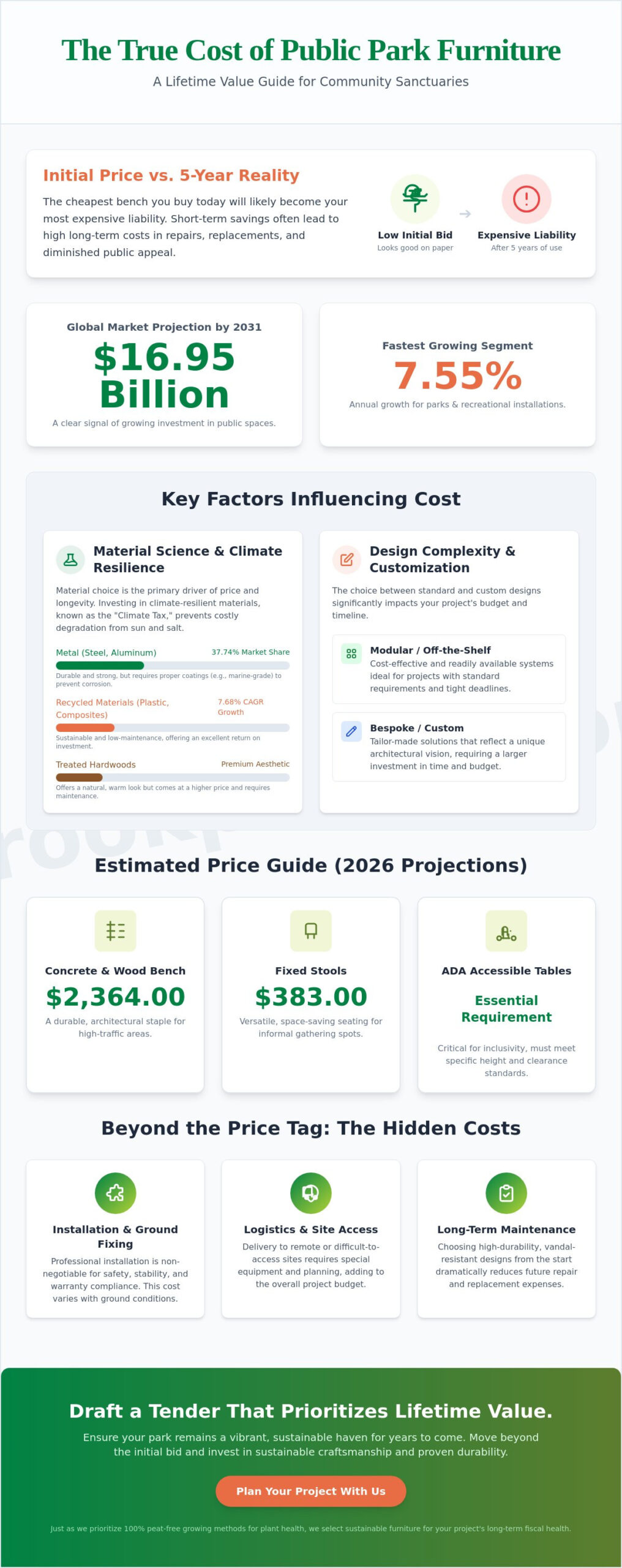
Budgeting by Item: Estimated Price Ranges for Public Park Furniture
When you’re mapping out a new community space, the cost of street furniture for public parks can vary as much as the plants in a perennial border. We find it helpful to categorize your wishlist into three distinct tiers: Standard, Premium, and Architectural. Standard items focus on pure utility and durability; Premium pieces introduce better materials like Wood-Plastic Composite (WPC); and Architectural tiers offer bespoke, sculptural beauty that defines a park’s identity. For large-scale national developments, volume discounts are common, often helping your budget stretch further when ordering dozens of matching units to create a cohesive look across multiple sites.
Seating and Picnic Solutions
Seating remains the heart of any park, accounting for nearly 39% of the market share in 2025. For a high-quality Concrete and Wood Park Bench (Model 3238), you can expect an investment of $2,364.00. If your project allows for surface mounting, the Model 3238D offers a similar aesthetic for $1,944.00, while a backless version like the Model 3238C sits at $1,887.00. It’s vital to ensure these pieces meet ADA recommendations, such as a seat height between 17 and 19 inches, to keep the space inclusive. While natural timber has a delicate beauty, WPC is often chosen for its ability to withstand the elements without the heavy maintenance of traditional hardwoods.
Waste Management and Sanitation
Keeping a park lush and tidy requires a smart approach to waste. A basic litter bin might fit a modest budget, but smart recycling stations with solar-powered sensors are becoming the 2026 standard for urban hubs. The real secret to longevity here is the internal liner. Choosing high-grade, corrosion-resistant liners might cost more upfront, but it prevents the “rust-out” that forces early replacements. Specialized additions, such as pet waste stations or cigarette bins, are small investments that significantly protect the health of your softscape and soil.
Planters, Bollards, and Decorative Fixtures
For smaller accents or quick rest spots, a Fixed Concrete Stool (Model 466B) is a hardy choice at $383.00. Large-scale custom planters for urban trees require a bigger portion of the budget, especially when they incorporate integrated irrigation or tree grates to protect roots in high-traffic areas. Security bollards also range in price depending on whether they are fixed, removable, or telescopic. Gardener’s Note: We always suggest investing in high-quality architectural planters. A well-designed, insulated planter protects the delicate root systems of your trees, reducing the cost of replacing plants that might otherwise struggle in the summer heat. Much like our 100% peat-free growing philosophy, the right foundation ensures your greenery—and your budget—thrives for the long term.
The Hidden Costs: Installation, Logistics, and Long-Term Maintenance
Buying a beautiful bench is much like purchasing a prized specimen tree; the journey doesn’t end when the delivery truck arrives. To truly understand the cost of street furniture for public parks, you must look at the Total Cost of Ownership (TCO) over a 10-year lifecycle. Initial purchase prices represent only a fraction of the investment. The real story lies in how the piece is anchored and how it’s cared for through the seasons. In fact, consistent preventative maintenance can reduce your eventual replacement costs by up to 40%, ensuring your budget remains as healthy as a well-tended border.
Installation Methods and Surface Requirements
How you choose to secure your fixtures depends heavily on your site’s existing landscape. Bolt-down installations are often the most budget-friendly, ideal for hard surfaces like concrete or stone. However, for softer areas or high-security zones, root-fixing provides a permanent, subterranean anchor that’s much harder to disturb. You’ll need to budget for the creation of concrete pads if they aren’t already present, as heavy architectural pieces require a stable foundation to prevent shifting. Professional installation is almost always a prerequisite for manufacturer warranties. Skipping this step might save a few pounds today, but it risks the entire investment if a fixture fails due to poor mounting.
Maintenance Schedules and Refurbishment
Every material has its own seasonal needs. Natural timber requires periodic oiling to maintain its vibrant hue and structural integrity, while powder-coated steel needs simple cleaning to prevent salt and grit from dulling the finish. Vandalism is a financial risk that’s best managed through foresight. Investing in anti-graffiti coatings during the initial procurement phase can save thousands in professional cleaning fees later. Gardener’s Note: If your project includes large-scale planters, consider integrating automatic irrigation systems at the start. While this increases the initial furniture budget, it prevents the significant cost of replacing parched plants and ensures your greenery thrives with minimal manual labor.
Logistics also play a quiet but significant role in the national pricing of urban projects. Site access can be a hurdle; delivering heavy concrete benches to a remote corner of a park requires specialized equipment and more man-hours than a roadside drop-off. We always suggest coordinating your deliveries to match the planting seasons. This streamlined approach reduces the carbon footprint and keeps your site management costs manageable. Just as we take pride in our “grown by us” quality, choosing durable, locally-sourced street furniture ensures that your park remains a reliable sanctuary for the community for decades to come.
Strategic Sourcing: Balancing Aesthetics with Lifetime Value
Drafting a successful tender for a community project requires a shift in perspective. It’s tempting to focus on the lowest bid, but the initial cost of street furniture for public parks is just the first chapter of a much longer story. A well-written procurement document should prioritize “years of service” over “unit price.” We’ve seen projects where cheap alternatives required replacement after only 24 months, effectively doubling the original budget. By specifying high-durability materials like powder-coated steel, which holds a 37.74% market share for a reason, you ensure the public’s investment stands the test of time and weather.
A cohesive urban design often blurs the lines between the open air and sheltered social hubs. If your project includes transitional spaces like glass-fronted pavilions or community centers, it’s wise to coordinate your outdoor fixtures with your interior greenery. You might find inspiration in our indoor plant wholesale uae guide to create a seamless aesthetic flow. When the architectural language of your benches matches the lush, vibrant plants inside, the entire development feels like a single, harmonious sanctuary for the community.
The Brook Plants Approach to Urban Craftsmanship
Our “grown by us” philosophy isn’t just about the 100% peat-free soil in our nursery; it’s a mark of quality that extends to every fixture we select for a landscape. We act as a dedicated mentor, helping you choose street furniture that respects the lifecycle of the planet. By partnering with a craftsman who understands both the hardscape and the horticulture, you avoid common pitfalls. For instance, we ensure that planter drainage won’t damage your paving and that seating won’t cast unwanted shadows on delicate, sun-loving herbaceous perennials. This holistic view is vital for a sustainable, healthy park.
Checklist for Procuring Park Furniture in 2026
As the global street furniture market grows toward $16.95 billion by 2031, staying informed is your best defense against poor investments. Use this checklist to verify your 2026 selections:
- Thermal Comfort: Verify seating materials are heat-resistant to prevent “hot-seat” syndrome during the peak of summer.
- ADA Compliance: Confirm that tables provide a surface height between 28 and 34 inches with at least 27 inches of knee clearance for accessibility.
- Modularity: Select modular systems that allow for easy part replacement, reducing the need for entirely new units if one section is damaged.
- Material Origin: Favor locally sourced materials to avoid the rising costs and procurement delays associated with international tariffs.
Gardener’s Note: When choosing finishes, look for those that age with grace rather than those that simply resist the sun. A high-quality timber or a naturally textured concrete develops a beautiful patina over time in the desert sun, much like a well-established garden. If you’re ready to build a space that lasts, explore our custom street furniture and landscaping solutions to find the perfect fit for your community’s unique needs.
Cultivating a Legacy in Public Spaces
Building a public park is an act of faith in the future. We’ve explored how the cost of street furniture for public parks is best measured through its lifecycle rather than a single invoice. By choosing climate-resilient materials and accounting for the 40% reduction in replacement costs that comes with preventative planning, you ensure your green sanctuary remains vibrant. Whether you’re navigating the $2,364.00 investment for a premium bench or integrating smart technology, the goal is always a space that ages with architectural grace.
At Brookplants, we bring over 20 years of national landscaping expertise to every project. We’re specialists in climate-resilient urban fixtures, acting as a trusted mentor to major retail and commercial developers who value sustainable craftsmanship. Our “grown by us” philosophy ensures that every element, from the soil to the seating, is selected for long-term health. Ready to transform your community vision into a hardy reality? Request a Comprehensive Quote for Your Park Project. Let’s grow something beautiful together.
Frequently Asked Questions
What is the average lifespan of street furniture in the UAE climate?
High-quality fixtures typically last between 10 and 15 years when they are properly selected for extreme heat. In this intense climate, the actual lifespan depends heavily on the use of UV-stabilized coatings and marine-grade finishes that prevent structural degradation. Using durable materials like powder-coated steel helps ensure your investment survives the summer without warping or significant fading.
How much does it cost to install a single park bench?
Installation costs are separate from the purchase price and depend entirely on the anchoring method and site preparation required. Root-fixing into a new concrete pad is generally more labor-intensive than simply bolting a bench to an existing hard surface. For a $2,364.00 bench, professional installation is a wise investment to ensure the manufacturer’s warranty remains valid and the piece stays secure against public use.
Which materials are most resistant to high UV and extreme heat?
Powder-coated steel and Glass Reinforced Plastic (GRP) are among the most resilient materials for high-heat environments. Metal remains the industry leader with a 37.74% market share because it doesn’t degrade or become brittle as quickly as standard plastics under intense UV exposure. These architectural materials are hardy enough to maintain their structural integrity even when surface temperatures peak during the day.
Are there sustainable or recycled options for public park furniture?
Eco-friendly options like recycled plastics and upcycled aluminum are increasingly popular, with a projected growth rate of 7.68% through 2031. At Brookplants, our commitment to being 100% peat-free in the nursery mirrors our passion for sustainable urban design. Using upcycled materials helps lower the long-term cost of street furniture for public parks while protecting the health of our planet.
Does street furniture require a building permit for public parks?
Most standard park furniture doesn’t require a full building permit, though you should always check with local municipal authorities first. Large shade structures or installations requiring deep foundations often need specific approvals to ensure safety and compliance with underground utilities. Coordination with a professional landscaping team helps you navigate these regulatory requirements during the planning phase.
How do I choose between wood and metal for outdoor seating?
Metal offers superior durability and low maintenance for high-traffic zones, while Wood-Plastic Composite (WPC) provides an organic aesthetic without the maintenance of natural timber. Metal is a reliable choice for longevity; however, WPC is a fantastic alternative for those who want the warmth of wood without the risk of splintering. Both choices should prioritize thermal comfort to ensure they remain usable in direct sunlight.
Can smart technology be retrofitted into existing park furniture?
Many modern modular furniture systems are designed to allow the retrofitting of solar charging ports, Wi-Fi hubs, or IoT sensors. This flexibility is a major trend in 2026, as it lets you upgrade your park’s utility without the expense of replacing entire fixtures. It’s a savvy way to manage the long-term cost of street furniture for public parks while keeping the space technologically relevant.
What is the typical lead time for custom-designed urban fixtures?
Custom-designed urban fixtures typically have a lead time of 8 to 12 weeks from the moment the final design is approved. Recent tariffs on imported materials like steel and aluminum can sometimes extend these timelines, so early procurement is essential. Sourcing from national experts helps you navigate these logistical hurdles and ensures your project stays on its seasonal schedule.
Disclaimer
The content on this blog may be automatically generated and is provided “as is” without warranties of any kind, express or implied. No guarantee is made regarding the accuracy, completeness, or suitability of the information. The company expressly disclaims any liability for decisions or actions taken based on this content.
As this blog post was generated using automated content‑creation tools. While our team reviews posts for accuracy and relevance, the information provided may not always reflect the most current developments. The content is intended for general informational purposes only and should not be taken as professional advice. Our company is not liable for any actions taken based on this material.