
What if the vertical gardens and indoor plants in your workspace were actually silent high-performers, working just as hard as your team to protect your bottom line? With the May 30, 2026, compliance deadline for the UAE Climate Law now in effect, calculating ROI on corporate greening projects has moved from a decorative afterthought to a core financial necessity. You’ve likely felt the pressure of mandatory emissions reporting and the struggle to keep life thriving in our desert heat without seeing your utility costs climb. It’s a common worry, but we believe that nature and profit can grow in perfect harmony when you have the right tools.
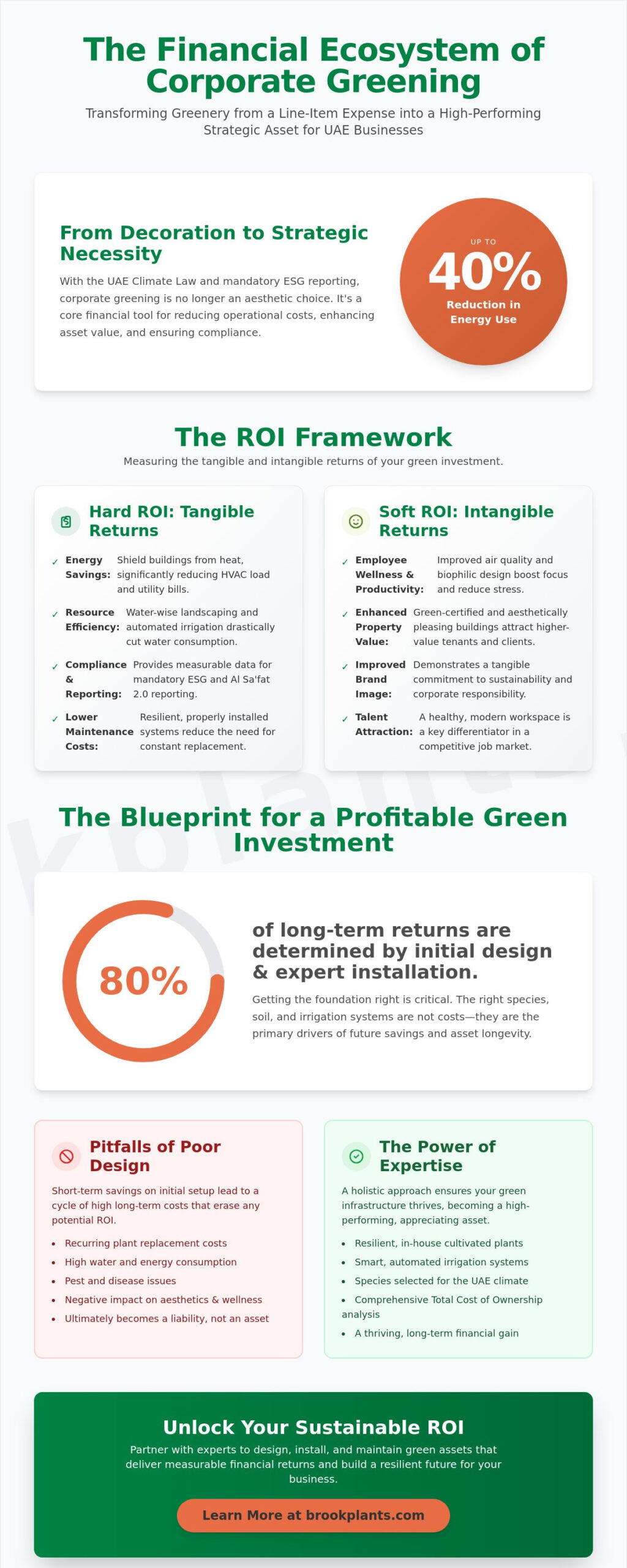
We’ll show you how to transform these living installations into measurable financial assets that can slash energy use by up to 40% and provide the data needed for Al Sa’fat 2.0 reporting. This guide provides a clear framework to quantify the value of every leaf, moving from the “why” of environmental stewardship to the “how” of fiscal success. You’ll gain a reliable formula to present to stakeholders, proving that an investment in the natural world is a direct investment in your company’s future health and resilience.
Key Takeaways
- Discover how to transition from viewing greenery as a simple decoration to treating it as a strategic asset that enhances property valuation and supports mandatory ESG reporting.
- Gain a clear framework for calculating ROI on corporate greening projects by quantifying both direct energy savings and the vital benefits of employee wellness.
- Understand the financial impact of water-wise landscaping and automatic irrigation in the UAE climate, turning environmental challenges into measurable resource efficiency.
- Learn how establishing a comprehensive Total Cost of Ownership helps you identify hidden savings while avoiding the long-term costs of poor design.
- Explore how mindful cultivation and expert craftsmanship ensure your living installations thrive, protecting your investment from the cycle of constant replacement.
Beyond Aesthetics: Why Corporate Greening is a Strategic Financial Asset
For generations, we’ve viewed indoor plants as mere window dressing, a bit of color to brighten a quiet corner. That era has ended. In 2026, green infrastructure has become a mission-critical asset for any business operating in the UAE. When we talk about calculating ROI on corporate greening projects, we aren’t just looking at the cost of a ceramic pot and some potting soil. We’re looking at a holistic framework that integrates the health of your team with the efficiency of your building. This approach is often called Sustainable Return on Investment (S-ROI), and it helps us see how environmental stewardship directly feeds into the triple bottom line of people, planet, and profit.
To help you visualize how these numbers come together in a practical sense, take a look at this walkthrough:
The shift toward mandatory ESG reporting means that every vertical garden or cluster of indoor landscaping must be accounted for as a functional tool. These living systems help lower ambient temperatures and improve air quality, which reduces the load on HVAC systems. It’s a beautiful cycle where nature does the heavy lifting, provided we treat these installations with the respect they deserve as primary biological assets. By aligning your workspace with national sustainability goals, you’re not just following a trend; you’re building a resilient foundation for your company’s future.
The Evolution of the Green Workspace
The days of static, dusty plastic plants are long gone. Today’s corporate standards demand authenticity. We’ve moved toward functional, oxygen-producing vertical gardens and indoor landscaping that actually breathes. As primary producers at Brook Plants & Landscaping LLC who cultivate our own stock, we know that the longevity of these assets depends on their origin. A plant that’s been nurtured from a seedling is far more resilient than one that’s been shuffled through multiple resellers. This internal cultivation ensures that your green infrastructure remains a high-performing asset for years, rather than a recurring expense that needs constant attention.
Anticipated vs. Actual Returns
Realizing a profit from nature requires patience and a deep understanding of growth cycles. When calculating ROI on corporate greening projects, it’s vital to set realistic baselines for plant health. You won’t see the full cooling effect of an outdoor landscaping project on day one. However, the initial design quality dictates about 80% of your future returns. If the right species aren’t paired with the right automatic irrigation system from the start, the return will be swallowed by replacement costs. We believe in getting the foundation right, ensuring that the aesthetic beauty you see today matures into a robust financial gain tomorrow.
The ROI Framework: Measuring Tangible and Intangible Returns
To truly master the art of calculating ROI on corporate greening projects, we must look at the building as a living organism. Traditional accounting often treats plants as a line-item expense; however, a deeper dive into understanding sustainability ROI reveals a more rewarding story. We categorize these returns into two distinct streams: the “Hard ROI” of direct operational savings and the “Soft ROI” of human wellness and productivity. Both are essential for a balanced financial harvest that sustains your business over the long term.
Hard ROI: Energy Savings and Operational Efficiency
The most immediate impact of green infrastructure is often seen in the monthly utility bill. Strategic outdoor landscaping and vertical gardens act as thermal buffers, shielding the building envelope from the intense UAE sun. Research indicates that certified green buildings can achieve 25% to 40% reductions in energy use. This happens because natural transpiration and shading significantly lower the HVAC load. Instead of forcing mechanical systems to work overtime, we let nature provide the cooling. Additionally, using indoor landscaping as a natural air filtration system reduces the wear and tear on mechanical filters. This extends the lifecycle of your building’s vital organs while cutting down on mechanical filtration costs.
Soft ROI: Productivity, Recruitment, and Retention
While energy savings are easy to track, the human element is where the most profound growth occurs. The Biophilia Effect is a measurable performance enhancer. Studies show that a simple view of nature can increase cognitive function by 15%, turning a sterile office into a hub of innovation. In a competitive market, greenery acts as a silent recruiter. Eco-conscious professionals from Gen Z and the Millennial generation prioritize workplaces that reflect their values of environmental stewardship. Even a modest 1% reduction in staff turnover, driven by a healthier and more inspiring environment, can save a company significant sums in recruitment and training costs. It’s about creating a space where people don’t just work, but truly thrive.
Beyond these internal metrics, the presence of high-quality greening projects directly influences property valuation. Buildings that integrate nature often command higher lease premiums and enjoy lower vacancy rates. By moving away from “Sick Building Syndrome” through the use of living air purifiers, you’re protecting your most valuable asset: your people. This holistic view ensures that your investment in the natural world yields a diverse and resilient financial return. If you’re ready to start this transformation, exploring a range of indoor plants is a wonderful first step toward a healthier bottom line.
Navigating UAE-Specific ROI Drivers: Water and Heat Mitigation
In our desert landscape, water isn’t just a resource; it’s a precious lifeblood that requires mindful management. When calculating ROI on corporate greening projects in the UAE, the conversation must center on the unique challenges of our climate. Traditional landscaping often fails because it fights the environment rather than working with it. By choosing a water-wise approach, you align your business with the UAE Water Security Strategy 2036, which aims to reduce total water demand by 21%. This isn’t just about compliance; it’s about building a project that remains a financial asset rather than a drain on your resources.
Smart Irrigation: The Path to Water-Wise Savings
Precision is the hallmark of a true craftsman. Installing automatic irrigation systems equipped with moisture sensors can reduce water waste by up to 40%. These smart systems ensure that every drop reaches the roots where it’s needed most, rather than evaporating in the midday sun. To further protect this investment, we use high-quality geotextiles and specialized soil conditioners that retain moisture deep within the earth. While native species often offer the best long-term value due to their natural resilience, a balanced design can include imported favorites if the foundation is built for efficiency from the start.
Thermal Comfort and Energy Load Reduction
The “Urban Heat Island” effect can drive corporate energy bills to staggering heights as concrete and glass trap the sun’s intensity. We can counter this through the strategic placement of outdoor landscaping and vertical gardens. A living wall acts as a layer of organic insulation, preventing heat from penetrating exterior walls. For areas where water use must be kept to an absolute minimum, preserved palms offer the majestic aesthetic of the desert without the need for a single drop of water. This allows you to meet aesthetic goals while maintaining a zero-water cost for those specific features.
When you calculate the “Green Cooling” dividend, you see the true power of nature. Large commercial campuses that integrate these elements often see a significant reduction in the solar gain on their glass facades. This eases the burden on cooling systems and contributes to the energy savings targeted by the Al Sa’fat 2.0 Silver green building standard. By investing in these thermal and hydraulic engineering tools, you’re ensuring that calculating ROI on corporate greening projects results in a figure that makes both the board and the environment proud.
How to Calculate Your Project’s ROI: A Step-by-Step Guide
Moving from inspiration to implementation requires a steady hand and a clear roadmap. When calculating ROI on corporate greening projects, we must look beyond the initial purchase price to understand the full lifecycle of these living systems. Unlike a piece of office furniture that depreciates the moment it’s unwrapped, a well-designed green installation is a biological asset that appreciates in value as it matures. Nature doesn’t rush, and neither should your financial planning. By following a structured approach, you can present a financial case that’s as robust as the plants themselves.
Defining Your Investment and Baseline Costs
The first step involves establishing the Total Cost of Ownership (TCO). This includes the thoughtful design, the execution of the project, and high-quality materials like planters or ecogrid. Sourcing from a wholesale indoor plant provider who grows their own stock significantly improves your initial ROI. It ensures you’re starting with resilient, acclimated life rather than stressed plants that may fail. You’ll also need to identify your current baseline for energy and water usage. Don’t forget to calculate the “Cost of Doing Nothing.” This hidden drain includes the inevitable energy spikes from unshaded glass and the subtle but real cost of low employee morale in a sterile environment.
Quantifying Annual Gains and Payback Periods
Once your baseline is set, you can begin aggregating your annual gains. This includes measurable utility savings from reduced HVAC loads and potential tax incentives linked to UAE Climate Law compliance. You should also forecast the value of productivity gains and healthcare savings. A healthier team is a more present team. To find your “Break-Even” point for vertical gardens or expansive outdoor landscaping, you can apply a refined ROI formula that factors in the lifespan of the plant assets. Most high-quality installations begin to pay for themselves within the first few years, but their value continues to climb.
- Quantify the Savings: Aggregate your total energy, water, and retention savings for the year.
- Determine TCO: Sum your initial investment and any ongoing care requirements.
- Apply the Formula: (Total Annual Gains – Annual Care Costs) / Initial Investment.
As your plants grow, their surface area increases, which enhances their ability to cool and purify the air. This means your asset actually becomes more efficient over time. This natural appreciation is a unique feature of green infrastructure that traditional office upgrades simply can’t match. If you’re ready to build a workspace that pays dividends for years to come, we invite you to explore our indoor landscaping solutions to find the perfect fit for your strategic goals.
Partnering for Sustainable Growth: The Brook Plants & Landscaping LLC Methodology
The true success of calculating ROI on corporate greening projects depends entirely on the vitality of the living foundation. We don’t just act as an intermediary; Brook Plants & Landscaping LLC are primary producers who care deeply about the lifecycle of every leaf and branch. By cultivating our own stock, we ensure that the indoor landscaping or vertical gardens you invest in are acclimated to the region and ready to thrive from the moment they’re installed. This craftsman’s approach ensures that your financial roadmap isn’t derailed by early plant failure or poor quality. When you start with a healthy, resilient organism, your ROI remains protected and predictable.
Quality Sourcing as a Risk Management Tool
Choosing budget options from resellers often leads to a frustrating cycle of disease and death that quickly erodes your financial returns. When you source from a producer like Brook Plants & Landscaping LLC who prioritizes high ecological standards, you’re choosing risk management over a quick transaction. Our status as primary producers allows us to guarantee a level of plant resilience that intermediaries simply can’t match. We pair these healthy plants with precision tools like automatic irrigation and geotextiles to create a stable, flourishing environment. It’s about getting the design right the first time so you aren’t paying for costly replacements a year down the line.
A holistic landscape also includes the human-centric elements that make a workspace truly functional. Integrating street furniture with outdoor landscaping creates usable, shaded square footage that boosts the perceived and actual value of your property. We believe that every element, from the planters to the preserved palms, should serve a dual purpose of aesthetic beauty and financial utility. This complete vision turns a simple greening project into a landmark of corporate stewardship and fiscal responsibility.
Expert Maintenance: Protecting Your Investment
While we provide the high-quality assets to build your vision, ongoing care acts as the essential insurance policy for your green ROI. It’s vital for stakeholders to ensure a robust maintenance schedule is in place to monitor plant health. This prevents small, manageable issues from turning into major capital expenses that could impact your bottom line. By treating your living infrastructure with the same professional rigor as your mechanical systems, you ensure that the cooling and air-purification benefits remain at peak performance. Consistent care is the secret to ensuring that calculating ROI on corporate greening projects continues to show positive growth year after year.
Ready to build your business case and transform your workspace into a high-performing financial asset? Contact Brook Plants & Landscaping LLC for a professional landscape consultation and let’s grow something lasting together.
Securing Long-Term Value in the Living Workspace
By shifting your perspective from seeing plants as decor to viewing them as essential green infrastructure, you’ve taken the first step toward a more resilient business model. We’ve explored how calculating ROI on corporate greening projects reveals significant gains in energy efficiency and employee well-being, especially when you account for the unique demands of our UAE climate. From the cooling power of vertical gardens to the precision of water-wise automated irrigation, every choice you make is an investment in your company’s longevity and ESG standing. It’s a journey that balances aesthetic beauty with hard financial data.
Since 2004, Brook Plants & Landscaping LLC has dedicated itself to the craft of cultivation. As primary producers and importers, we take pride in ensuring that every plant we provide is a picture of health and vitality, ready to thrive in its new home. We specialize in creating systems that respect our natural resources while delivering measurable financial value. If you’re ready to see how these living assets can transform your specific space, we invite you to Book a Professional Landscape ROI Consultation with Brook Plants & Landscaping LLC. Together, we can build a workspace that breathes with life and grows with your success.
Frequently Asked Questions
How long does it take to see a positive ROI on a greening project?
Most corporate projects reach a break-even point within three to five years. This timeline depends heavily on the project’s scale and the quality of the initial design. High-quality living systems appreciate as they grow, so the financial return actually accelerates over time as the plants become more efficient at cooling and air purification.
Can indoor plants really reduce office energy costs?
Yes, indoor plants act as natural humidifiers and air coolers through a process called transpiration. By releasing moisture into the air, they can slightly lower the ambient temperature, which eases the burden on your HVAC system. This is a subtle but consistent contribution to energy savings that grows more effective when plants are grouped in larger clusters.
What is the most cost-effective greening solution for a corporate office?
Strategic indoor landscaping using resilient, low-water species often provides the fastest return for interior spaces. If you’re looking for an outdoor solution with zero water cost, preserved palms offer a majestic aesthetic without the need for irrigation. These choices allow you to meet your greening goals while keeping operational expenses at a minimum.
How do I quantify the “soft” benefits of biophilia for a board presentation?
You can translate improved wellness into financial terms by tracking metrics like reduced absenteeism and lower staff turnover rates. When calculating ROI on corporate greening projects, assigning a value to a 1% improvement in retention provides a concrete figure for stakeholders. You might also look at the reduction in health-related complaints after installing living air purifiers.
Is maintenance included in the ROI calculation for landscaping?
Yes, professional care must always be factored into the Total Cost of Ownership to ensure your ROI remains accurate. While we provide high-quality plants and systems, you’ll need to account for a separate care schedule to protect your investment. Treating upkeep as a fixed operational cost ensures your living assets continue to provide their documented energy and wellness benefits.
Do native plants offer a better ROI than imported varieties in the UAE?
Native plants generally offer a superior long-term ROI because they’re naturally adapted to the local heat and soil conditions. They typically require less water and are more resilient to the regional climate than many imported varieties. This resilience translates to lower replacement costs and reduced water usage, making them a sound financial choice for any outdoor project.
What happens to the ROI if my plants need frequent replacement?
Frequent replacements can quickly turn a green asset into a financial drain. This is why we emphasize the importance of sourcing from primary producers who ensure maximum plant health from the start. A well-designed system with automatic irrigation prevents the “buy and replace” cycle, keeping your calculating ROI on corporate greening projects trajectory moving in a positive direction.
Can vertical gardens help with LEED or local sustainability certifications?
Vertical gardens are excellent tools for earning points toward LEED or the Al Sa’fat 2.0 Silver green building standard. They contribute to categories like indoor environmental quality, energy efficiency, and water-wise landscaping. By integrating these living walls, you’re not just improving aesthetics; you’re building a documented case for your building’s overall sustainability and market value.
Disclaimer
The content on this blog may be automatically generated and is provided “as is” without warranties of any kind, express or implied. No guarantee is made regarding the accuracy, completeness, or suitability of the information. The company expressly disclaims any liability for decisions or actions taken based on this content.
As this blog post was generated using automated content‑creation tools. While our team reviews posts for accuracy and relevance, the information provided may not always reflect the most current developments. The content is intended for general informational purposes only and should not be taken as professional advice. Our company is not liable for any actions taken based on this material.