
What if your urban project didn’t just survive the desert heat but actually thrived as a cooling, living ecosystem? We’ve all felt the frustration of watching carefully planned greenery wither under the intense UAE sun or seeing costs spiral out of control. It’s a common struggle for those trying to bring nature back into our cities. However, implementing biophilic design for urban spaces is no longer just a luxury; it’s a vital engineering strategy for thermal comfort and urban survival. With Dubai’s Al Sa’fat 2.0 Silver regulations now mandatory for all new building permits in 2026, creating resilient green environments is a necessity for both compliance and community well-being.
You don’t have to settle for high-maintenance failures or sterile, grey environments. You can transform concrete spaces into thriving, nature-integrated ecosystems that endure the unique challenges of our climate. We’ll show you how to choose resilient species like Ghaf and Sidr that truly belong in our landscape. You’ll discover how smart automatic irrigation and vertical gardens create high-impact visual results with efficiency and care. We’re going to walk through the essential steps to build a sustainable green space that improves lives while meeting the latest 2026 environmental standards.
Key Takeaways
- Discover how integrating natural patterns helps combat the urban heat island effect, turning harsh concrete into cooling retreats that breathe.
- Learn how vertical gardens serve as more than just living art, acting as vital natural insulation to protect building facades from the intense UAE sun.
- Master the principles of biophilic design for urban spaces by choosing heat-tolerant species and implementing smart automatic irrigation for lasting vitality.
- Explore how multi-functional street furniture and planters can breathe life back into public areas, creating restorative spaces for the community to gather.
- Gain insights into a holistic lifecycle approach to urban landscaping that prioritizes ecological stewardship and authentic, sustainable craftsmanship.
Understanding Biophilic Design for Urban Spaces in the UAE
At its heart, biophilic design isn’t just about placing a few pots in a lobby; it’s a profound commitment to weaving the living world back into our daily surroundings. By following established biophilic design principles, we can bridge the gap between our modern architecture and our biological need for nature. In the UAE, where our cities are often defined by glass and steel, this approach becomes a vital tool for survival. It’s about more than aesthetics. It’s about health.
Integrating biophilic design for urban spaces helps us tackle the intense urban heat island effect that plagues our concrete-heavy developments. When we replace heat-absorbing surfaces with living systems, we don’t just create a prettier view; we actually lower the local temperature. This represents a major psychological shift for our region. We’re moving away from seeing greenery as a decorative after-thought and recognizing it as an essential nature-based solution. The benefits are tangible: improved air quality, reduced stress for residents, and a documented increase in property value across national commercial sectors.
To better understand this concept, watch this helpful video:
The Three Pillars of Biophilic Integration
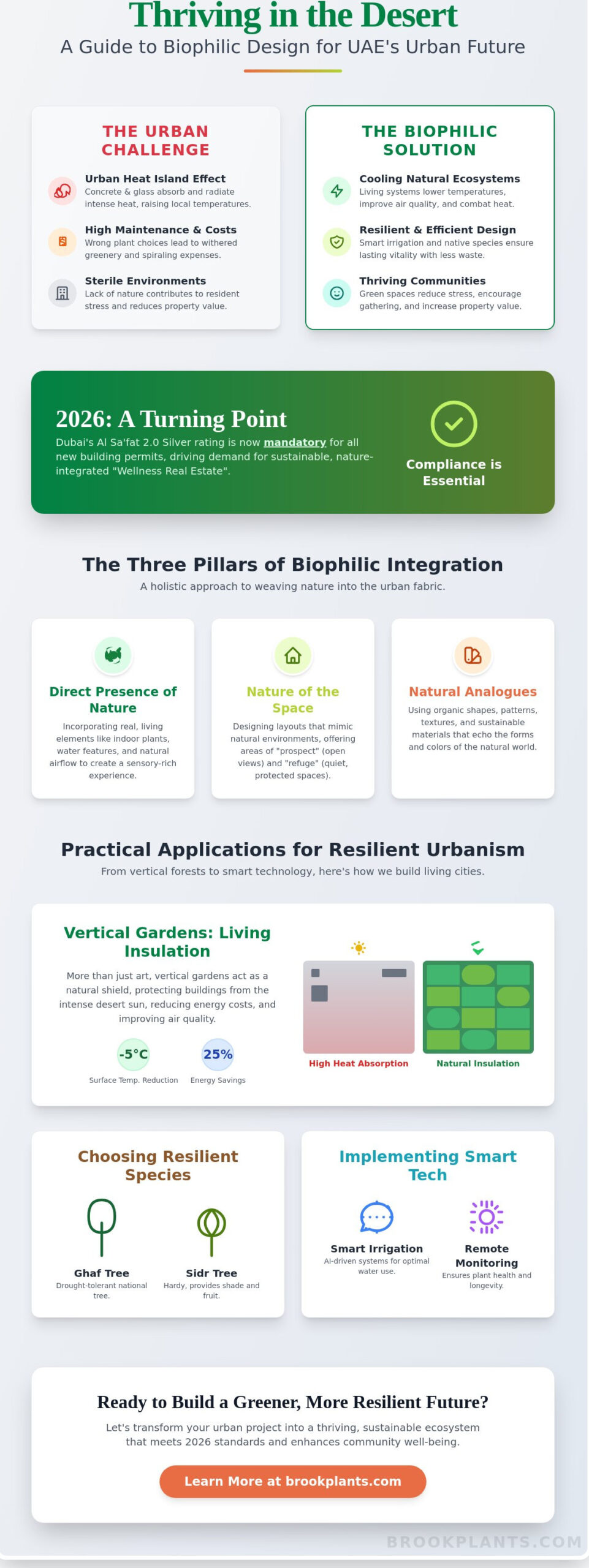
We look at biophilic integration through three specific lenses. First, there’s the direct presence of nature in the space. This includes the cooling touch of airflow, the sound of water, and the vibrant life of indoor plants. Second, we consider the nature of the space. This means creating layouts that mimic natural environments, offering both “refuge” for quiet focus and “prospect” for open views. Finally, we use natural analogues. These are organic shapes, textures, and sustainable materials found in our street furniture and planters that echo the patterns of the wild desert landscape.
Why 2026 is the Year for Green Urbanism
This year marks a turning point for our built environment. With the mandatory Al Sa’fat 2.0 Silver rating now in full effect for all new Dubai building permits, sustainability is the new baseline. Our projects must now align with national net-zero targets, driving a massive demand for “Wellness Real Estate.” People want to live in homes that breathe. We’re also seeing incredible technological leaps. Smart automatic irrigation systems and AI-driven plant monitoring now make it possible to sustain lush vertical gardens even in our harshest months, ensuring your investment grows stronger every year.
The Science of Living Cities: Core Principles for National Projects
Building a city that breathes requires more than just planting a few trees; it’s about engineering with life itself. This process often benefits from the expertise of a multidisciplinary firm like Global Engineering Office, which helps align architectural vision with structural engineering and environmental goals. When we talk about biophilic design for urban spaces, we’re looking at how softscaping manages the microclimates of our neighborhoods. In our region, concrete and glass act like heat sponges. By introducing living systems, we break that cycle. Vertical gardens aren’t just beautiful tapestries; they act as natural insulation for building facades, shielding the structure’s “skin” from the relentless desert sun. This scientific approach is supported by extensive Biophilic Urban Design Research, which demonstrates how nature-integrated architecture mitigates the extremes of our climate.
We also have to consider the spots where nature finds it hardest to take root. In areas with extreme weight restrictions or zero natural light, we often use preserved palms. These provide the same high-impact visual and psychological benefits as live trees where growth is technically impossible. Every urban pocket we create is an opportunity to support local biodiversity, inviting birds and beneficial insects back into our shared spaces. It’s about creating a resilient, interconnected web of life that thrives alongside our modern infrastructure.
Thermal Comfort and Energy Efficiency
Nature has its own cooling mechanism called evapotranspiration. As plants breathe, they release moisture that naturally cools the air in urban plazas. It’s a simple, elegant solution. By using strategic shading with large-scale trees and large shade structure umbrellas, we can significantly reduce the AC load on nearby buildings. Think about the difference between standing in the middle of a paved parking lot and a lush biophilic courtyard. The temperature gap is palpable. A well-designed green space can feel significantly cooler than the surrounding street, making our outdoor spaces usable for more months of the year.
Acoustic and Visual Restoration
The city can be a noisy, draining place. We use dense greenery as a natural sound barrier to muffle the constant hum of urban traffic. Beyond the ears, nature heals the eyes. Looking at the complex, repeating patterns of leaves and branches, known as the “Fractal Effect,” has been shown to reduce cognitive fatigue for office workers. It helps the brain reset. To make these spaces truly functional, we focus on integrating sustainable street furniture that encourages social interaction. When you pair comfortable seating with lush planters, you transform a transit corridor into a restorative destination. It’s these small, intentional details that turn a project into a living, thriving community.
Designing for Resilience: Overcoming Harsh Climates and Resource Scarcity
Implementing biophilic design for urban spaces in the UAE requires a deep respect for the desert’s limits. We don’t fight the heat; we design around it. Xeriscaping principles are our foundation. This means selecting plants that thrive in high salinity and extreme heat. But it’s not just about the plants. It’s about what lies beneath. We use specialized geotextiles and substrates to create a bank for moisture, ensuring every drop of water is held where the roots need it most. Recent research on biophilic design in Dubai highlights how these technical strategies are essential for long-term occupant satisfaction in our unique climate.
We’ve found that the most successful projects are those that embrace the lifecycle of the urban forest from the very first sketch. By treating maintenance as a design feature rather than an afterthought, we create spaces that are naturally easier to care for. This involves choosing materials like Ecogrid for stable, permeable surfaces and selecting hardy species that won’t require constant intervention. It’s a patient, thoughtful way of building that honors both the environment and the long-term vision of the project.
Water-Wise Greenery Strategies
Water is our most precious resource. Traditional spraying is a thing of the past because the UAE sun evaporates water before it even touches the soil. We rely on precision automatic irrigation systems that use drip technology. It’s a quieter, more efficient way to nourish the garden. For large-scale urban landscaping, we’re seeing a shift toward recycling greywater, which turns waste into a life-giving stream. Smart technology plays a huge role here too. AI-driven sensors monitor soil moisture in real-time. If the ground is damp enough, the system stays off. This prevents water waste and keeps the ecosystem in a perfect state of balance.
Selecting Resilient Species
Choosing the right life for your space is a delicate balance. We often mix native species like the Ghaf tree with adaptive varieties that offer more aesthetic variety. Succulent plants are also stars of low-water biophilic zones. They store their own hydration, making them incredibly hardy and visually striking. When you’re sourcing, it’s vital to work with a partner who understands these local nuances. Professional designers often turn to a trusted indoor plant wholesale UAE provider to ensure every specimen is acclimated to our specific environment. This careful selection ensures your project remains a thriving, nature-integrated ecosystem for years to come.
Practical Applications: From Vertical Forests to Restorative Street Furniture
Biophilic design for urban spaces isn’t just a theory; it’s a collection of practical tools that turn grey cities green. Vertical gardens are perhaps the most striking example of this transformation. We use these living tapestries to hide blank concrete and bring nature to eye level, reclaiming the vertical plane for biodiversity. But we also look at the ground beneath our feet. Using Ecogrid allows us to create permeable parking lots and walkways where grass or gravel can breathe. This reduces runoff and cools the earth, making every square meter of a project work harder for the environment.
Custom planters play a crucial role that many designers often overlook. In our climate, the ground can reach scorching temperatures that can literally cook plant roots. We use high-quality, durable materials and specific designs to insulate these roots, ensuring the plant stays healthy even in the height of summer. This is where the craft of a primary producer truly matters. We don’t just sell a box; we provide a protective vessel for life that is built to withstand the unique challenges of the UAE landscape.
Vertical and Rooftop Greening
Modular systems are the backbone of our vertical forests. They allow for easy management and ensure that each plant has the exact amount of nutrients it needs to thrive. When we retrofit these elements onto existing buildings, we carefully calculate weight loads to keep the structure safe and secure. Beyond the aesthetic beauty, these green walls act as a protective shield. By blocking intense UV radiation, they actually extend the life of the building’s facade materials, which helps preserve the structural integrity of the urban environment over time.
The Infrastructure of Public Spaces
Creating a restorative space means thinking deeply about how people sit and interact with their surroundings. Our street furniture often integrates seating directly with large planters, creating a “pocket park” feel even on a busy sidewalk. To make these areas usable during the hottest hours, we incorporate large shade structure umbrellas. These provide the necessary relief from the sun, allowing the biophilic elements to be enjoyed year-round. If you’re ready to start your own transformation, you can explore our range of sustainable street furniture and planters to see how these elements come together. High-quality planters are also essential for preventing root rot, as they ensure proper drainage and aeration in our unique conditions.
Implementing Your Vision: The Brook Plants Approach to Sustainable Urbanism
We believe that every urban project is a chance to heal our relationship with the natural world. Our philosophy at Brook Plants & Landscaping LLC isn’t built on transactional landscaping; it’s rooted in a deep, earthy passion for the craft of cultivation. We see ourselves as primary producers and dedicated craftsmen who care about the long-term health of the planet. When we approach biophilic design for urban spaces, we aren’t just looking at the day of installation. We’re considering the entire lifecycle of the ecosystem we’re building together. It’s a holistic journey that moves from the first spark of inspiration through to a thriving, mature landscape that breathes with the city.
Sourcing is the foundation of any resilient green space. Brook Plants & Landscaping LLC has spent years building a robust wholesale network that allows us to provide the highest-quality indoor and outdoor plants. Because we understand the unique stresses of the UAE climate, we select specimens that have been acclimated to withstand our specific environmental conditions. This commitment to quality ensures that your vision doesn’t just look good in a render; it thrives in reality. Our national reach means we can deliver this excellence across the entire country, bringing expert guidance to projects from Abu Dhabi to the Northern Emirates.
Expert Landscape Design and Execution
Complexity shouldn’t mean uncertainty. We use fixed-price design fees to provide transparency and peace of mind for developers and project managers. This allows us to focus entirely on the best ecological outcomes without hidden surprises. Professional project management is essential when you’re retrofitting biophilic elements into dense urban environments. At Brook Plants & Landscaping LLC, we integrate automatic irrigation systems from the very beginning of the design phase. By pairing our technical expertise in water management with our outdoor landscaping skills, we ensure that every plant has a guaranteed path to growth. It’s about building a system that works with nature, not against it.
Long-Term Stewardship and Health
A successful biophilic project is a living thing, and living things require consistent stewardship. While the design and installation are the first steps, we view ongoing health as the heartbeat of the urban forest. We’re proud of our strict ecological production standards, which act as our moral anchor for everything we grow. Brook Plants & Landscaping LLC monitors plant health and soil conditions to ensure our sustainable methods are delivering the impact we promised. This patient, reliable approach is what distinguishes a true craftsman from a reseller. Ready to breathe life into your project? Contact Brook Plants & Landscaping LLC for a consultation and let’s discuss how we can grow something beautiful together.
Cultivating a Greener Future Together
Creating a living city in our unique climate is a journey of patience and expertise. We’ve explored how biophilic design for urban spaces turns harsh concrete into cooling, restorative ecosystems that meet the mandatory Al Sa’fat 2.0 standards of 2026. By choosing heat-hardy native species and implementing precision automatic irrigation, you’re not just planting a garden; you’re engineering a sustainable legacy for the next generation. It’s about respecting the desert’s limits while celebrating its incredible potential for growth.
Since 2004, Brook Plants & Landscaping LLC has dedicated itself to this craft with a genuine, earthy passion. With over 20 years of national experience, we specialize in sourcing high-heat resilient plants and providing a comprehensive design-to-completion model. We’re here to act as your trusted mentor, ensuring your vision is realized through expert craftsmanship and ecological stewardship. Transform your urban space with Brook Plants & Landscaping LLC today and discover the difference of a truly nature-integrated approach. Let’s work together to make our cities breathe again.
Frequently Asked Questions
What are the primary benefits of biophilic design for urban office spaces?
Biophilic design for urban spaces improves cognitive function and reduces stress for office workers by reconnecting them with the natural world. By integrating indoor plants and maximizing natural light, these environments foster a sense of well-being that directly boosts productivity. It’s a shift away from sterile, grey cubicles toward restorative atmospheres that support the biological needs of your team.
Can biophilic design help reduce the heat in urban areas of the UAE?
Yes, nature-integrated architecture significantly lowers ambient temperatures through a process called evapotranspiration. When we replace hard, heat-absorbing concrete with vertical gardens and lush softscaping, we create a cooling microclimate that counters the urban heat island effect. This strategy is essential for meeting the energy reduction requirements of the Al Sa’fat 2.0 Silver regulations by reducing the cooling load on buildings.
Which plants are best suited for biophilic projects in this region?
Native species like the Ghaf and Sidr are the champions of our landscape because they’ve evolved to thrive in high heat and salinity. For indoor or more controlled zones, we often use adaptive succulents and hardy tropicals that can withstand constant air conditioning. We select these specimens specifically for their resilience, ensuring they stay healthy and vibrant throughout the year in our unique climate.
Is biophilic design more expensive to maintain than traditional landscaping?
While the initial investment in biophilic design for urban spaces may be higher due to specialized technology like smart irrigation, it often results in lower long-term resource costs. By using xeriscaping principles and resilient species, you reduce water waste and plant mortality. It’s a shift toward a more sustainable, self-regulating system that provides lasting value without the constant need for frequent plant replacements.
How do vertical gardens stay alive in the extreme UAE summer heat?
Vertical gardens survive the extreme summer by using advanced modular systems that protect the root zones from overheating. We integrate precision automatic irrigation that delivers water directly to the roots, minimizing evaporation. The plants themselves act as a living shield for the building, blocking intense UV radiation and keeping the substrate at a stable, manageable temperature.
What role does street furniture play in biophilic urban planning?
Street furniture acts as the bridge between human interaction and the natural world in public plazas. By integrating comfortable seating with large planters and shade structures, we create “social hubs” that encourage people to linger in green spaces. This multi-functional approach turns a simple transit corridor into a restorative destination that supports community well-being and social interaction.
Can we retrofit biophilic elements into an existing concrete building?
Existing concrete structures can be transformed using modular vertical gardens and lightweight planters. We carefully assess weight limits and use specialized geotextiles to ensure proper drainage without damaging the building’s facade. Retrofitting allows older developments to comply with modern sustainability goals while significantly improving the aesthetic and psychological appeal of the space for its occupants.
How does automatic irrigation integrate with biophilic design?
Automatic irrigation is the essential lifeline of any successful desert-based project. It integrates seamlessly by using AI-driven sensors that monitor soil moisture levels in real-time, ensuring plants receive exactly what they need to thrive. This precision prevents both over-watering and dehydration, which is critical for maintaining plant health in high-density environments where manual care isn’t practical or efficient.
Disclaimer
The content on this blog may be automatically generated and is provided “as is” without warranties of any kind, express or implied. No guarantee is made regarding the accuracy, completeness, or suitability of the information. The company expressly disclaims any liability for decisions or actions taken based on this content.
As this blog post was generated using automated content‑creation tools. While our team reviews posts for accuracy and relevance, the information provided may not always reflect the most current developments. The content is intended for general informational purposes only and should not be taken as professional advice. Our company is not liable for any actions taken based on this material.