
What if the very sand you’re trying to hide is actually the secret foundation of your future oasis? Most UAE gardeners feel the sting of watching a vibrant bougainvillea wither in the mid-July heat or seeing their water bills climb because the ground simply won’t hold onto a drop of moisture. It’s exhausting to stand in a local nursery, staring at rows of identical plastic bags, wondering if “sweet soil” or a premium potting mix is the true cure for a barren backyard. Choosing the right soil for desert gardening is less about fighting the landscape and more about understanding the delicate, living balance beneath the surface.
We’ve spent years cultivating a deep respect for our local environment, and we’re here to help you master the science of desert soil to transform stubborn sand into a thriving, sustainable landscape. You’ll learn which amendments actually work in our unique climate, how to slash your water consumption by up to 50%, and why the latest 2026 national sustainability frameworks are changing the way we nurture our gardens. From engineering perfect drainage to mimicking the moisture retention of a natural oasis, this guide provides the expert path to a lush garden that adds real value to your home while respecting the planet.
Key Takeaways
- Learn why native UAE sand often rejects water and how to identify the specific challenges of high alkalinity and salinity in your own backyard.
- Discover the “Three Pillars” of high-performance soil that ensure your plants’ roots can breathe and stay hydrated even during the most intense summer heat.
- Master the art of choosing the right soil for desert gardening by knowing exactly when to use premium potting mixes and when to amend the native ground for large-scale beauty.
- Follow a simple, step-by-step process to prepare your site, including a “bucket” drainage test to avoid the common pitfalls of stagnant water and root rot.
- Understand how to maintain your soil as a living ecosystem that works in perfect harmony with automatic irrigation systems for a truly sustainable landscape.
Understanding the UAE Soil Profile: Why Desert Sand Isn’t Enough
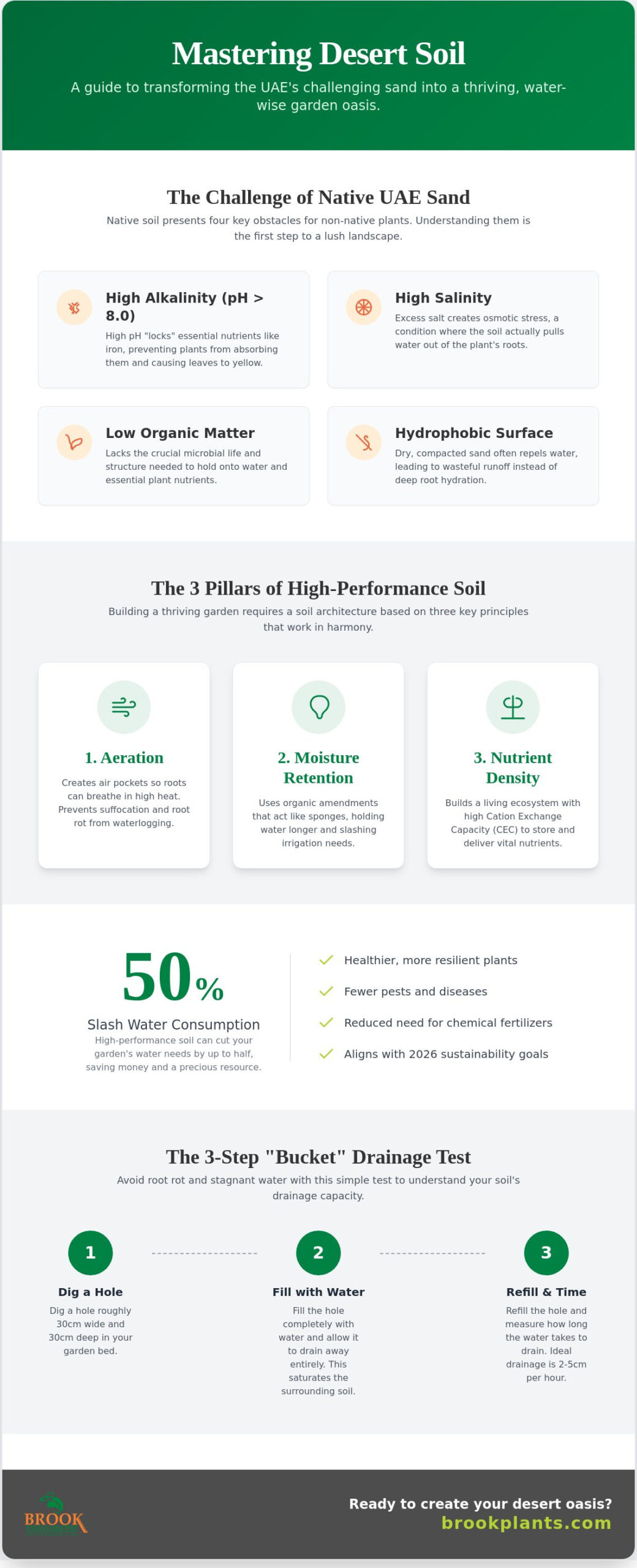
The ground beneath our feet in the UAE is a marvel of resilience, but for a traditional garden, it presents a formidable set of challenges. Most of our native sand is characterized by high alkalinity, almost non-existent organic matter, and a surprising level of salinity. It’s not just that the sand is dry; it’s often chemically hostile to non-native root systems. When you’re choosing the right soil for desert gardening, you aren’t just buying dirt. You’re actually investing in a biological bridge that allows life to take hold in an environment that often lacks the microbial diversity found in temperate climates. Without these tiny organisms, plants simply can’t process the nutrients they need to survive the summer.
Many gardeners are surprised to find that desert sand can be hydrophobic. Instead of soaking in, water often beads on the surface or creates narrow channels that drain away before the roots can take a single sip. By choosing the right soil for desert gardening, you’re essentially engineering a micro-environment that defies these harsh external conditions. This process ensures that your garden becomes a self-sustaining ecosystem rather than a constant struggle against the elements.
To better understand how different soil components affect plant health, watch this helpful video:
Xeriscaping soil is a medium designed to balance rapid drainage with deep-root hydration.
The Problem with Alkalinity and pH Balance
In our region, soil pH levels frequently climb above 8.0, which creates a chemical “lock” on essential micronutrients. Even if you add fertilizer, a high pH prevents roots from absorbing iron and manganese, leading to the yellowing leaves we see so often in local gardens. Beneath the surface, you might also encounter caliche, a stubborn hardpan layer of calcium carbonate that acts like natural concrete. We overcome this by introducing organic amendments that act as a pH buffer, gently lowering the alkalinity to a range where plants can finally breathe and feast.
Salinity: The Silent Plant Killer
Salinity remains one of the most misunderstood hurdles in the Emirates. High salt concentrations create osmotic stress, a condition where the soil actually pulls water out of the plant’s roots instead of providing it. While inland soils deal with mineral salts, coastal gardens face the added challenge of salt spray and saline groundwater. Modern Desert greening techniques often involve a process called leaching, where high-quality water is used to flush these salts deeper into the earth, away from the delicate root zone. Understanding these chemical realities is the first step toward a landscape that doesn’t just survive, but truly thrives.
The Three Pillars of High-Performance Desert Soil
To build a garden that truly thrives in the Emirates, we must look at soil as a living architecture rather than just a place to put plants. High-performance soil relies on three essential pillars that work in harmony to combat our intense climate. When you’re choosing the right soil for desert gardening, you’re essentially balancing the need for roots to breathe with the necessity of keeping them cool and fed. It’s a delicate dance between drainage and storage that requires a thoughtful approach to every ingredient you mix into the ground.
Pillar one is aeration. In high heat, roots consume oxygen at an accelerated rate; if the soil is too dense or waterlogged, they suffocate and rot. Pillar two is moisture retention, which involves using materials that act like tiny reservoirs to help plants survive the 45-degree midday sun. Finally, pillar three is nutrient density. This is about creating a self-sustaining ecosystem through organic matter. A key technical concept here is Cation Exchange Capacity, or CEC. Think of CEC as the soil’s magnetic ability to hold onto nutrients. Without a high CEC, your fertilizers simply wash away through the sand every time you water, leaving your plants hungry and stressed.
Scientific research on improving sandy soils shows that adding high-quality organic matter is the most effective way to boost this capacity and prevent nutrient leaching. By focusing on these three pillars, you ensure that every drop of water and every gram of nutrient is used to its fullest potential.
Aeration Tools: Perlite, Vermiculite, and Sand
While our desert is full of sand, it’s often too fine and wind-blown to provide long-term structure. We prefer coarse horticultural sand or crushed volcanic rock, which create permanent air pockets that don’t collapse over time. Perlite is another favorite, especially for those using premium planters, because it’s incredibly lightweight and prevents the soil from compacting into a brick-like mass after repeated watering cycles. Unlike native sand, these materials ensure that oxygen reaches the deepest roots even in the height of summer.
Retention Agents: Peat Moss vs. Coco Coir
To keep moisture where it belongs, we often choose between peat moss and coco coir. We’re particularly fond of coco coir because it’s a sustainable byproduct of the coconut industry and doesn’t become water-repellent when it dries out. These materials act as sponges, significantly reducing how often your automatic irrigation needs to run. If you’re starting with very dry soil, a natural wetting agent can help the water penetrate deep into these fibers rather than just sitting on the surface, ensuring choosing the right soil for desert gardening leads to a resilient, water-wise landscape.
Potting Mixes vs. Soil Amendments: Finding the Right Balance
One of the most frequent questions we hear from villa owners is whether they should replace their entire garden floor with imported soil or work with what they have. The answer depends entirely on the scale of your project. For localized features like vertical gardens or decorative planters, using a 100% premium potting mix is almost always the right move. These contained environments need a sterile, highly controlled medium to support intense growth in small spaces. However, when you’re choosing the right soil for desert gardening on a larger scale, importing massive quantities of topsoil can be both financially and environmentally costly.
Building your soil on-site is often a more sustainable path for extensive outdoor landscaping. By treating your native sand as a base mineral rather than a waste product, you can create a thriving ecosystem through strategic amendments. While a 50-liter bag of all-purpose potting soil typically costs between AED 34 and AED 36, filling a large landscape bed exclusively with this can drain your budget quickly. Instead, we recommend blending high-quality organic compost, which sits at a similar price point, directly into the native sand to improve its biological life and structure.
Be cautious of “budget” soil bags found in some local nurseries. These often contain high levels of uncomposted wood chips or “green” waste that hasn’t fully broken down. These fillers actually rob your plants of nitrogen as they decompose, leaving your garden looking pale and stunted. We pride ourselves on using only fully matured organic matter that enriches the earth immediately upon contact.
The Container Gardening Formula
In the UAE, container soil works much harder than ground soil because it’s exposed to heat from all sides. For indoor plants, we suggest a mix that is roughly 60% peat or coir and 40% perlite for maximum breathability. Outdoor succulents, however, need a grittier ratio to prevent root rot during the occasional humid winter weeks. Because the intense heat causes organic matter to break down faster, expect to refresh your container soil every 12 to 18 months. Always line your pots with geotextiles to prevent your precious soil from washing out through the drainage holes during watering cycles.
Amending the Earth: Softscape Strategies
For new garden beds, we often employ the “lasagna” method. This involves layering organic compost, sweet sand, and mulch over the native ground to create a rich, tiered environment. To give your plants a head start in barren areas, we recommend introducing mycorrhizal fungi. These beneficial organisms form a symbiotic relationship with roots, effectively extending their reach and helping them pull nutrients from the amended sand more efficiently. This biological boost is a cornerstone of choosing the right soil for desert gardening, ensuring your landscape becomes a living, breathing oasis rather than just a collection of plants in the sand.
How to Prepare and Amend Your Garden Soil Step-by-Step
Transforming a patch of dry sand into a lush sanctuary requires more than just a few bags of dirt; it’s a process of intentional preparation. When you’re choosing the right soil for desert gardening, the first step isn’t at the nursery, but in your own yard. Start with a simple drainage test. Dig a hole about 30cm deep and fill it with water. If the water vanishes in minutes, your sand is too porous; if it sits like a puddle for hours, you’ve likely hit a hardpan layer that needs breaking. This simple “bucket” method tells you exactly how much organic matter you’ll need to add to find that perfect balance.
Next, clear the area of any “sweet soil” that looks grey or dusty. This material is often construction-grade silt with high salinity that will only hinder your progress. Once the area is clean, it’s time to incorporate your life-giving amendments. We recommend mixing organic compost or treated manure to a depth of at least 30cm. This is the primary root zone for most garden plants. Adding a 50-liter bag of bio-organic compost, which typically costs around AED 35, provides the biological jumpstart your ground needs to support life. To combat the UAE’s natural salinity, mix in mineral gypsum; it helps flush out excess salts and prevents the soil from becoming a solid block. Finally, never leave your new soil naked. Apply a thick layer of mulch to act as a shield against UV sterilization, keeping the delicate microbes cool and active.
Ready to start your transformation? Explore our range of outdoor landscaping solutions to find the perfect foundation for your garden.
The Importance of Soil Solarization
If you’re starting your garden preparation during the peak of the UAE summer, you have a powerful ally: the heat. Soil solarization is a chemical-free way to kill off pathogens and weed seeds before you even plant. Simply moisten your prepared soil, cover it tightly with clear plastic sheeting, and let the sun bake it for four to six weeks. This process can raise soil temperatures to levels that naturally pasteurize the ground. It’s a traditional, eco-conscious method that sets the stage for a healthy growing season when the cooler weather arrives in September. Timing your preparation this way ensures you aren’t fighting nature, but working with its cycles.
Testing Your Progress
You don’t need a laboratory to monitor your garden’s health. A simple handheld pH meter can tell you if your amendments are successfully buffering the alkalinity. You can also observe your plants for indicators of soil health. If you notice new leaves turning yellow while the veins stay green, they’re likely suffering from iron chlorosis. This is a clear signal that your soil pH is still too high, locking out essential nutrients despite your best efforts. While DIY tests are a great start, a professional lab analysis every few years can provide a deep dive into your soil’s mineral balance, ensuring your landscape remains a thriving investment for years to come.
Long-Term Soil Health and Professional Maintenance Strategies
Think of your garden soil as the lungs of your landscape; it needs to breathe and circulate life to stay healthy. Choosing the right soil for desert gardening isn’t a one-time transaction, but the start of a long-term relationship with your land. In our harsh climate, the organic matter we add today will naturally break down and disappear over time due to the intense heat. This means we must view soil as a living entity that requires consistent, mindful replenishment to keep your plants thriving year after year. When soil health is integrated into your initial landscape design, it creates a foundation that actually gains value as the ecosystem matures.
A healthy soil profile does more than just feed plants; it protects your investment. High-quality soil with proper structure reduces the stress on your greenery, making them more resilient against the pests and diseases that often strike weakened gardens. By maintaining a rich, microbial environment, you’re following the principles of the 2023 National Framework for Sustainable Development, which encourages environmental protection and the promotion of a green economy. It’s about moving away from the “buy and replace” cycle and toward a garden that grows stronger with every season.
The Role of Automatic Irrigation
There’s a powerful synergy between your soil quality and the efficiency of your automatic irrigation system. When you’ve engineered your soil to hold moisture like a sponge, you can move away from frequent, shallow watering and toward “deep soak” patterns. This encourages roots to grow deeper into the cooler earth, where they’re protected from the surface heat. Research shows that smart irrigation systems can lead to water savings of 30% to 50% compared to basic timers, but these savings are only possible if the soil can actually retain the water delivered. Since DEWA uses a slab tariff system that penalizes heavy consumption, choosing the right soil for desert gardening is a critical financial decision that prevents your water bills from skyrocketing.
Sustainable Maintenance Cycles
To keep your soil’s nutrient levels optimal, we recommend a seasonal schedule for top-dressing with organic matter. The best time for this is from September to December, aligning with the UAE’s primary planting season. During this window, adding a fresh layer of compost or treated manure replenishes the “bank” of nutrients your plants used during the summer. We also suggest using slow-release fertilizers that work with our specific soil chemistry rather than harsh synthetic options that can increase salinity. This steady, natural approach ensures your garden remains a lush oasis without the need for constant chemical intervention. Ready to build a garden that lasts? Consult with our landscape design experts to start your journey toward a sustainable, thriving outdoor space.
Cultivating Your Own Desert Oasis
Turning a patch of barren sand into a lush sanctuary is a journey of understanding the life beneath your feet. By focusing on the three pillars of aeration, moisture retention, and nutrient density, you’ve taken the first step toward a garden that defies the heat. Choosing the right soil for desert gardening is about more than just a single afternoon of planting; it’s about engineering a sustainable, living environment that grows stronger with every passing season. When you pair high-quality organic amendments with precise water delivery, you create an oasis that truly belongs in our unique climate.
At Brook Plants & Landscaping LLC, we bring over 20 years of experience in UAE landscape execution to every project we touch. We’re specialists in sustainable, water-wise automatic irrigation and expert outdoor landscaping for residential and commercial gardens. Transform your landscape with Brook Plants & Landscaping LLC and experience the joy of a thriving, eco-conscious outdoor space. You have the knowledge and the tools to succeed; now it’s time to let your garden grow.
Frequently Asked Questions
Can I use regular potting soil for my outdoor desert garden in the UAE?
Regular potting soil isn’t ideal for large outdoor beds because it’s designed for containers and lacks the structural weight needed for ground landscaping. In the UAE heat, these lightweight mixes often dry out too quickly when exposed to the vast desert floor. Instead, use potting soil for your planters and focus on amending your native sand with organic compost for the main garden area to create a more resilient foundation.
How often should I add compost to my desert soil?
You should aim to replenish your soil with organic compost twice a year, ideally at the start and end of the cooler growing season. The intense summer heat accelerates the breakdown of organic matter, leaving the ground depleted of nutrients by September. A fresh application in early autumn and again in late spring ensures your plants have a steady supply of energy to survive the year’s harshest cycles.
What is the best soil for growing palms in the UAE?
Palms thrive in a sandy loam that offers exceptional drainage while still holding onto essential moisture. While they’re naturally hardy, they prefer a mix of roughly 50% sweet sand and 50% organic matter to establish deep, healthy root systems. This balance prevents water from pooling around the trunk, which can lead to rot, while providing the hydration needed for those iconic, lush green fronds.
Why does my soil feel like a brick after a few months?
Soil often turns brick-like due to heavy compaction and the buildup of mineral salts from hard tap water. When choosing the right soil for desert gardening, it’s vital to include aeration agents like perlite or coarse volcanic rock. These materials create permanent air pockets that prevent fine sand particles from settling into a solid, impenetrable mass that suffocates your plants’ roots and prevents water penetration.
Does the color of the sand indicate its quality for gardening?
Color is a helpful indicator, as red or yellow “sweet sand” typically contains more beneficial minerals and fewer salts than grey silt or coastal sand. However, color alone doesn’t tell the whole story of soil health. You must still evaluate the texture and drainage capacity to ensure the grains aren’t too fine, regardless of the shade, to support a thriving, oxygen-rich ecosystem for your garden.
How do I know if my soil has too much salt?
You can identify high salinity by looking for a white, crusty residue on the soil surface or noticing “burned” brown tips on your plant leaves. This osmotic stress prevents roots from drinking properly, even when the ground feels wet to the touch. If you see these signs, it’s time to flush the area with high-quality water to leach the salts deeper into the earth away from the root zone.
Is it better to buy soil in bulk or in bags for a villa garden?
Buying in bulk is significantly more cost-effective for large landscaping projects, while bagged soil is better suited for specific planters or indoor collections. A 50-liter bag of quality compost is perfect for refreshing a few pots, but a villa garden often requires several cubic meters of material to be effective. Choosing bulk deliveries allows you to blend amendments more precisely across your entire outdoor landscape.
Can I make my own desert potting mix at home?
You can absolutely create a high-performance mix at home by blending native materials with professional-grade amendments. A reliable recipe for choosing the right soil for desert gardening involves mixing 50% sweet sand with 20% coco coir, 20% organic compost, and 10% perlite. This homemade blend provides the perfect balance of drainage, nutrient density, and moisture retention for almost any UAE garden project you wish to undertake.
Disclaimer
The content on this blog may be automatically generated and is provided “as is” without warranties of any kind, express or implied. No guarantee is made regarding the accuracy, completeness, or suitability of the information. The company expressly disclaims any liability for decisions or actions taken based on this content.
As this blog post was generated using automated content‑creation tools. While our team reviews posts for accuracy and relevance, the information provided may not always reflect the most current developments. The content is intended for general informational purposes only and should not be taken as professional advice. Our company is not liable for any actions taken based on this material.