
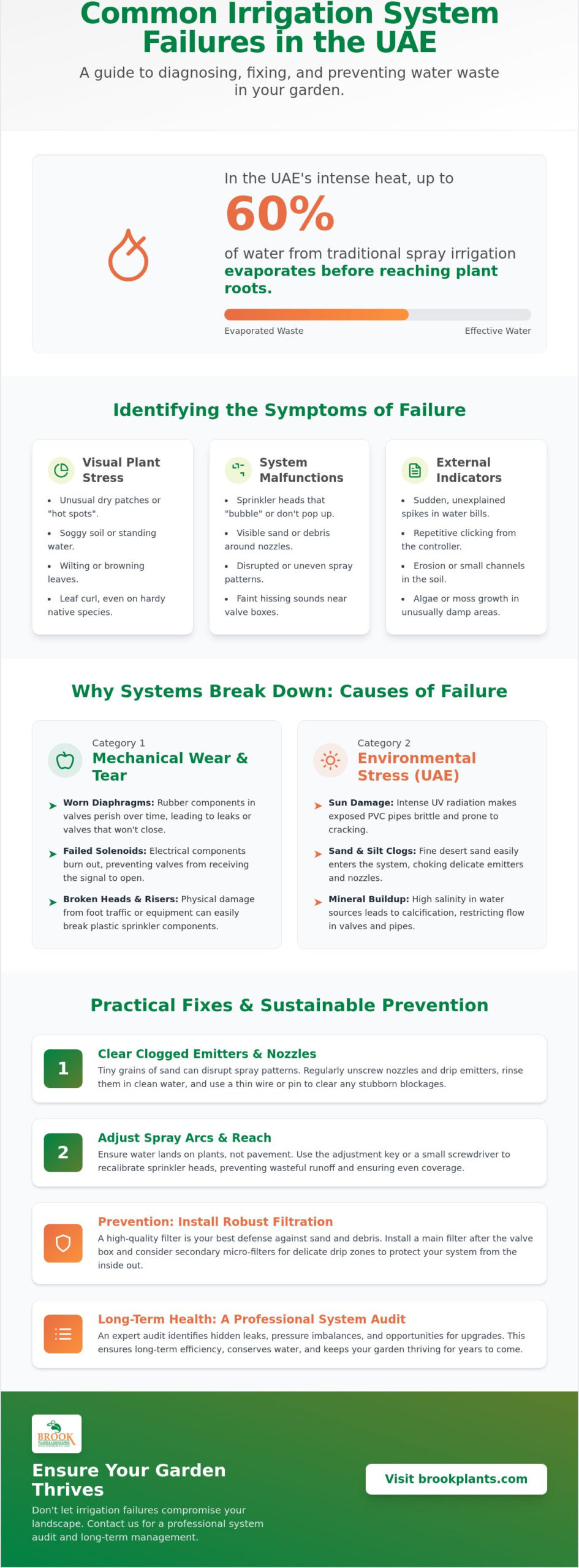
Did you know that in the intense heat of the UAE, nearly 60% of the water from traditional spray irrigation evaporates before it even reaches the roots of your plants? It’s a staggering figure that highlights why maintaining a lush garden in our arid climate often feels like a constant battle against the elements. You’ve likely felt the frustration of watching a beloved hibiscus wilt or seeing your water bill climb, suspecting that your equipment is working against you rather than for you. Understanding common irrigation system failures and fixes is the first step toward reclaiming your outdoor sanctuary and practicing true environmental stewardship.
We believe that a garden should be a source of peace, not a drain on your resources or the planet. You deserve a landscape that thrives through the summer months without wasting a single precious drop. In this guide, you’ll learn how to diagnose hidden leaks, clear stubborn sand from delicate emitters, and calibrate your system for maximum efficiency. We’ll walk through the practical steps to ensure your automatic irrigation remains a reliable partner in your gardening journey, helping you cultivate a healthy, vibrant landscape that honors the unique beauty of our desert home.
Key Takeaways
- Identify the early warning signs of distress, such as unusual dry patches or soggy soil, before they lead to plant loss or expensive water waste.
- Gain clarity on common irrigation system failures and fixes by distinguishing between natural mechanical wear and the environmental toll taken by the harsh UAE sun.
- Learn practical, step-by-step methods for clearing sand-clogged emitters and recalibrating spray arcs to keep your system running smoothly.
- Discover how seasonal adjustments and robust filtration can shield your delicate equipment from the desert’s extreme heat and dust.
- Explore the benefits of a thorough system audit to identify long-term improvements that ensure your garden’s health and water efficiency.
Identifying Symptoms of Irrigation Failure in Your Garden
A garden in the Emirates is a delicate sanctuary that requires constant vigilance to thrive against the desert’s heat. When things go wrong, the signs aren’t always immediate, but your plants will eventually tell a story of distress. Understanding common irrigation system failures and fixes begins with keen observation, turning you into a steward of your own green space. By catching these symptoms early, you protect your investment and the precious water resources we all share.
To help you visualize these challenges and begin your journey toward a more efficient garden, this tutorial offers a great starting point for troubleshooting:
One of the most obvious signs of a system in trouble is the appearance of “hot spots.” These are localized dry patches where the turf or groundcover begins to brown while the surrounding area stays lush. Conversely, if you notice soggy soil or standing water long after the timers have finished their cycle, you might be dealing with a weeping valve or a subsurface pipe leak. These issues often lead to a sudden, unexplained spike in your monthly utility bill, which is a clear signal that water is escaping somewhere it shouldn’t. If you’re looking for a comprehensive overview of irrigation methods to better understand how these components interact, it can provide valuable context for your diagnostic work. You should also watch for heads that “bubble” or barely lift, as this usually points to low pressure or sand-choked lines.
The Visual Cues of Thirsty Plants
Your plants are the best indicators of system health. Native species like Ghaf trees are hardy, but even they show stress through leaf curl or a duller grey-green hue. Imported tropicals will wilt visibly during the hottest part of the day. It’s vital to distinguish between temporary heat-induced dormancy, where a plant rests to survive the sun, and genuine thirst. A simple probe test, using a long screwdriver or a dedicated moisture meter, will tell you if the water is reaching the required root depth or simply evaporating on the surface.
Auditory and Physical System Warnings
Sometimes the system speaks to you before the plants do. If you stand near your valve box and hear a faint hissing sound, it often indicates a high-pressure leak at a fitting. A repetitive clicking sound from the controller without any water flow suggests an electrical issue with the solenoid. Diagnosing common irrigation system failures and fixes also requires a physical inspection of your hardware. In our environment, sand is a constant adversary. Look for visible sand accumulation around nozzle heads; even a tiny grain can disrupt a spray pattern, turning a cooling mist into a wasteful stream.
Mechanical vs. Environmental Failures: Why Systems Break Down
While we often view our gardens as soft, living spaces, the systems that sustain them are hardworking machines buried beneath the surface. Mechanical wear is an inevitable part of any system’s lifecycle. Diaphragms and solenoids act as the heart and nerves of your setup, opening and closing thousands of times each season. Over time, these components simply tire out. Understanding these common irrigation system failures and fixes allows you to anticipate these moments of fatigue before they threaten your plants. When a solenoid fails, the electrical signal to water is lost; when a diaphragm tears, a valve may stay open, leading to the soggy patches we discussed earlier.
In our unique environment, environmental stress often outpaces mechanical age. The relentless UAE sun is a powerful force that degrades even the toughest materials. Exposed PVC piping becomes brittle and prone to shattering; poly-pipes can lose their structural integrity under extreme thermal expansion. Then there is the water itself. High salinity and mineral content in many local sources lead to calcification. This crusty buildup slowly chokes valves and nozzles, turning an efficient system into a struggling one. Maintaining a resilient garden requires a deep understanding of common irrigation system failures and fixes, especially when sand and heat are your primary opponents.
The Impact of Extreme Heat on Electronics
Irrigation controllers are the brains of the operation, but they don’t enjoy the heat any more than we do. When mounted in unshaded outdoor spots, internal circuits can bake. Wiring insulation often cracks under the intense UV rays, leading to short circuits that are frustrating to trace. Moving your controller to a shaded area or investing in smart controllers with robust thermal protection can prevent this heat-related burnout. These modern units often feature weather-sealed housings that protect delicate components from both the soaring temperatures and the humidity of the coastal regions.
Sand and Soil: The Clogging Challenge
Sand ingress is perhaps the most persistent challenge for desert gardeners. Our fine desert sand has a way of bypassing standard residential filters. It finds its way into micro-drip emitters where it acts like a tiny, permanent plug. Beyond clogging, the very earth itself is in motion. Shifting sands put immense pressure on buried lateral lines and joints, causing them to pull apart over time. For those using subsurface drip, root intrusion is another quiet threat as plants seek out the nearest moisture source. Integrating high-quality automatic irrigation systems designed specifically for these conditions is a vital step in ensuring your landscape’s long-term health.
Step-by-Step Diagnostic: Fixing Common Sprinkler and Drip Failures
There’s a quiet satisfaction in rolling up your sleeves and restoring the life-giving flow to your garden. When you approach common irrigation system failures and fixes with a bit of patience and the right knowledge, you’re doing more than just repairing a pipe; you’re nurturing an ecosystem. Let’s walk through a systematic diagnostic flow that will help you pinpoint and resolve issues with the precision of a seasoned craftsman. Taking this hands-on approach ensures your landscape remains a resilient sanctuary even during the peak of the UAE summer.
- Step 1: Clean or replace clogged nozzles. In our sandy environment, nozzles are often the first to fail. Use a fine needle or a soft brush to clear the orifice of any grit. If mineral buildup from local water is too stubborn, replacing the nozzle is a small cost for a big gain in efficiency.
- Step 2: Adjust the spray arc and radius. Don’t water the pavement. Use a small screwdriver to adjust the radius on your heads, ensuring every drop lands on the soil where it’s needed most.
- Step 3: Flush the lines. Open the end caps of your drip lines or remove the last head in a zone. Run the water for about 60 seconds to push out the fine silt that naturally settles in the low points of your system.
- Step 4: Replace a faulty solenoid or diaphragm. If a zone won’t turn off, the rubber diaphragm is likely torn. If it won’t turn on, the electrical solenoid might be burnt out. These are simple “unscrew and replace” tasks that don’t require heavy tools.
- Step 5: Test the system zone-by-zone. Walk the garden while the system is live. Look for uniform coverage and ensure no plants are being shielded by newer growth or garden furniture.
How to Repair a Punctured Drip Line
Locating a leak in a drip system doesn’t have to mean digging up the entire garden. Look for an unusually green patch of weeds or a “geyser” of water during the run cycle. Once found, use a sharp pair of cutters to remove the damaged section. For small punctures, “goof plugs” work wonders, while larger cuts require a simple barbed coupler for a permanent, watertight fix. Always ensure the line is re-buried at a depth of 5 to 10 centimeters. This protects the poly-pipe from the sun’s UV rays and accidental damage from garden tools.
Replacing Broken Sprinkler Heads
Selecting the right head is vital for maintaining balance. Use pop-ups for turf areas and rotors for larger shrub beds where a longer throw is required. The “unscrew and replace” method is straightforward for most residential setups; just be sure to keep dirt out of the vertical pipe while the head is off. It’s essential to set the head height flush with the soil level. A head that sits too high is a magnet for lawnmower blades, while one too low will eventually be swallowed by thatch and sand. Mastering these common irrigation system failures and fixes keeps your garden’s heart beating steadily all year round.
Sustainable Prevention: Shielding Your System from the Elements
True gardening mastery in the United Arab Emirates isn’t just about fixing what breaks; it’s about creating a landscape that works in harmony with its environment. While we’ve discussed common irrigation system failures and fixes in earlier sections, the most sustainable approach is prevention. Shielding your hardware from the relentless sun and shifting sands ensures that your garden remains a sanctuary rather than a source of stress. By implementing a few proactive measures, you can extend the life of your equipment and significantly reduce your water footprint.
Seasonal adjustments are the cornerstone of this proactive care. As temperatures climb, water consumption in Dubai typically rises by 18 to 20 percent. Simply leaving your timers on a winter setting during the peak of July is a recipe for plant loss. Conversely, over-watering in the cooler months can lead to fungal issues and root rot. Pressure regulation is another vital factor. If you see a fine mist instead of distinct droplets, your pressure is too high. This leads to massive evaporation losses and puts unnecessary strain on your pipes, potentially causing the very bursts we want to avoid. Adding a layer of organic mulch further supports your system by acting as a biological shield, keeping the soil cool and reducing the frequency your system needs to run.
Advanced Filtration Strategies
In a desert environment, your filtration system is your first line of defense. Standard residential screen filters often struggle with the fine silt found in local groundwater. Upgrading to disc filters provides a more robust solution for sand management. A disc filter acts as a secondary barrier against fine silt, using a series of stacked, grooved discs to trap particles that would otherwise clog your emitters. For larger estates, self-flushing filters offer a hands-off approach to maintaining water quality, ensuring that mineral buildup and debris are purged before they reach your delicate plants.
Water-Wise Programming
Smart programming transforms a basic setup into a sophisticated life-support system. Instead of one long watering session, try the “cycle and soak” method. This involves running the water for shorter periods with breaks in between, allowing the moisture to penetrate the sandy soil deeply rather than running off. Even in our arid climate, rain sensors are a wise investment; they prevent the system from running during those rare but intense downpours, honoring the natural cycle. If you’re looking to expand your green space, choosing the right source is essential. Our indoor plant wholesale uae guide provides professional insights into selecting resilient species that pair beautifully with a well-planned irrigation strategy. To ensure your landscape is equipped with the best technology, consider exploring our range of automatic irrigation solutions designed for desert resilience.
Professional Management for Long-Term Landscape Health
While the satisfaction of a successful DIY repair is undeniable, there comes a point in every garden’s lifecycle where a more holistic approach is required. As your landscape matures, the root systems of larger trees can shift buried lines, and older components may reach the end of their functional life. Identifying common irrigation system failures and fixes is a vital skill for any homeowner, but for larger estates or complex commercial green spaces, professional stewardship ensures that these issues are caught before they escalate into catastrophic losses. A comprehensive system audit is especially valuable for older properties, as it can uncover hidden inefficiencies like root-crushed pipes or outdated controllers that lack modern water-saving features.
High-quality greenery represents a significant investment in both time and resources. When you’ve carefully selected species to enhance your outdoor landscaping, the stakes are high. A single missed watering cycle during the peak of a UAE summer can undo years of growth, particularly for delicate or newly planted specimens. Integrating a professionally designed system from the start ensures that your automatic irrigation is a foundational element of your garden’s architecture rather than an afterthought. This expert level of care transforms a simple watering setup into a resilient life-support system that honors the natural world while protecting your investment.
The Benefits of Recurring Maintenance
Consistency is the secret to a thriving desert garden. Monthly checks are about more than just looking for leaks; they’re about predictive care. By inspecting diaphragms and solenoids before they fail, you prevent the sudden dry patches that lead to plant stress. These regular assessments allow for the fine-tuning of spray arcs as your plants grow and change shape, ensuring that water always reaches the root zone. This proactive rhythm keeps your garden in a state of constant health, maintaining it as a lush, sustainable sanctuary regardless of the soaring external temperatures.
Partnering with Brook Plants & Landscaping LLC
We approach irrigation with the heart of a craftsman and the precision of an expert. Our team understands that a garden is a living, breathing entity that deserves a custom solution tailored to its specific needs. Whether you’re managing a small residential retreat or a sprawling commercial project, we bring an earthy, authentic passion to every design and execution. We pride ourselves on creating systems that are as efficient as they are reliable, moving beyond basic common irrigation system failures and fixes to provide true long-term vitality. Request a consultation for your irrigation system today.
Nurturing Your Oasis with Confidence and Care
Caring for a landscape in the UAE is a journey of partnership with the natural world. By mastering the common irrigation system failures and fixes we’ve explored, you’ve taken a significant step toward becoming a true steward of your environment. You now possess the tools to spot early signs of distress, manage the persistent challenge of desert sand, and implement the seasonal shifts that keep your water usage efficient and your plants thriving. This knowledge transforms maintenance from a chore into a meaningful act of preservation.
At Brook Plants & Landscaping LLC, we’ve spent over two decades since our founding in 2004 perfecting the art of water-wise landscape execution. Our team brings a deep, earthy passion to every project, offering comprehensive design and support for both residential and commercial projects. We believe that every garden deserves expert stewardship to remain a lush, sustainable sanctuary. Whether you’re planning a new green space or revitalizing an older property, we’re here to act as your trusted mentor in the garden. Explore our professional irrigation and maintenance services to see how our local expertise can protect your living investment. Your garden is a vibrant legacy; let’s ensure it flourishes for years to come.
Frequently Asked Questions
Why is my irrigation controller screen blank or unresponsive?
A blank screen usually indicates a power surge or a failed transformer, which is common after local electrical fluctuations. You should check your circuit breaker first, then inspect the internal fuse or the backup battery. If the unit was mounted in an unshaded outdoor spot, internal heat-related burnout might have occurred, requiring a replacement with a more robust, weather-sealed model that can withstand our intense summer temperatures.
How often should I clean my irrigation filters in the UAE?
You should clean your filters at least once a month, though bi-weekly checks are much better during the dusty summer season. Because our fine desert sand easily bypasses many standard screens, frequent rinsing prevents silt from reaching your delicate emitters. Regular maintenance is a cornerstone of managing common irrigation system failures and fixes, ensuring your garden’s life-support system remains clear and efficient through every sandstorm.
Can I use greywater for my home irrigation system safely?
Yes, using treated wastewater or Treated Sewage Effluent (TSE) is permitted and even encouraged by municipalities like Dubai to conserve our precious potable water. However, it must be used under controlled conditions to ensure it’s safe for both your family and your specific plant species. Using TSE is a beautiful way to practice environmental stewardship in a region where water is one of our most finite and valued resources.
What is the best time of day to run my sprinklers in the summer?
The ideal time to irrigate is between 10:00 PM and 5:00 AM when temperatures are lower and winds are typically calm. Since 60% of water from spray irrigation can evaporate before reaching the soil during the day, night-time cycles ensure every drop actually nourishes the roots. This timing also reduces the risk of leaf burn and fungal growth that often occurs when water sits on foliage in the midday heat.
Why do my sprinkler heads stay up even after the water is turned off?
This usually happens because fine sand or grit has become lodged between the pop-up riser and the outer body of the head. The resulting friction prevents the internal spring from pulling the riser back down into its protected housing. Cleaning the riser with fresh water or replacing a fatigued internal spring often solves this, preventing accidental lawnmower damage and keeping your garden’s aesthetic lines clean and tidy.
How much water does a typical UAE villa garden require daily?
While needs vary by size, your landscape’s demand peaks during the summer when water consumption in Dubai typically rises by 18 to 20 percent. Residents in the UAE consume an average of 550 liters per person daily, which is more than double the global average. Calibrating your system to deliver exactly what your plants need prevents waste and keeps your utility bills manageable under the DEWA slab tariff system.
Is it better to have a drip system or sprinklers for desert plants?
Drip irrigation is almost always the superior choice for desert landscapes because it can reduce water consumption by up to 50% compared to sprinkler systems. By delivering water directly to the root zone, you minimize evaporation and discourage the growth of thirsty weeds. For those navigating common irrigation system failures and fixes, transitioning to drip represents a modern, eco-conscious commitment to a sustainable and thriving garden.
Can sand ingress permanently damage my irrigation pump?
Yes, sand is highly abrasive and can quickly erode the internal impellers of your pump, leading to a permanent loss of pressure or total mechanical failure. Without proper suction-side filtration, fine silt acts like sandpaper on the pump’s moving parts. Protecting your pump with a high-quality disc filter is a vital investment in the long-term health and reliability of your entire outdoor landscaping infrastructure.
Disclaimer
The content on this blog may be automatically generated and is provided “as is” without warranties of any kind, express or implied. No guarantee is made regarding the accuracy, completeness, or suitability of the information. The company expressly disclaims any liability for decisions or actions taken based on this content.
As this blog post was generated using automated content‑creation tools. While our team reviews posts for accuracy and relevance, the information provided may not always reflect the most current developments. The content is intended for general informational purposes only and should not be taken as professional advice. Our company is not liable for any actions taken based on this material.