
Why do so many public benches and planters in Dubai look like they have aged decades after only two summers in the sun? It is a common sight to see once-vibrant materials succumb to the “Triple-Threat” of intense UV radiation, high humidity, and extreme thermal expansion. Finding truly durable street furniture for UAE climate requires more than just picking a catalog item; it demands an understanding of how materials like 316 stainless steel and sustainable hardwoods interact with our unique environment. We know how frustrating it is when a project loses its structural integrity due to salt-spray corrosion or warping, especially as we adapt to the strict requirements of Dubai Law No. (3) of 2026.
In this guide, we’ll show you how to identify pieces that will last over ten years while maintaining their aesthetic soul. You’ll discover the essential material science behind UAE-grade furniture and how to navigate the Al Sa’fat 2.0 Silver certification standards. We will also dive into the importance of the new Sustainable Materials Passport, ensuring your public spaces are as environmentally responsible as they are resilient. Whether you’re planning a coastal promenade or a shaded park, this journey from the “why” to the “how” will help you create spaces that thrive for generations.
Key Takeaways
- Master the science of material resilience by understanding how the UAE’s intense heat and UV radiation affect molecular bonds over time.
- Compare high-performance materials like marine-grade 316 stainless steel and Grade A Teak to choose the most durable street furniture for UAE climate.
- Explore how to harmonize street furniture with automatic irrigation and landscaping to create a cooling, sustainable oasis in dense urban areas.
- Establish a proactive care cycle that guards against corrosive salinity and abrasive sand to keep your public spaces looking pristine for a decade or more.
- Align your projects with the latest 2026 sustainability standards by choosing pieces crafted with an ecological soul and documented material integrity.
Understanding the Triple-Threat: Why UAE Weather Destroys Standard Furniture
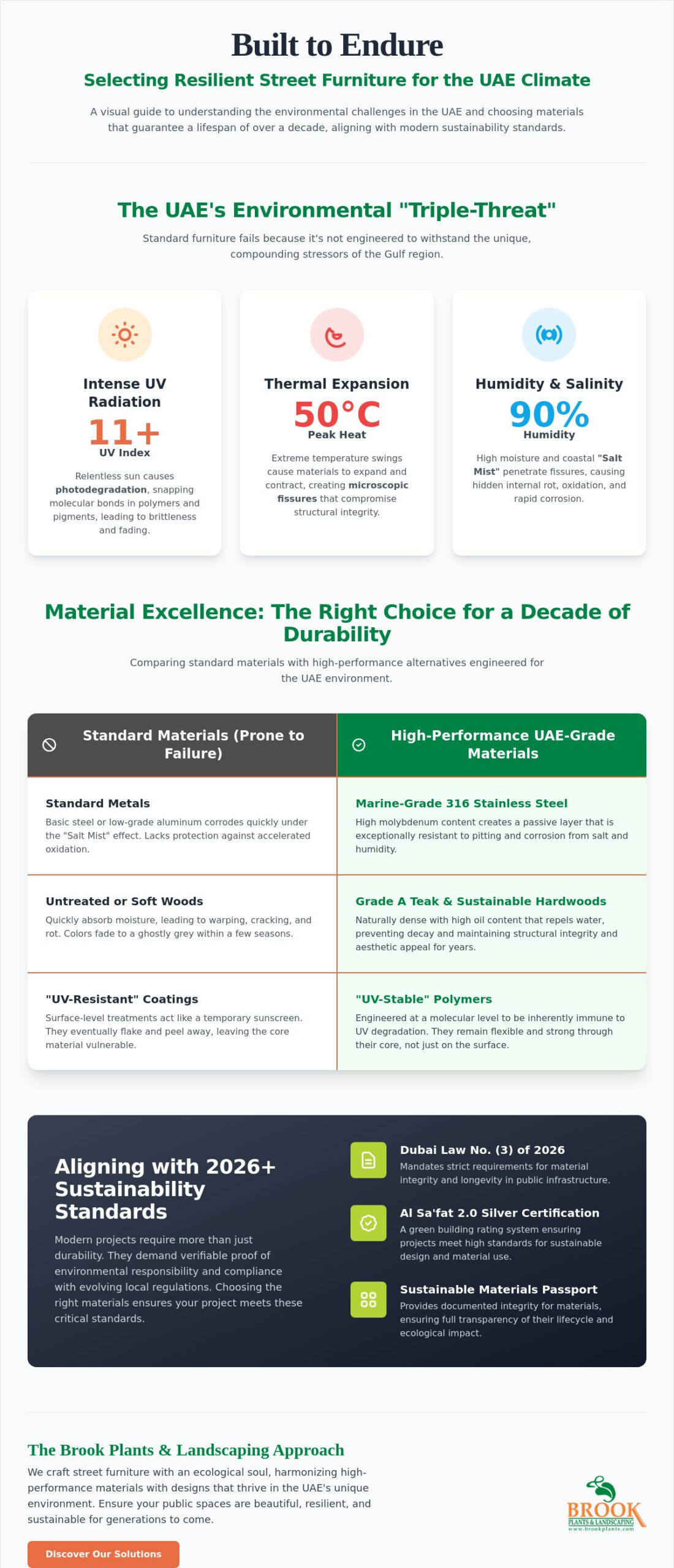
The UAE sun is more than a source of light; it’s a powerful force that tests the very soul of our outdoor spaces. While standard Street furniture might thrive in temperate climates, it often fails here within a single season. This failure happens because our environment presents a “Triple-Threat”: the compounding synergy of 50°C heat, 90% humidity, and extreme UV radiation. When temperatures soar, materials expand at the molecular level, creating microscopic fissures. Humidity then drives moisture and salt deep into these openings, leading to internal rot or oxidation that remains hidden until the structure fails. Choosing durable street furniture for UAE climate requires a deep respect for these invisible stressors.
To see how these environmental challenges are met with high-end design and material selection, watch this look at exclusive outdoor collections:
Most international durability ratings are designed for climates where the UV index rarely exceeds 6 or 7. In the Emirates, we regularly face a UV index of 11 or higher. This intensity means that standard materials simply aren’t equipped for the job. True resilience isn’t just about a thick coat of paint; it’s about selecting materials that are fundamentally stable under the most aggressive conditions. We’ve seen many projects struggle because they relied on international standards that don’t account for the unique salinity and thermal cycles of the Arabian Gulf.
The Science of UV Degradation
The relentless sun does more than just fade colors. High-index UV rays act as a catalyst for photodegradation, a process that snaps the chemical bonds in polymers and pigments. You’ve likely seen plastic benches become brittle or vibrant wood turn a ghostly grey. This is why we distinguish between “UV resistant” coatings, which act like a temporary sunscreen, and “UV stable” materials that are engineered to remain flexible and strong through the core. Surface-level treatments eventually flake away, leaving the material beneath vulnerable to the elements.
Humidity and Coastal Salinity
Coastal regions in the UAE face the “Salt Mist” effect, where fine droplets of saline water hang in the air, settling on every surface. For non-marine grade metals, this is a death sentence, as salt accelerates oxidation at an alarming rate. Non-porous materials are essential here to prevent salt from nesting within the furniture’s structure. Designs that allow moisture to pool in hidden joints create a breeding ground for internal structural failure, as trapped water expands and contracts with the daily heat cycle. Finding truly durable street furniture for UAE climate means choosing designs that breathe and shed water naturally while resisting the corrosive touch of the sea.
Material Excellence: Comparing the Most Durable Options for 2026
Choosing the right materials is the foundation of any lasting public space. In our experience as craftsmen, we’ve learned that durability isn’t just about strength; it’s about how a material breathes and moves within its environment. When selecting durable street furniture for UAE climate, we must look beyond basic weatherproofing. We look for materials that can handle the silent stress of thermal expansion, where temperatures swing enough to cause different substances to pull apart at the seams. For 2026, the industry has shifted toward high-performance alloys and bio-composites that respect both the planet and the harsh local elements.
Metals: Beyond Simple Rust Resistance
While many projects specify aluminium for its weight, we often recommend marine-grade 316 stainless steel for coastal and high-traffic urban areas. The high molybdenum content in 316 steel provides a vital defense against the pitting corrosion caused by our saline air. If you choose aluminium, the powder-coating thickness is non-negotiable. For the Emirates, coatings must meet a minimum of 60 to 80 microns to ensure a deep, protective bond that won’t flake under 50°C heat. We also consider thermal conductivity; lighter-colored finishes and specific alloy blends help ensure that benches and rails don’t become too hot for a child’s hand during the peak of July.
Sustainable Woods and Bio-Composites
There is a unique warmth in wood that metal simply cannot replicate. However, “soft woods” like pine or cedar are a liability here, as they dry out and splinter within months. We prefer FSC-certified Grade A Teak because its exceptionally high natural oil density acts as a built-in shield against moisture and UV rays. For projects requiring a more modern, low-maintenance approach, high-quality wood-plastic composites (WPC) have evolved significantly. These bio-composites are now engineered with higher thermal stability to prevent the sagging and warping that plagued earlier versions. If you are looking to integrate these resilient materials into a broader vision, our team at Brook Plants can help you select the right textures for your specific microclimate.
Modern urban design is also embracing Ultra-High-Performance Concrete (UHPC) and Glass Reinforced Plastic (GRP). UHPC is nearly impermeable, making it an incredible choice for permanent installations that need to resist both heavy use and salt absorption. GRP allows for fluid, organic shapes that mirror the natural world while remaining entirely immune to rot and corrosion. By balancing these advanced materials with traditional craftsmanship, we create street furniture that doesn’t just survive the desert; it matures beautifully within it.
Designing for Density: Street Furniture for High-Traffic Urban Environments
Urban density in cities like Dubai and Abu Dhabi requires a shift from decorative pieces to high-performance infrastructure. In these bustling hubs, durable street furniture for UAE climate must serve as a bridge between hardscaping and the natural world. Designing for these environments means considering how a bench or a planter interacts with thousands of daily users while standing firm against the relentless Shamal winds. We believe that public furniture should feel like a natural extension of the landscape, combining rugged vandal-resistance with an inviting, earthy aesthetic that encourages community connection.
One of the most critical factors in public realm design is the “cool-touch” requirement. In a climate where ambient temperatures regularly exceed 40°C, a poorly chosen metal bench can quickly become a liability rather than an asset. We solve this by pairing thermally stable materials like GRP or Grade A Teak with ergonomic designs that promote natural airflow. By utilizing slatted surfaces rather than solid blocks, we allow heat to dissipate rapidly, ensuring that public plazas remain welcoming even during the warmer parts of the day. This functional beauty is what distinguishes expert craftsmanship from mere production.
Integrated Planters and Green Seating
Planters are the lungs of the city, but they face unique challenges in high-humidity urban zones where moisture can easily become trapped. To ensure both the longevity of the vessel and the health of the greenery, we focus on sophisticated internal drainage systems that prevent water-logging. When we design custom street furniture, we often integrate automatic irrigation lines directly into the structure. This synergy ensures that plants thrive without constant manual intervention, while high-performance moisture-barrier liners protect the furniture’s internal structural integrity from the constant humidity.
Heavy-Duty Benches and Public Rest Areas
In open urban plazas, weight and anchoring are just as important as material choice. Seasonal sandstorms and high-velocity winds can exert significant pressure on unanchored items, which is why we utilize deep-bolt anchoring systems or high-density UHPC bases that provide a literal anchor for the community. Modular designs are particularly effective for scalable urban projects, allowing for flexible configurations that can grow alongside the surrounding landscape. These pieces are crafted to be modular yet feel permanent, providing a reliable sanctuary for pedestrians. If you are looking to enhance your public realm with these specialized designs, our team at Brook Plants can guide you through the intersection of craftsmanship and urban resilience.
Preservation Strategies: Ensuring Decades of Use in Harsh Conditions
Investing in the highest quality materials is only half the battle. Even the most resilient durable street furniture for UAE climate requires a rhythmic, proactive care cycle to reach its full ten-year potential. In our years as craftsmen, we’ve seen that the difference between furniture that gracefully patinas and furniture that fails often comes down to how well it’s shielded from the abrasive nature of our environment. Sand acts like high-grit sandpaper in the wind, while salt deposits from the coastal air create a corrosive film that can eat through even the best finishes if left undisturbed. We believe that caring for these pieces is an act of stewardship for the public spaces they inhabit.
When considering the lifecycle of your installation, it’s often more sustainable and cost-effective to invest in professional restoration rather than total replacement. High-quality materials like 316 stainless steel or Grade A Teak are designed to be refurbished. A deep cleaning and a fresh application of protective finishes can breathe new life into a weathered bench, honoring the original craft while meeting the lifecycle requirements of Dubai Law No. (3) of 2026. If you’re ready to select pieces built for this long-term journey, you can explore our full range of handcrafted street furniture designed specifically for the Emirates.
The Professional Maintenance Schedule
A quarterly inspection is the heartbeat of a successful preservation strategy. During these checks, we look for joint stability and structural integrity, as the intense thermal expansion mentioned in earlier sections can occasionally loosen fixings over time. Cleaning protocols should focus on using pH-neutral solutions that lift corrosive salt and fine dust without stripping the essential UV-stable coatings. It’s vital to re-apply high-quality protective oils to timber surfaces in the spring before the peak summer heat begins to draw out the natural moisture. This simple act of preparation ensures the wood remains supple and resistant to splintering when the temperatures climb toward 50°C.
Protection Through Design
Strategic placement is one of the most effective ways to extend the life of urban furniture. By utilizing large shade structure umbrellas, you can mitigate the direct UV impact by up to 90%, significantly slowing the photodegradation of pigments and polymers. We also advise designers to consider the proximity of furniture to automatic irrigation heads. Frequent overspray from irrigation systems can lead to mineral buildup and localized moisture-trapping, which eventually damages even the toughest finishes. By placing seating relative to prevailing winds and ensuring they’re shielded from direct water contact, you create a microclimate where your furniture can truly thrive for decades.
- Quarterly Inspections: Check for bolt tightness and surface pitting.
- Salt Removal: Rinse surfaces with fresh water after sandstorms or high-humidity weeks.
- Shade Integration: Use umbrellas to reduce surface temperatures and UV exposure.
- Oil Maintenance: Treat hardwoods annually to maintain internal density.
The Brook Plants Approach: Crafted Street Furniture with an Ecological Soul
At Brook Plants & Landscaping, we don’t see ourselves as just another supplier; we’re dedicated craftsmen who care deeply about the lifecycle of every piece we produce. We believe that durable street furniture for UAE climate should be more than just functional infrastructure. It should be a reflection of the natural world, built with a patience and care that honors the harsh environment it serves. Our approach is rooted in the belief that true quality comes from internal cultivation. This means we understand the origins and the resilience of every material we use, from the dense grain of our sustainable hardwoods to the micron-level finish of our marine-grade alloys.
We present ourselves as primary producers rather than intermediaries, and this distinction is central to our identity. By maintaining control over the production process, we ensure that every planter, bench, and shade structure meets our rigorous ecological standards. This hands-on expertise allows us to act as a trusted mentor to our clients, moving seamlessly from the “why” of material science to the “how” of practical urban installation. Our goal is to inspire confidence through a shared love for the natural world, creating public spaces that feel both expert and accessible.
From Concept to Handover
Having a single partner for your outdoor landscaping and furniture needs ensures a level of harmony that fragmented projects often lack. We manage the entire journey, ensuring that your street furniture integrates perfectly with the surrounding softscape. This means matching the aesthetic of your custom planters with the specific textures of your chosen flora, while ensuring that automatic irrigation systems are seamlessly hidden yet fully functional. Our national reach allows us to deliver these durable urban solutions across the Emirates, maintaining a consistent standard of excellence from the first sketch to the final placement on site.
Sustainability as a Moral Anchor
For our team, sustainability is not a marketing buzzword; it’s our moral anchor and a brand signature. We focus on authentic material sourcing and internal production to distinguish our work from mass-produced resellers who often lack a deep understanding of local environmental stressors. Choosing durable street furniture for UAE climate is, in itself, the ultimate sustainable practice. When a bench or planter lasts for over a decade rather than needing replacement every few years, we’re actively reducing waste and respecting the planet’s resources. This long-term vision drives us to create pieces with an ecological soul, ensuring the UAE’s urban environments remain healthy and vibrant for generations.
If you’re ready to transform your public realm with pieces that balance aesthetic beauty with rugged resilience, we invite you to start a conversation with us. Enquire about our custom street furniture and landscaping services to see how we can bring your vision to life with craftsman quality and environmental stewardship.
Cultivating Resilient Public Spaces for the Future
Creating a public realm that stands the test of time requires a deep respect for the elements and a commitment to quality craftsmanship. We’ve explored how the intersection of material science and thoughtful design can overcome the UAE’s environmental challenges. By prioritizing marine-grade alloys and sustainable hardwoods, you ensure your investment remains a beautiful, functional part of the landscape. True success happens when we marry these durable street furniture for UAE climate choices with smart design principles and proactive care cycles.
Since 2004, we’ve brought this earthy passion to every project, blending decades of local expertise with a unique ability to integrate hardscape and softscape elements. Our national coverage across the Emirates ensures that this craftsman’s touch is available for every community project. We invite you to consult with our experts for your next landscaping and street furniture project. Together, we can build urban environments that aren’t just resilient, but truly soulful and welcoming. Let’s work together to nurture a more sustainable and durable future for our cities.
Frequently Asked Questions
What is the best wood for street furniture in the UAE climate?
Grade A Teak is widely considered the best wood for the Emirates because its exceptionally high natural oil density acts as a built-in shield against extreme heat and UV radiation. While other woods might splinter or warp under the 50°C sun, teak remains stable and develops a beautiful silver patina over time. We focus on FSC-certified sources to ensure that our furniture is as kind to the planet as it is resilient to the desert climate.
How often should street furniture be maintained in high-humidity areas?
We recommend a professional inspection and deep cleaning at least every three months to ensure the longevity of your installation. This quarterly cycle allows you to remove corrosive salt deposits and fine sand before they can damage protective finishes. In high-traffic or coastal areas, rinsing surfaces with fresh water after sandstorms is a simple but effective way to maintain the structural integrity of your durable street furniture for UAE climate.
Does powder-coated aluminium really last in the heat?
Powder-coated aluminium is remarkably durable in the heat, provided the coating meets the 60 to 80-micron thickness standard required for the Emirates. This finish creates a hard, non-porous barrier that resists fading and prevents the metal from oxidizing. It is also a fantastic choice for public seating because it doesn’t retain heat as intensely as untreated darker metals, keeping surfaces cooler for users during the peak summer months.
Can I use standard indoor furniture materials for a shaded outdoor area?
Standard indoor materials are generally not suitable for outdoor use, even in fully shaded areas, because they lack the molecular stability to handle our high humidity and ambient heat. Indirect UV rays and the “Salt Mist” effect can quickly degrade indoor fabrics, glues, and light-density woods. For a truly lasting result, it’s essential to use furniture specifically engineered for the outdoors, featuring marine-grade fixings and UV-stable polymers that won’t become brittle over time.
How do I prevent my outdoor planters from cracking in the summer?
To prevent planters from cracking in the summer heat, you should choose materials with low thermal expansion rates, such as Glass Reinforced Plastic (GRP) or Ultra-High-Performance Concrete (UHPC). These materials are designed to move slightly without fracturing when temperatures fluctuate. Additionally, ensuring your planters are integrated with automatic irrigation helps maintain consistent soil moisture, which prevents the internal pressure changes that often lead to structural stress and visible cracks.
What is the difference between Grade A and Grade C teak for durability?
The primary difference lies in the oil content and maturity of the wood, as Grade A teak is harvested from the heart of the tree and is rich in protective natural oils. Grade C is sapwood, which is much softer, lacks weather-resistant oils, and is prone to rot and insect damage in our climate. For permanent urban installations, Grade A is the only choice that provides the necessary density to survive a decade of exposure.
Are there specific regulations for street furniture in public UAE spaces?
Public spaces in the UAE are governed by strict quality and safety standards, including the new Dubai Law No. (3) of 2026 which mandates high building and maintenance quality throughout a project’s lifecycle. New projects must also comply with Al Sa’fat 2.0 Silver green building standards, which impact material selection and sustainability. These regulations ensure that all street furniture contributes to a safe, pedestrian-friendly, and environmentally conscious urban environment that aligns with the nation’s long-term goals.
How does salinity affect stainless steel furniture near the coast?
Salinity causes a phenomenon known as “tea staining” or pitting corrosion on lower grades of stainless steel, which is why marine-grade 316 steel is essential for coastal areas. The addition of molybdenum in 316 steel provides the necessary resistance to the chlorides found in our sea air. Without this specific alloy, even stainless steel will develop unsightly brown spots and structural weaknesses within just a few months of being placed near the Arabian Gulf.
Disclaimer
The content on this blog may be automatically generated and is provided “as is” without warranties of any kind, express or implied. No guarantee is made regarding the accuracy, completeness, or suitability of the information. The company expressly disclaims any liability for decisions or actions taken based on this content.
As this blog post was generated using automated content‑creation tools. While our team reviews posts for accuracy and relevance, the information provided may not always reflect the most current developments. The content is intended for general informational purposes only and should not be taken as professional advice. Our company is not liable for any actions taken based on this material.