
With Abu Dhabi climbing to 5th place in the 2025 IMD Smart City Index, the pressure is on for our urban environments to be as intelligent as they are inviting. We all know that creating a vibrant plaza is one thing, but making it withstand the relentless 2026 summer heat while meeting the strict new safety standards of Dubai Law No. 2 is a much tougher challenge. It’s frustrating to see architectural materials fail under extreme UV or to realize a decorative project actually hinders a person using a wheelchair. Effective public space street furniture design UAE requires a delicate balance between sensory appeal and rigorous functional engineering.
You’ll discover how to design inclusive, climate-resilient urban spaces using the latest 2026 UAE accessibility guidelines and sustainable furniture solutions that won’t buckle under the humidity. We’ll walk through the specific requirements of the Dubai Universal Design Code, explore why materials like upcycled palm biomass are changing the game, and share tips for keeping your streetscapes functional for every member of our community. It’s about moving from simple objects to creating a lush, welcoming ecosystem where everyone feels at home.
Key Takeaways
- Learn how to transform static urban areas into vibrant “social nooks” that act as the vital connective tissue of the modern UAE landscape.
- Identify high-performance materials like 316-grade stainless steel that excel in public space street furniture design UAE by resisting salt-air corrosion and extreme UV.
- Master the latest 2026 accessibility standards to create inclusive environments that provide both physical access and sensory comfort for People of Determination.
- Discover the art of “shadow path” mapping to strategically place seating and large shade structures for maximum thermal comfort during the peak summer months.
- Explore how pairing architectural street furniture with our “grown by us” botanical selections ensures a lush, resilient, and cooling effect for every pedestrian.
The Evolution of Public Space Street Furniture Design in the UAE
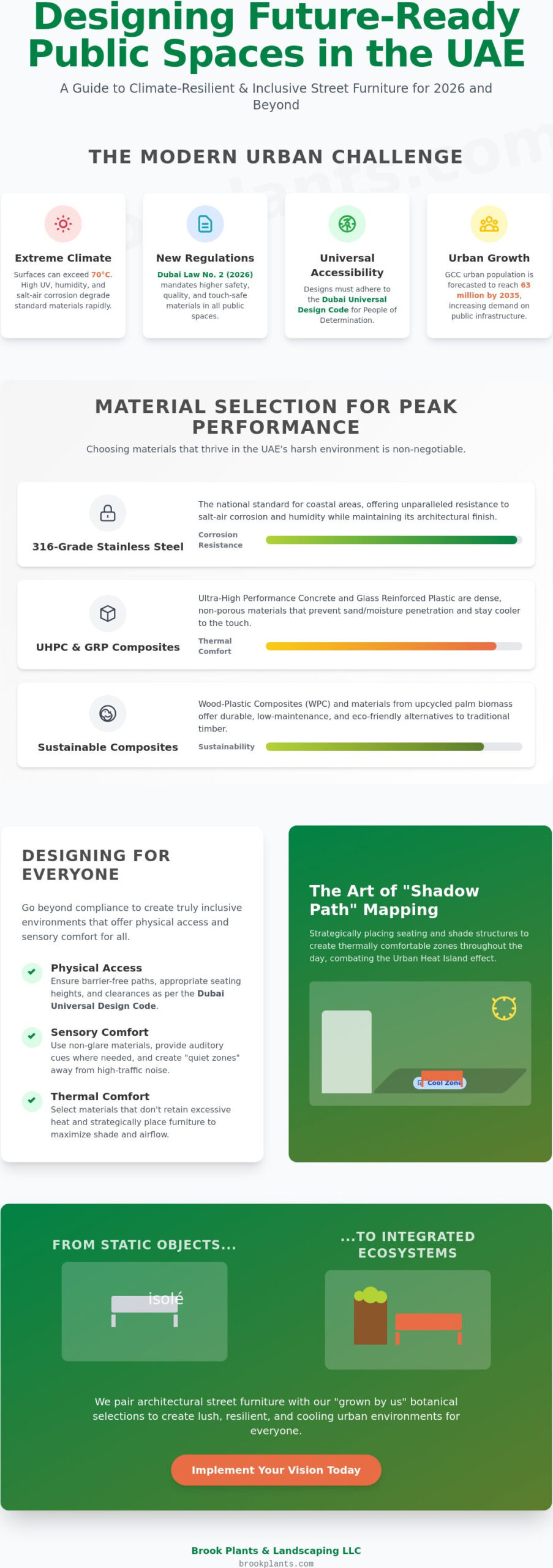
The way we experience our cities is changing at an incredible pace. Street furniture acts as the vital connective tissue of our urban fabric, binding together the spaces between buildings into a cohesive, living whole. In 2026, public space street furniture design UAE has moved far beyond simple benches and bins. With Dubai Law No. 2 of 2026 taking effect on June 1, the focus has shifted toward creating safe, high-quality environments that prioritize the person over the vehicle. As our urban population in the GCC is forecasted to reach 63 million by 2035, these spaces must work harder to provide genuine comfort and a sense of community.
Modern urban planning now tackles the “Urban Heat Island” effect through thoughtful, integrated placement. By pairing seating with large shade structures and lush, architectural greenery, we aren’t just decorating a sidewalk; we’re actively cooling the city. This approach is central to the Dubai Urban Plan 2040, which aims to double the size of our public parks and leisure areas. It ensures every resident has a breathable, vibrant space to call their own, even during the peak of summer. We’ve moved away from “ornamental objects” toward inclusive ecosystems that breathe life into the concrete.
From Transit Zones to Social Hubs
We’ve seen a beautiful shift from furniture that merely facilitates transit to designs that encourage us to linger. These “conversation nooks” are carefully crafted to turn a sidewalk into a social destination where neighbors can connect. When people stop to sit, they engage with their surroundings and local commerce. This increased foot traffic provides a measurable boost in economic activity for surrounding businesses. It’s no longer about solar poles that just charge phones; it’s about human-centric design that provides free Wi-Fi and sensory comfort, making our streets feel like a warm extension of our own homes.
The Aesthetic of the Modern UAE Streetscape
Finding the right balance between our rich heritage motifs and sleek, contemporary lines is an art form. We use architectural planters and seating to create a distinct “sense of place” in new developments, ensuring they don’t feel sterile or transactional. The psychological impact of “green” furniture is profound. Pairing a sturdy, hardy bench with a vibrant, “grown by us” botanical display softens the hard edges of the city. Gardener’s note: Choosing the right planter isn’t just about the aesthetic; it’s about ensuring the root systems have the space to thrive in our unique climate, creating a lush sanctuary that actually lowers the ambient temperature for the person sitting there.
Material Selection for Extreme Heat and Coastal Humidity
Selecting the right materials for public space street furniture design UAE isn’t just an aesthetic choice; it’s a battle against some of the harshest environmental conditions on the planet. By May 2026, data shows that standard materials often fail within eighteen months if they aren’t specifically rated for our UV levels and thermal expansion. In coastal areas, salt-air corrosion can eat through inferior metals in a single season. This is why 316-grade stainless steel has become the non-negotiable national standard for seaside developments. It offers the hardy resilience needed to withstand the humidity without losing its architectural luster.
Beyond metal, we’re seeing a surge in Ultra-High Performance Concrete (UHPC) and Glass Reinforced Plastic (GRP). These materials are incredibly dense, which prevents sand and moisture from penetrating the surface. More importantly, they offer excellent thermal comfort. In a region where direct sunlight can heat surfaces to over 70°C, selecting materials that remain touch-safe is a safety requirement under Dubai Law No. 2 of 2026. We often recommend light-colored stone cladding or specific composites that don’t absorb heat as aggressively as dark metals or untreated woods. If you’re looking for durable, heat-resistant options, exploring our range of street furniture can provide the tactile and resilient solutions your project needs.
Sustainable and Recycled Material Innovations
Our commitment to a sustainable future means looking at the lifecycle of every bench and bin. The shift toward Wood-Plastic Composite (WPC) made from recycled plastics is a fantastic step for eco-conscious projects. It gives the warm look of timber without the risk of splintering or rot. We believe that “peat-free” thinking, the idea of removing harmful, non-renewable components from our process, should extend to the materials surrounding our plants. Using upcycled palm biomass, such as Desert Board, allows us to utilize local waste while creating hardy, beautiful structures that feel rooted in the UAE landscape.
Maintenance and Lifecycle Costs
Designing for the long term means planning for the inevitable. Dubai Law No. 3 of 2026 now emphasizes ongoing operational responsibility, making maintenance-friendly design a priority. Anti-graffiti coatings and easy-clean surfaces are essential for high-traffic zones like the 895 air-conditioned bus shelters recently audited by the RTA. We advocate for modularity; it’s much better to replace a single damaged slat than an entire seating unit. Gardener’s note: When we design furniture with integrated planters, we always include automatic irrigation access points. It ensures the “grown by us” greenery remains lush and vibrant without requiring constant manual intervention, keeping the lifecycle costs low and the beauty high.
UAE Accessibility Guidelines: Designing Inclusive Urban Environments
Creating a space where every neighbor feels welcome is at the heart of what we do as craftsmen and designers. In 2026, public space street furniture design UAE has evolved to treat accessibility as a foundational right rather than an afterthought. The Dubai Universal Design Code provides a rigorous framework that ensures our urban environments are navigable for everyone, particularly People of Determination. It’s about more than just a ramp; it’s about creating a seamless, sensory-rich journey through the city. Abu Dhabi’s 2024 investment of AED 3.4 billion in mobility and road network projects highlights this shift toward a more human-scale, inclusive city where pedestrian-first design is the golden rule.
A successful inclusive environment relies on a “clear path” strategy. This means maintaining an obstacle-free pedestrian zone, typically between 1.8 and 2.4 meters wide, depending on the specific district requirements. We integrate tactile paving into the ground plane to guide those with visual impairments, ensuring that furniture placement never interrupts the flow. Gardener’s note: We love using our architectural planters to act as natural “shorelines.” When placed correctly, they provide a tactile edge that helps with navigation while bringing a lush, cooling presence to the walkway. It’s a way of using nature to provide both safety and beauty.
Inclusive Seating and Resting Points
Resting points are vital for those with limited mobility, and the 2026 guidelines are very specific about their design. Benches should ideally sit at a height of 450mm to 500mm, with sturdy armrests to assist people when sitting or standing. We also ensure that “companion seating” spaces are provided. These are clear, level areas next to benches that allow wheelchair users to sit side-by-side with their friends and family. Along major pedestrian arteries, these resting clusters should be spaced every 30 to 50 meters to ensure no one feels overextended during their walk.
Signage and Wayfinding for All
Wayfinding should be a conversation with the user. We integrate Braille and high-contrast visual cues directly into our street furniture and information kiosks to assist all residents. Beyond the visual, we consider the acoustic environment. By strategically placing “green” furniture like vertical gardens or dense planter clusters, we can dampen city noise, creating a calmer experience for sensory-sensitive users. Every amenity, from drinking fountains to bins, is designed with a reach-range that is accessible from a seated position, ensuring that the city’s heart beats for every person who calls it home.
Strategic Placement: Enhancing Flow and Thermal Comfort
The sun’s journey across our sky is the first thing we consider when placing a new bench or table. We don’t just look at the blueprint; we look at the heat. By mapping the “shadow path,” we ensure that every piece of furniture remains a welcoming spot rather than a hot surface during the peak hours. This strategic approach to public space street furniture design UAE creates pockets of relief throughout the day. When we pair these seating clusters with our large shade structure umbrellas, we’re doing more than just providing a place to sit. We’re building a sanctuary that invites residents to step out of the glare and into a cool, comfortable environment. It’s about creating a refuge that feels as natural as a garden corner.
Planters act as more than just containers for our greenery. They are gentle, living guides that define the edges of our walkways without the need for harsh barriers. Gardener’s note: We always look for “breezeways” when positioning these units. By allowing the natural wind to flow through a seating area rather than blocking it with solid walls, we can lower the perceived temperature by several degrees. It’s these small, thoughtful adjustments that make a public space feel like a natural extension of a home rather than a concrete corridor. We want every pedestrian to feel a sense of ease as they move through the city.
Integrating Softscape with Hardscape
The philosophy at Brook Plants & Landscaping LLC is that furniture should breathe life into the city. We love integrating vertical gardens and preserved palms into our designs to soften the hard edges of the urban landscape. When we place furniture near established trees, we use specialized grilles and raised seating to protect the root systems from soil compaction. This ensures the “grown by us” plants have the space they need to thrive alongside the people who enjoy them. It’s a holistic way of thinking that keeps our urban forests healthy for generations. If you’re ready to see how nature and design can work in harmony, explore our latest street furniture options.
Lighting for Safety and Atmosphere
Safety and beauty should always go hand in hand. We integrate low-level LED lighting into our bollards and benches to guide the way after sunset without overwhelming the senses. By focusing the light downward, we reduce light pollution and maintain a calm, atmospheric glow that highlights the architectural beauty of the space. While solar-powered solutions are a fantastic way to utilize our abundant sunshine, we always prioritize a seamless look. The technology should be a quiet helper, ensuring every nighttime stroll feels safe, welcoming, and beautifully illuminated for everyone in our community.
Implementing Your Vision with Brook Plants & Landscaping LLC
Bringing a grand urban vision to life requires more than just a delivery truck; it needs the careful eye of a dedicated craftsman. At Brook Plants & Landscaping LLC, we take pride in being more than just a supplier. We act as a trusted partner that understands how public space street furniture design UAE must function as a long-term investment. Since our founding in 2004, we’ve learned that the most successful projects are those where the furniture and the landscape are designed in tandem. We don’t just see a bench; we see the shade it requires and the roots it must protect. It’s this holistic view that ensures every installation feels like a natural part of the city’s heart.
Our “grown by us” philosophy is what truly sets us apart in the national landscape. Because we operate our own nursery, we know exactly which species will thrive in our custom-designed planters. We don’t have to guess about drainage requirements or soil depth; we build the furniture to meet the biological needs of the plants. This ensures that the lush, architectural beauty you see on opening day remains vibrant for years to come. It’s a level of quality and authenticity that only a grower-led business can provide. Gardener’s note: We always recommend coordinating the planter’s internal irrigation during the furniture design phase. It’s the best way to keep your greenery lush while saving water in our desert climate.
Custom Solutions for Landmark Projects
Every district in the UAE has its own unique character, and we believe street furniture should reflect that identity. We work closely with municipal planners to create bespoke pieces that honor local heritage while utilizing modern, resilient materials. This collaborative process ensures that every bollard, bin, and seating cluster feels like it belongs to its specific environment. We take the technical requirements of national accessibility codes and turn them into beautiful, functional features that enhance the public realm without compromising on style. Our goal is to ensure your project stands as a testament to quality for decades.
Your Partner in Sustainable Urbanism
Choosing a single partner for your landscaping, irrigation, and furniture needs simplifies the complex journey of urban development. Our 100% peat-free commitment is a moral anchor that guides every decision we make, ensuring our projects support local biodiversity and long-term soil health. We aren’t just selling products; we’re nurturing the lifecycle of our cities and the planet. Whether you’re developing a new neighborhood park or revitalizing a historic street, our team is here to guide you through every step of the process. If you’re ready to create a resilient, inclusive space for our community, consult with our urban design experts for your next project and discover the difference that two decades of expertise can make.
Crafting Resilient Urban Sanctuaries for Every Neighbor
Designing for our unique climate means choosing materials that withstand 70°C UV exposure while ensuring every path remains open and safe for People of Determination. A successful public space street furniture design UAE project blends these technical requirements with a genuine love for our local environment. We’ve seen how the strategic placement of a bench under a mapped shadow path, paired with a lush, architectural planter, can transform a sterile walkway into a vibrant social hub. It’s about creating a space where everyone feels they belong.
Since 2004, we’ve brought over two decades of UAE expertise to every project, acting as a trusted mentor from the first sketch to the final execution. As specialists in 100% peat-free sustainable landscaping, we take pride in ensuring urban biodiversity thrives alongside our high-performance hardscapes. We provide a comprehensive suite of design, execution, and supply services to ensure your vision is built to last. You can explore our sustainable street furniture and landscaping solutions to find the perfect fit for your next community project. Let’s work together to grow a greener, more inclusive future for our cities.
Frequently Asked Questions
What are the primary UAE accessibility standards for street furniture?
The Dubai Universal Design Code serves as the primary benchmark for public space street furniture design UAE. It mandates specific dimensions for wheelchair maneuvering and reach ranges for amenities like bins or kiosks. Since June 1, 2026, Law No. 2 also requires all public venues to meet updated safety and accessibility certifications. These standards ensure that every resident can enjoy our urban parks and plazas with dignity and ease.
Which materials are most durable for street furniture in the UAE climate?
High-performance materials like Ultra-High Performance Concrete (UHPC) and Glass Reinforced Plastic (GRP) are ideal because they resist UV degradation and thermal expansion. In our experience, these materials remain touch-safe even when ambient temperatures exceed 48°C. We often pair these with hardy, “grown by us” plants in custom planters to provide natural cooling and architectural beauty that won’t fade under the intense summer sun.
How does street furniture design impact urban heat in the UAE?
Street furniture mitigates the Urban Heat Island effect by replacing heat-absorbing asphalt with shaded, breathable resting points. By integrating vertical gardens and large shade structure umbrellas, we create micro-climates that can be 5 to 10 degrees cooler than open pavement. This is a vital part of the Dubai Urban Plan 2040, which aims to double the city’s green leisure areas to improve overall liveability for residents.
Are solar-powered street furniture solutions practical for the UAE?
Solar-powered solutions are highly practical for the UAE given our average of 3,500 hours of sunshine per year. They are most effective for low-energy needs like LED wayfinding, Wi-Fi hotspots, and charging ports. While they are a staple in the 895 air-conditioned bus shelters audited in 2026, we always ensure the panels are angled to minimize dust accumulation, which can reduce efficiency by 20% if left uncleaned.
What is the “clear path” requirement for UAE pedestrian walkways?
The “clear path” requirement generally dictates a minimum width of 1.8 meters for low-traffic areas and up to 2.4 meters for busy commercial zones. This ensures two wheelchair users can pass each other comfortably. Following the Abu Dhabi Urban Street Design Manual, we place furniture in a designated “furnishings zone” to keep the main pedestrian artery completely free of obstacles and hazards for all users.
How can street furniture be made inclusive for People of Determination?
Inclusivity goes beyond physical access to include sensory comfort for People of Determination. We design furniture with high-contrast edges for those with low vision and use tactile paving to signal changes in the environment. Gardener’s note: Integrating dense, lush greenery can also dampen city noise. This creates a much calmer, more inclusive experience for users who may be sensitive to loud or chaotic urban sounds.
Why is 316-grade stainless steel preferred for UAE urban projects?
316-grade stainless steel is preferred because its 2% molybdenum content provides superior resistance to chloride-induced pitting. This is essential for public space street furniture design UAE in coastal areas where salt-laden humidity is high. While 304-grade steel might suffice inland, coastal projects require the hardy resilience of 316 to prevent “tea staining” and structural failure within the first twenty-four months of installation.
How often should public street furniture be maintained in the UAE?
Under Law No. 3 of 2026, building and public space owners are now responsible for ongoing operational safety throughout a project’s lifecycle. We recommend a formal inspection every three months to check for UV wear, structural integrity, and the health of integrated irrigation systems. Regular cleaning of solar panels and touch-surfaces ensures the furniture remains both beautiful and functional for the 90 million annual public bus riders in Abu Dhabi.
Disclaimer
The content on this blog may be automatically generated and is provided “as is” without warranties of any kind, express or implied. No guarantee is made regarding the accuracy, completeness, or suitability of the information. The company expressly disclaims any liability for decisions or actions taken based on this content.
As this blog post was generated using automated content‑creation tools. While our team reviews posts for accuracy and relevance, the information provided may not always reflect the most current developments. The content is intended for general informational purposes only and should not be taken as professional advice. Our company is not liable for any actions taken based on this material.