
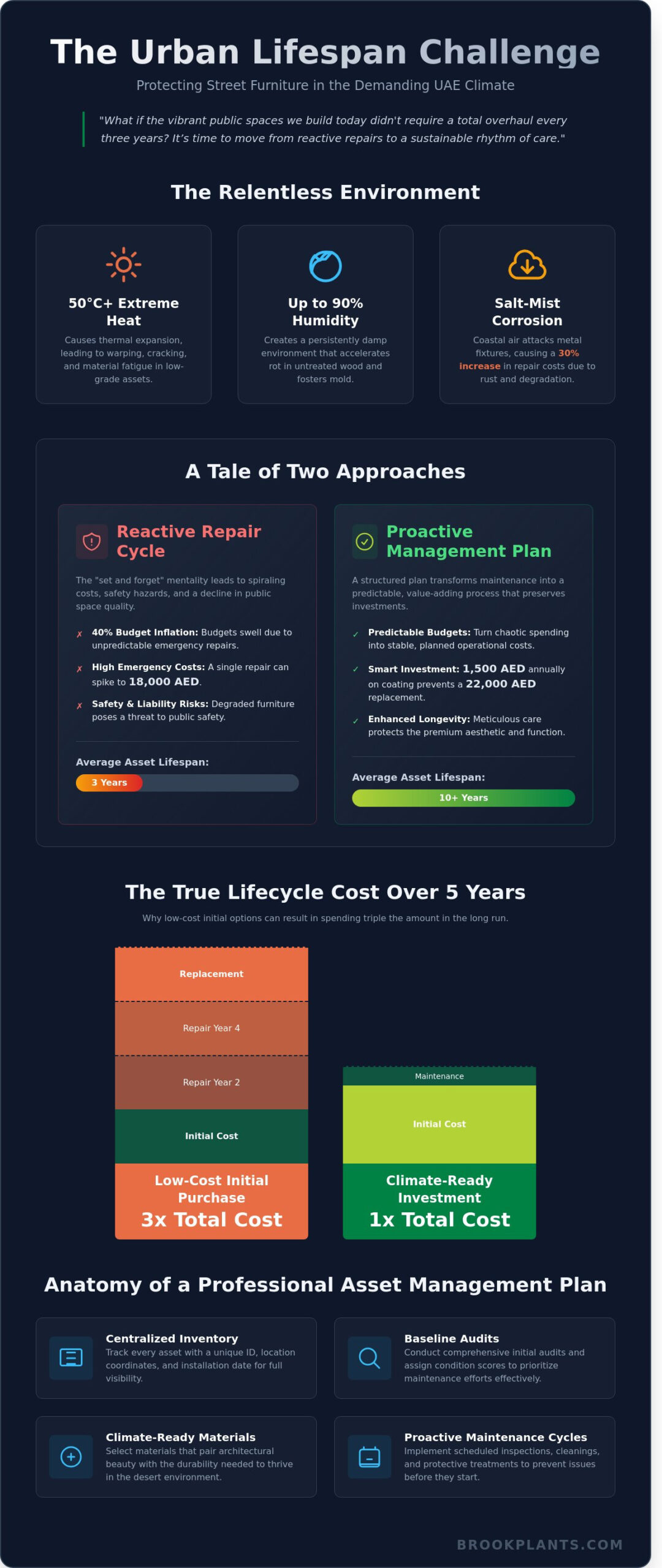
What if the vibrant public spaces we build today didn’t require a total overhaul every three years due to the relentless 50°C heat and 90% humidity? We all know that the UAE’s unique environment can turn even the sturdiest bench into a weathered eyesore faster than expected. It’s frustrating to see beautiful urban designs lose their architectural charm while maintenance budgets fluctuate unpredictably. According to 2024 regional infrastructure audits, poorly managed urban assets in coastal regions face a 30% increase in repair costs due to salt-mist corrosion alone.
You can regain control over your investment and the longevity of your landscape with our professional street furniture asset management plan template, specifically tailored for the 2026 UAE urban landscape. We’ve designed this framework to help you master the full lifecycle of your assets, moving from reactive repairs to a sustainable, expert rhythm of care. This guide walks you through building a centralized inventory and implementing climate-ready maintenance cycles to ensure your city’s assets remain as inviting as the day they were installed. By following these gardener’s notes for the urban world, you’ll reduce long-term costs and protect the aesthetic soul of your community.
Key Takeaways
- Discover how a professional street furniture asset management plan template helps you transition from costly reactive repairs to a nurturing, proactive lifecycle that protects your urban investments.
- Understand the true lifecycle cost of materials under the intense UAE sun, revealing why low-cost options can result in spending triple the amount in AED over just five years.
- Learn to conduct a comprehensive baseline audit and assign condition scores, ensuring your benches, planters, and lighting remain vibrant and functional for the long term.
- Gain insights into selecting climate-ready materials that pair architectural beauty with the durability needed to thrive in our unique desert environment.
- Explore how partnering with dedicated local experts can transform your urban landscape into a sustainable, well-maintained sanctuary that reflects a deep care for the community.
Why Your Project Needs a Street Furniture Asset Management Plan
A street furniture asset management plan template isn’t just a digital filing system; it’s the lifeblood of a thriving urban landscape. In the heart of our bustling UAE cities, these plans act as a roadmap for longevity, ensuring that every piece of the public realm remains as architectural and vibrant as the day it was installed. To truly grasp the scope of these elements, it helps to revisit the foundational question: What is Street Furniture? and how does it integrate into our daily lives? Without a structured approach, developers often find themselves trapped in a cycle of reactive repairs that drain resources and diminish the aesthetic appeal of a community.
To better understand this concept, watch this helpful video:
The financial cost of waiting for things to break is staggering. In Dubai and Abu Dhabi, reactive maintenance can inflate operational budgets by 40% compared to proactive scheduling. A single emergency repair for a damaged high-end shade structure can easily spike to 18,000 AED, whereas routine inspections and minor adjustments cost a fraction of that amount. Beyond the dirhams, there’s a serious safety and liability aspect. A “set and forget” mentality leads to loose fixtures or splintering surfaces, creating unnecessary risks for families and tourists in our public parks.
Gardener’s Note: We’ve always believed that furniture and plants exist in a delicate, shared ecosystem. A rusted planter isn’t just an eyesore; it can leach harmful oxides into the soil, affecting the health of your lush greenery. Conversely, an unmanaged root system can heave up a bench’s foundation. We treat these assets as one living entity that requires a nurturing, expert touch to flourish over the long term.
The UAE Climate Factor: UV, Heat, and Humidity
Our local environment is uniquely demanding. When temperatures soar past 50°C, thermal expansion causes low-grade materials to warp or crack. Standard international templates often fail because they don’t account for the 80% humidity levels in coastal regions that accelerate corrosion on metal fixtures. Our 2026 guide emphasizes selecting materials and maintenance cycles specifically designed to withstand the intense UV radiation that can bleach a vibrant finish in just one summer season.
Long-Term ROI of Structured Asset Planning
Structured planning is the difference between a bench lasting 3 years or 10 years. By following a dedicated street furniture asset management plan template, developers can transform unpredictable “emergency repair” spikes into stable, predictable budgets. Spending 1,500 AED annually on specialized protective coatings can prevent a full 22,000 AED replacement cost down the line. This meticulous care maintains the premium aesthetic that attracts residents and keeps our urban spaces feeling welcoming and high-quality.
The Anatomy of a Street Furniture Asset Management Plan Template
A successful street furniture asset management plan template acts as the root system for a thriving urban environment. It transforms a simple list of benches and bins into a strategic roadmap for longevity. Every template begins with essential header data: a unique Asset ID, precise location coordinates, and the exact installation date. In the UAE’s rapid development cycle, where approximately 12% of urban infrastructure is updated or expanded annually, tracking these details prevents costly oversights during site handovers or municipal audits.
Material classification is equally vital for long-term health. Whether you’re managing architectural wood, powder-coated metal, or recycled plastic, each material reacts differently to the 45°C heat of a typical July in Abu Dhabi. We’ve found that documenting these materials helps teams predict when a protective oiling or a structural check is due. For instance, timber elements often require specialized treatment every 6 months to prevent splitting in the arid climate, while composite materials might only need a monthly wash down to remove fine desert dust.
Inventory and Identification Fields
Modern templates utilize GPS tagging to pin assets across sprawling national developments like Yas Island or Expo City. This spatial data ensures maintenance crews don’t waste time searching for a specific bollard in a 50-hectare park. Standardizing naming conventions across all departments is a top tip for clear communication. Instead of “Bench 1,” use a code like “DXB-DOWNTOWN-SEAT-001” to provide instant context. This level of precision is what distinguishes a professional grower of urban spaces from a mere observer.
Condition Assessment and Risk Grading
A simple 1-5 rating system is the most effective way to prioritize repairs. A “1” represents a brand-new installation, while a “5” signals an asset at its end of life that poses a safety risk. This grading is especially critical for assets within 2 kilometers of the coast. Salt air increases corrosion rates by up to 20% compared to inland areas, making these “High Risk” zones. While local standards are evolving, referring to Federal Highway Administration guidelines on asset management provides a solid foundation for understanding how to weigh these risks against investment strategies.
Photo documentation serves as the backbone of this process. High-resolution images taken during quarterly inspections provide a visual history of wear and tear. It’s much like keeping a gardener’s log; you can see exactly how a finish has faded or where a joint has weakened over time. Choosing the right materials from the start, much like selecting sustainable outdoor solutions, ensures your assets remain vibrant for years. Consistent maintenance logs tracking cleaning and structural integrity will ultimately save thousands of AED in premature replacement costs across the asset lifecycle.
Evaluating Lifecycle Costs: Materials and Maintenance Strategies
Choosing the right materials for a public space is much like selecting the right sapling for a sun-drenched courtyard. You must look beyond the initial price tag to understand the long-term health of your investment. A robust street furniture asset management plan template helps managers account for the harsh reality that budget options often require replacement or heavy repair within 24 months. In the UAE, high UV levels and humidity mean that a bench costing 1,500 AED today can easily rack up 4,500 AED in maintenance and early replacement costs over a five-year cycle. This 300% increase is a common pitfall for those who prioritize low procurement costs over lifecycle durability.
To build a resilient urban landscape, we look to frameworks like Oregon’s official Transportation Asset Management Plan, which emphasizes risk-based lifecycle planning to avoid these financial pitfalls. Beyond the structural integrity, hidden costs often lurk in specialized cleaning requirements. Delicate architectural finishes or porous stones can require specific chemical treatments or high-pressure equipment that adds 500 AED to 800 AED per unit in annual labor. We prefer sustainable, UV-stabilized materials that grow old gracefully without demanding constant, expensive intervention.
Hardwood vs. Metal vs. Composites
Teak and Iroko are favorites for their natural beauty, but they require oiling every 90 to 120 days to prevent silvering and cracking in our 50°C summers. For metalwork, Grade 316 stainless steel is the gold standard for coastal areas like Dubai Marina, as it resists tea-staining far better than powder-coated mild steel. We’re also seeing a beautiful shift toward recycled composites. These materials are UV-stabilized and don’t splinter, making them a kind choice for both the planet and the public. Using a street furniture asset management plan template allows you to track these specific material performance metrics over time.
Preventative Maintenance Schedules
Prevention is the heart of any sustainable plan. Daily dusting prevents abrasive sand from scratching delicate architectural finishes, while monthly structural checks ensure every bolt remains tight. Before the peak summer heat arrives in June, a Deep Care cycle is essential. This involves applying protective sealants and checking for thermal expansion issues. It’s about nurturing the asset so it serves the community for decades rather than seasons.
- Daily: Surface dusting and debris removal to prevent sand abrasion.
- Monthly: Structural integrity checks and lubrication of moving parts.
- Quarterly: Deep cleaning of porous surfaces and hardware tightening.
- Seasonal: Pre-summer UV-protective coating applications and shade structure inspections.
Gardener’s Top Tip: Integrate your furniture cleaning with existing irrigation schedules. By using the controlled runoff from nearby planters to assist in rinsing dust from benches, you reduce water waste and keep the environment lush and tidy without extra utility strain.
How to Implement Your Asset Management Template
Bringing a street furniture asset management plan template to life is much like tending to a new nursery bed. It requires patience and a keen eye for detail. You aren’t just tracking benches and bins; you’re preserving the structural integrity and aesthetic beauty of our shared urban spaces. Start by gathering every scrap of history you have. This includes original purchase orders from 2022 or 2023 and any warranty certificates for powder-coated finishes or sustainable timber. This documentation forms the root system of your entire management plan.
- Step 1: Conduct a comprehensive baseline audit of every asset, from the smallest bollard to the largest architectural planter.
- Step 2: Input this data into your template and assign condition scores from 1 (excellent) to 5 (critical failure).
- Step 3: Establish a realistic maintenance budget in AED. In the UAE climate, high UV exposure means budgeting at least 7% to 10% of the asset’s replacement value for annual upkeep.
- Step 4: Train your on-site teams to spot the early signs of fatigue. A quick fix today prevents a costly replacement in 2027.
The Baseline Audit: Where to Start
Your audit begins with a physical walk-through. In our local climate, where summer temperatures frequently exceed 48°C, you must look for “invisible” heat damage. This often appears as hairline cracks in composite materials or subtle warping in non-UV-stabilized plastics. By recording these findings now, you establish a “Year Zero” benchmark. This data point is vital because it allows you to track the exact rate of degradation over the next five years. It ensures your street furniture asset management plan template remains a living, breathing document rather than a static file gathering digital dust.
Software vs. Spreadsheet Management
Choosing your tools depends entirely on the scale of your green space. A simple Excel spreadsheet is often enough for a boutique garden or a small residential courtyard in Jumeirah. It’s portable, familiar, and easy to update during a morning stroll. However, for national-scale projects or sprawling public parks, scaling up to a Computerised Maintenance Management System (CMMS) is a smarter move. These systems handle thousands of data points and automate service reminders. Whatever you choose, ensure your data is portable. You should always be able to export your records to ensure the long-term health of your assets isn’t tied to a single piece of software.
Beyond the Template: Partnering for Urban Excellence
While a street furniture asset management plan template provides the essential framework for organization, the heartbeat of a thriving urban space lies in the living elements that surround it. At Brook Plants & Landscaping, we treat every bench, bollard, and shelter as part of a wider, breathing ecosystem. Since 2015, we’ve helped developers across Dubai and Abu Dhabi move beyond static spreadsheets toward vibrant, sustainable landscapes. Our “grown by us” philosophy ensures that every botanical element paired with your furniture has been nurtured in local nurseries to survive the 50°C peaks of a UAE summer.
We believe that asset health is a long-term commitment. By choosing furniture designs specifically crafted for the high humidity and salt-rich air of the Emirates, you’re investing in a legacy. Our team bridges the gap between hardscape durability and softscape beauty, ensuring that your 2026 urban goals are met with both precision and a deep-rooted passion for horticulture.
Maintenance Contracts That Work
Corporate clients often face the frustration of fragmented vendor lists where the furniture team and the gardening team don’t communicate. We simplify this by offering integrated monthly maintenance contracts that treat your assets as a single entity. Regular care is the most effective way to prevent the AED 20,000 to AED 50,000 costs often associated with replacing sun-damaged timber or corroded metal prematurely. Our expert oversight includes:
- Monthly structural audits: Checking for stability and safety hazards in high-traffic pedestrian zones.
- Integrated cleaning: Using eco-friendly solutions that protect both the furniture finish and the surrounding soil health.
- Seasonal adjustments: Calibrating irrigation for integrated planters to match the shifting UAE humidity levels.
Custom Planters and Integrated Seating
Standard furniture often feels disconnected from the natural world. We design custom solutions that incorporate vertical gardens and smart irrigation systems directly into the seating structures. For areas where water conservation is the highest priority, we utilize preserved palms. These provide an architectural, lush feel without the daily water demands of living specimens, making them ideal for indoor malls or shaded transit hubs.
By utilizing a street furniture asset management plan template alongside our bespoke designs, you can track the lifecycle of unique pieces that define a district’s identity. Custom-engineered planters serve as both elegant seating and high-impact security barriers for protecting pedestrian plazas from vehicular traffic. This dual-purpose approach maximizes your budget while maintaining a soft, welcoming aesthetic that purely functional concrete barriers lack.
Our commitment to peat-free growing mediums and eco-conscious craftsmanship means your urban assets contribute to the planet’s health. We don’t just supply products; we act as a trusted mentor to ensure your district remains a vibrant, green, and safe destination for decades to come.
Cultivating Longevity in the UAE’s Urban Landscape
Building a sustainable city environment requires more than just high-quality benches or solar-powered lighting; it demands a strategic approach to long-term preservation. By utilizing a robust street furniture asset management plan template, you ensure that every public asset withstands the intense UAE sun and humidity levels that often spike during summer months. We’ve seen how proactive maintenance cycles and selecting specialized UV-resistant materials can significantly reduce long-term replacement costs for developers. Since 2004, Brookplants has brought decades of local expertise to the region, blending a deep passion for the environment with technical asset care. We specialize in protecting your investments through comprehensive maintenance contracts that cover everything from architectural seating to complex irrigation systems across the residential and commercial sectors. Our team understands the specific pressures of the local climate and provides the steady, expert hand needed to keep urban spaces thriving. It’s about more than just aesthetics; it’s about the healthy lifecycle of the land and the longevity of the materials we place upon it. Request a Professional Landscape and Asset Maintenance Quote to begin your journey toward a more resilient urban future. We’re here to help your vision take root and flourish.
Frequently Asked Questions
What is included in a street furniture asset management plan?
A comprehensive street furniture asset management plan template includes a detailed inventory of every bench, bin, and bollard, paired with a condition rating from 1 to 5. You’ll find schedules for routine cleaning alongside 10 year financial forecasts for replacements. It’s vital to include GPS coordinates and installation dates. This ensures every piece of urban greenery or seating is tracked from its first day in the sun until its eventual recycling.
How often should street furniture be inspected in the UAE?
You should inspect street furniture in the UAE at least four times a year to account for the extreme seasonal shifts. The Dubai Municipality’s Code of Practice suggests monthly checks for high traffic areas like the Marina or Downtown. Frequent inspections catch sand abrasion damage before it compromises structural integrity. It’s much like tending to a delicate nursery; early intervention prevents small cracks from becoming irreparable breaks during the 50°C summer peaks.
What are the best materials for street furniture in high-heat areas?
High performance concrete and 316 grade stainless steel are the gold standard for resisting the UAE’s intense UV radiation and heat. These materials don’t warp or off gas when temperatures hit 50°C in July. For a more natural touch, we recommend FSC certified Iroko wood. It’s a hardy timber that breathes well. It stays cooler to the touch than metal, providing a comfortable rest for weary walkers in our urban gardens.
Can I use a standard Excel sheet for my asset management template?
You can use a basic spreadsheet for small parks, but a professional street furniture asset management plan template offers much better data integrity for 2026 urban standards. Standard sheets often fail to track the complex depreciation of 500 or more individual assets across different microclimates. Specialized templates integrate with GIS software, allowing you to visualize maintenance hotspots. This helps you move from reactive repairs to a more sustainable, proactive care cycle.
How do I calculate the replacement cost of urban furniture?
Calculate replacement costs by combining the current market price in AED with labor for installation and the cost of site restoration. You should factor in the UAE’s average annual inflation rate, which stood at 2.3% in 2023 according to official data. Subtract any potential salvage value from recycled materials. This total gives you a realistic budget for when a bench reaches the end of its 15 year lifecycle in the desert.
Is preventative maintenance cheaper than replacing broken furniture?
Preventative maintenance is significantly cheaper, often saving up to 45% in long term capital expenditure compared to total replacement. A simple AED 200 cleaning and resealing treatment can extend a timber bench’s life by five years. If you wait for the wood to split, you’ll face a full replacement cost of AED 3,000 or more. Regular care is the most sustainable way to keep our public spaces vibrant and safe for the community.
How does salt air affect street furniture in coastal UAE regions?
Salt air in coastal areas like Jumeirah or Abu Dhabi’s Corniche accelerates metal oxidation by up to 10 times the normal rate. This salt spray effect causes deep pitting in standard steel within just 18 months. We always suggest using marine grade finishes or powder coated aluminum for these zones. It’s the only way to protect the architectural beauty of your assets from the corrosive breath of the Arabian Gulf.
What is the average lifespan of a wooden bench in the desert?
A high quality hardwood bench typically lasts 15 to 20 years in the desert if it’s treated with UV resistant oils. Untreated softwoods rarely survive more than 5 years before the intense heat and low humidity cause terminal cracking. The key is choosing hardy species that can handle the 40 degree diurnal temperature swings. Proper placement in dappled shade can further extend this lifespan by preventing direct sun bleaching and material fatigue.
Disclaimer
The content on this blog may be automatically generated and is provided “as is” without warranties of any kind, express or implied. No guarantee is made regarding the accuracy, completeness, or suitability of the information. The company expressly disclaims any liability for decisions or actions taken based on this content.
As this blog post was generated using automated content‑creation tools. While our team reviews posts for accuracy and relevance, the information provided may not always reflect the most current developments. The content is intended for general informational purposes only and should not be taken as professional advice. Our company is not liable for any actions taken based on this material.